Many Hands, Many Voices: Writing, Editing, and Publishing Indian Captivity Narratives

by Zabelle Stodola, University of Arkansas at Little Rock

“Captivity narratives are tricky texts” says my friend and colleague Christopher Castiglia who teaches at Penn State University and who published the book Bound and Determined: Captivity, Culture-Crossing, and White Womanhood from Mary Rowlandson to Patty Hearst in 1996.[i]

These texts are tricky for many reasons. But one of the primary challenges for readers concerns the difficulty of “distinguishing the various splintered or . . . hybridized voices with which the captive speaks.”[ii] So while the telling, writing, editing, and publishing of Sophia Josephine Huggins’s captivity narrative seems very complicated, its history is not that rare within the genre of Indian captivity narratives where many accounts are mediated by various hands and voices.

For literary critics the term “mediation” means “intervention.” Thus a text is mediated if several people contribute to its composition, editing, or publishing. Indeed it’s no exaggeration to say that most captivity narratives are composite productions and that a “pure” autobiographical text is unusual. Yet the different voices can be so merged or submerged that it’s impossible to know which contributor said or wrote what unless external evidence points to an answer or internal narrative inconsistencies and intrusions suggest a specific individual. That person’s influence might affect substance, style, voice, or all three.

Carrie Zeman’s previous posts detailing the various incarnations of Sophia Josephine Huggins’ narrative touch on all kinds of interventions over about a decade. It’s worth looking more closely at them. But because there are so many documents connected to this story, I’m going to discuss them in three separate postings:

  1. Initial references within letters to the writing of Josephine’s story and also some thoughts on the issue of a missing holograph (handwritten) draft
  2. First-or third-person non-fictional versions published in newspapers or history books as well as references to those accounts within letters by Josephine (i.e. the main character) herself
  3. Fictional adaptations of the original story.

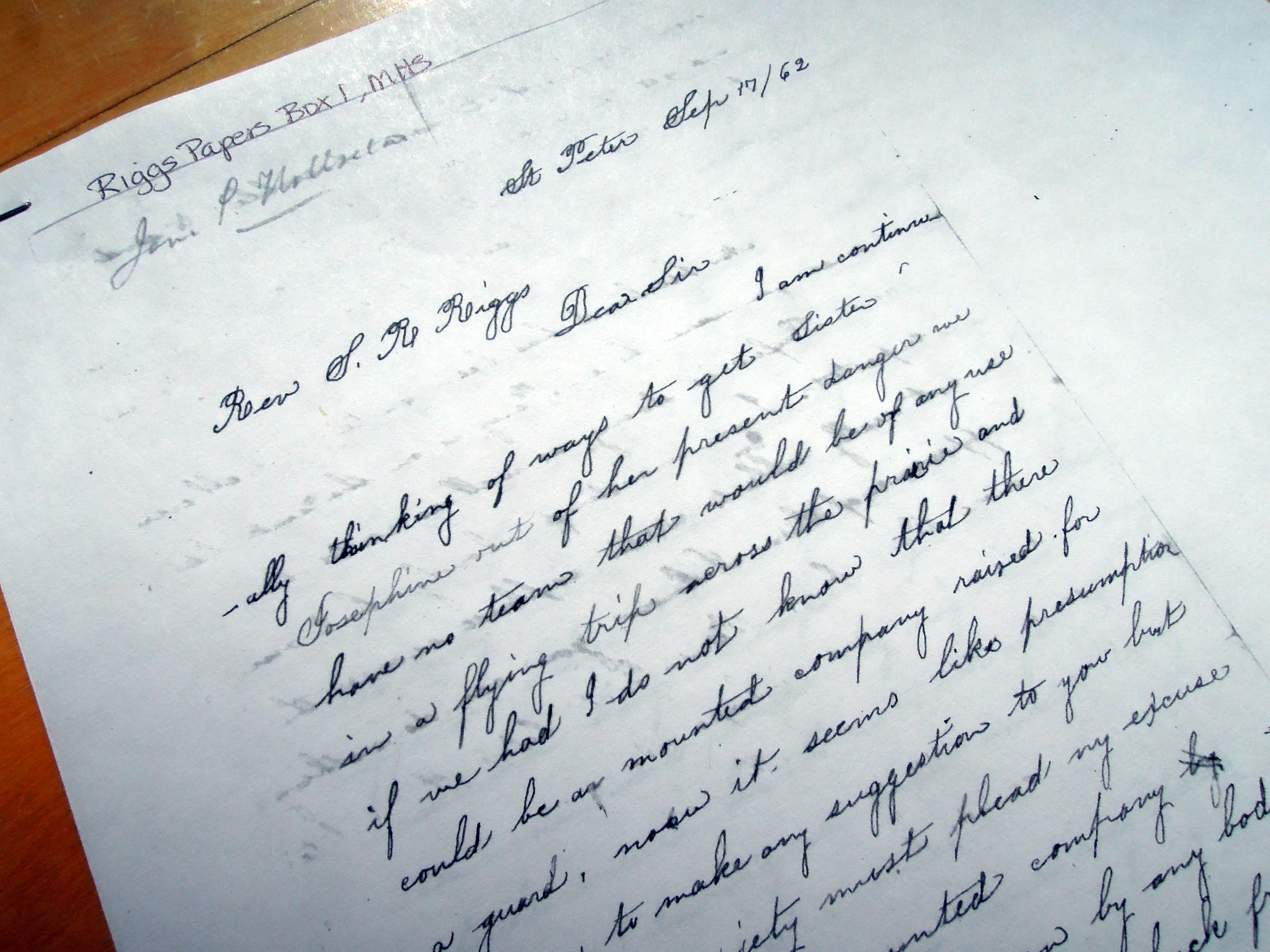
The letter from Jane Sloan Huggins Holtsclaw to Stephen Riggs dated 17 September 1862 reveals that Sophia Josephine Huggins was still a captive and that Jane was worried about her. From studying the publication history of many other Indian captivity narratives, I have found that personal correspondence like this can promote interest in a captive’s story, so that if s/he later provides first-person details, a ready audience exists for a book version. Nineteenth-century letters might be passed around to family and friends, further increasing interest in the material; letters back then were not necessarily the private documents they are today.

In fact, a reference in a letter by Eliza Huggins (Josephine’s sister-in-law) on 16 January 1863 to missionary Stephen Riggs indicates that he had already asked Josephine to send him information about her captivity. In her letter, Eliza told Riggs that “Josephine does not like to write and has not yet commenced her letter to you about her captivity. I have promised to help her as soon as I can, that is when I am a little stronger than I am now.” However, it isn’t clear what all of this means. Does Josephine find it physically hard to write? Is she pressed for time? Is she insecure about her penmanship or her ability to express herself? Is she nervous about recalling painful memories? If only we knew!

Despite Josephine’s qualms, Eliza promised to help her write the letter soon. But again, we don’t really know what kind of help Eliza was offering. Actual writing? Editing the basic text, maybe? Copying something word-for-word but in a neater hand? Expanding on the basics?

You might like to know that many ex-captives within the wider captivity narrative literature received help from a family member, friend, or amanuensis when writing their accounts. And even more intriguing, a surprising number of published narratives involved help from ministers in some way or another.

I can’t resist telling you about another captive-minister pairing.  The most famous of all the Indian captivity narratives concerns Mary Rowlandson, a New England minister’s wife whom Narragansett, Nipmuck, and Wampanoag Indians held hostage for three months in 1675.

Although Mary Rowlandson was well educated for a Puritan woman, it is very likely that her husband, Joseph, helped to edit the manuscript she composed after she returned from her ordeal. He died before it was published, but the eminent Puritan theologian and divine Increase Mather apparently oversaw the book’s publication, which in its early editions had a copy of Joseph’s last sermon appended at the end).[iii]

Scholar Lorrayne Carroll devotes an entire book to men—mostly ministers—who retold women’s Indian captivity narratives in the first person even though the “I” of the stories was no longer the woman herself. Her identity had been hijacked and co-opted by a man for political or religious reasons. Perhaps you can understand why Lorrayne Carroll gave her book the unforgettable title Rhetorical Drag: Gender Impersonation, Captivity, and the Writing of History![iv]

We assume that originally there was a holograph manuscript written by Eliza or Josephine, but it is no longer extant (or if it is, it hasn’t been located). This situation too is typical of many Indian captivity narratives whose holograph manuscripts are missing. These narratives tended to be hurriedly composed and cheaply printed, and their novelty value quickly faded.

For example, wouldn’t we love to see the handwritten version of Rowlandson’s account, which was titled The Sovereignty and Goodness of God . . .  for its three New England editions in 1682 and A True History . . . for its London edition in the same year? But it’s never been found. Indeed, only fragments of the first edition have been located. That first edition was a Puritan bestseller which was passed around and read to shreds. We know it was published in Boston, but only the second and third editions, which were published in Cambridge, Massachusetts, have survived in their entirety, as well as the fourth, London, edition of 1682.

As you can already see, the publication history of Josephine Huggins’s story is not at all unusual within the genre of Indian captivity narratives. In part two of this posting, I’ll provide evidence of even more mediation in the non-fictional versions of her narrative that appeared in newspapers or history books, and I’ll also cite references to those accounts from letters that Josephine herself wrote.


[i] For a full history of the 1682 publication of Rowlandson’s narrative see Kathryn Zabelle Derounian, “The Publication, Promotion, and Distribution of Mary Rowlandson’s  Indian Captivity Narrative in the Seventeenth Century” Early American Literature 23 (1988): 239-61.

[ii] Lorrayne Carroll, Rhetorical Drag: Gender Impersonation, Captivity, and the Writing of History (Kent, Ohio: Kent State University Press, 2007).

[iii] Castiglia, p. 128.

[iv] The quotation comes from Christopher Castiglia’s review of Cartographies of Desire: Captivity, Race, and Sex in the Shaping of an American Nation by Rebecca Blevins Faery which appeared in Early American Literature 36 (2001): 127-132. The quotation opens the review. Reference information for Castiglia’s book is Bound and Determined: Captivity, Culture-Crossing, and White Womanhood from Mary Rowlandson to Patty Hearst (Chicago: Univ. of Chicago Press, 1996).

Posted in Captivity, Josephine Huggins, Zabelle Stodola | 3 Comments

Yellow-back Gold

Malaeska: The Indian Wife of the White Hunter by Mrs. Ann E. Stephens, June 1860.

Edward S. Ellis’s first dime novel, Seth Jones: Captives of the Frontier, 1860, is said to have been one of Abraham Lincoln’s favorite stories.

Myrtle: The Child of the Prairie by Rose Kennedy December 5,1860

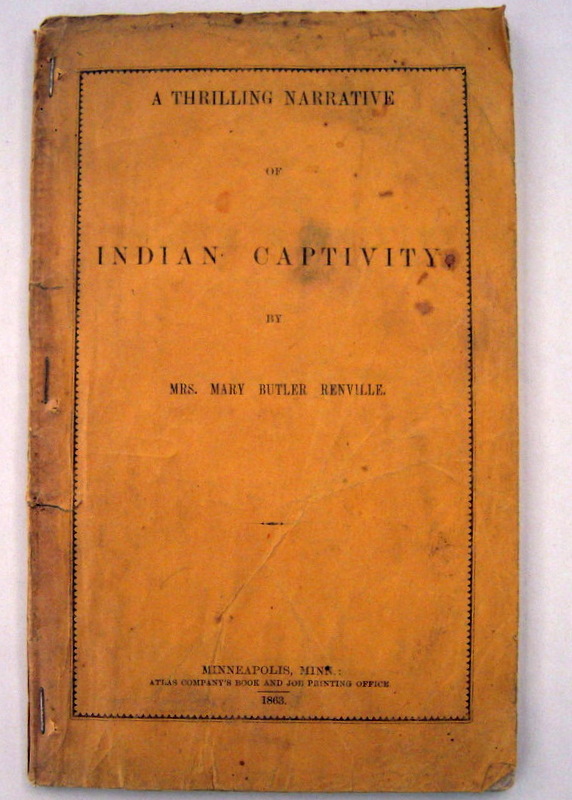
A Thrilling Narrative of Indian Captivity by Mrs. Mary Butler Renville July 1863

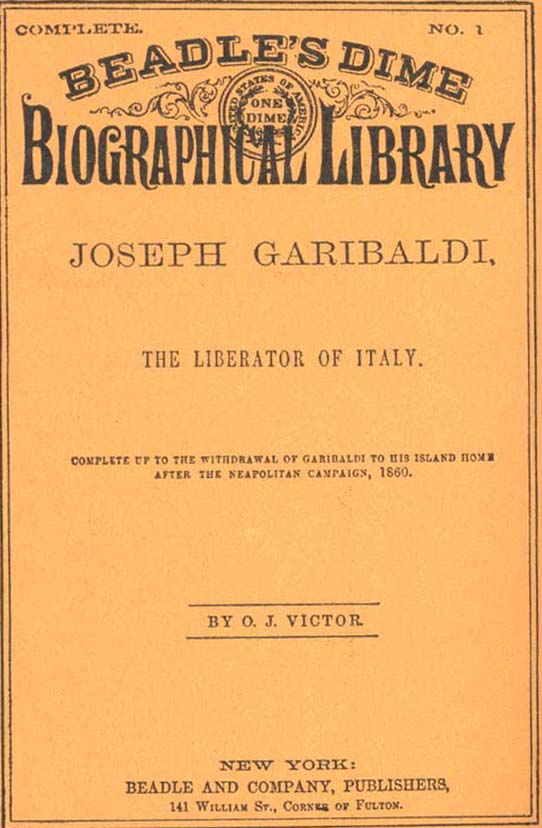
No. 1 in Beadle’s Dime Biographical Library,  issued 1860-65

Take these photos with the usual caveat about how colors reproduce on monitors, especially in photos made of old paper where color changes over time. Notice what these covers have in common?

In the beginning, using colored paper beneath black ink was the only “color” innovation available in pulp fiction printing. Wrappers on original copies of Malaeska are sometimes described as “salmon” –perhaps befitting its heroine and female author. But Seth Jones, released only weeks later, appeared in yellow-orange. Wrappers in the orange-gold range soon became the hallmark color of dime novels. Scholars today call these early dime books, “yellow-backs.”

Can it really be any coincidence that in 1863, “The Indian Captives: Leaves from a Journal” was reissued as a booklet with a much more sensational title, A Thrilling Narrative of Indian Captivity, packaged as a yellow-back?

Beyond the color, notice the printed frame defining the text space on each cover? Until I focused narrowly on dime covers produced around the time A Thrilling Narrative appeared, I did not realize that in this early phase of the dime novel craze, covers did not feature woodcut or engraved images which would become hallmarks of the genre by 1864.

If we remove the ornate banner on the Beadle titles, the remaining text looks remarkably like the layout choices someone made for A Thrilling Narrative. Why is the 1863 edition of ATN missing the distinctive masthead?

Beadle and Adams produced multiple series of dime books, which justified the creation of ornate masthead plates. These plates, like the banner on a newspaper, could be used over and over again.

But the Renvilles’ book was published by the more lowly Jobs Office of the Atlas Press of Minneapolis, Minnesota. Newspaper job offices produced small runs of ephemeral printed material, like annual membership directories for the Masonic Lodge or handbills advertising a circus. Politically well-connected editors sometimes landed plum government printing contracts for their paper’s job office. But newspapers were typically a newspaper press’s main business; it would have been costly to produce an ornate plate for a one-time small-run printing job like A Thrilling Narrative.

Notice the parallel between the by-line, “Mrs. Ann E. Stephens” (whose Malaeska, sold an astonishing 300,000 copies over Stephen’s career) and “Mrs. Mary Butler Renville”? Even though we know from the dual-signature, “J.B. and M.A. Renville,” at the end of the newspaper serial that John and Mary claimed joint authorship for their 1862 story, oddly, in 1863, only Mary’s name appeared on the cover.

Zabelle and Gwen and I, as scholars and as women, have always believed the 1863 title was sensationalized to increase sales. The title doesn’t sound like Mary or John and there is very little “thrilling” about their 1862 story. But until I began working on the story of the dime novelization of Josephine Huggins’s story, I hadn’t viewed enough dime covers, in chronological order to realize that the wrapper on the 1863 edition positioned the Renville’s book inside the market for dime books, the best-sellers of that day.

*****

Image credits: Northern Illinois University House of Beadle and Adams Illustrations archive; A Thrilling Narrative, photo by the author of Reserve copy, the Minnesota Historical Society.

Posted in A Thrilling Narrative, Dime Books, Edward Sylvester Ellis, history of printing | 2 Comments

The Remarkable Story of Edward S. Ellis

Edward Sylvester Ellis, 1840-1916

Who was Edward S. Ellis and what made him an authority on Minnesota history?

“Wait!” you might protest, “You said Ellis wrote pulp fiction! That is very different from writing history!”

Fiction and non-fiction seem like they ought to be distinct genres. That’s what my daughter is learning in third grade: fiction is “made up” and non-fiction is “not made-up.”

She can easily classify a book about fairies as fiction. But she puzzles over historical fiction like the American Girl series, because, she tells me, “It seems like it could be true. But I wasn’t alive then. So how can I know if it is made-up or not?”

Adults have the same difficulty. Ivy League libraries have fictional works by Ellis  and his contemporaries cataloged as “non-fiction” and “biography.” As I discussed in my essay, “Through the Heart of New Ulm: The persistence of place in stories of the Dakota women’s march,” fictional elements in Ellis’s nonfiction have been adopted as factual history.

That’s what makes Edward S. Ellis a slippery character. He cut his teeth as a writer using historical stories, like Josephine Huggins’s, as mental fodder for fiction. Then after decades as a best-selling novelist, Ellis began writing histories based on his prodigious research, with a maturing legion of readers a ready-made audience for his non-fiction.

Here, with the permission of my publisher, is a short version of the remarkable story of Edward S. Ellis adapted from, “Through the Heart of New Ulm.”

*****

New Jersey school teacher Edward Sylvester Ellis was 20 years old in 1860 when he sold his first best-selling book, the dime novel Seth Jones or the Captives of the Frontier, which led to a contract with New York publisher Beadle and Adams for four dime novels per year. Over the next thirty years, Ellis wrote more than 300 novels and story collections for several publishers.

Many of Ellis’s stories were set on the American frontier. Predictably given this era in American history, Ellis’ stories glorified white conquest of the continent. By writing popular juvenile stories,  and dime novels for young adults besides adult fiction, Ellis won several generations of readers for life. In 1907, one of those readers wrote with obvious nostalgia:

“What boy of the [eighteen] sixties can ever forget Beadle’s novels! To the average youngster of that time the advent of each of those books seemed to be an event of world consequence….How boys swarmed into and through stores and news-stands to buy copies and they came hot from the press!…And how those heroes and heroines and their allies, their enemies and their doings, cling to the memory across the gulf of years! The writer of this article has a far more vivid picture of some of the red and white paladins [champions] whom he met in Beadle’s pages than he has of any of the Red Cloud’s, Spotted Tail’s or Black Kettle’s fierce raiders, whom he [later saw first hand] at unpleasantly close range…”

It is no surprise that Ellis, among those authors whose fiction was more indelible than real life, also wrote more than 50 popular volumes of history, including The Indian Wars of the United States, which contains 33 pages on the U.S. Dakota War of 1862.

By the time Ellis embarked on historical writing, he had obtained a Master’s degree from Princeton and had given up teaching to devote his full attention to literature. Biographer Albert Johannsen commented on the appeal of Ellis’s non-fiction: “I regret very much that I did not have a book like Ellis’ Youth’s History of the United States when I was a boy, in place of a history that was simply a mass of names and dates of battles…”

Ellis’s Indian Jim appeared in 1864 –shortly before or shortly after his fictionalized version of Josephine Huggins’s story, “The Minnesota Captive.”

Ellis found Minnesota’s Dakota War of 1862 a fruitful subject and wrote at least six pieces of fiction loosely based on it. Ellis scholars will likely add to the list Zabelle Stodola and I composed while she was researching Ellis and Indian Jim for The War in Words:

  • “The Minnesota Captive” (dime story, 1863 or 1864)
  •  Indian Jim, A Tale of the Minnesota Massacre (dime novel, April 1864)
  • The Hunter’s Escape (dime novel, November 1864)
  • Old Zip (dime novel under the pen name “Bruin Adams,” 1871).
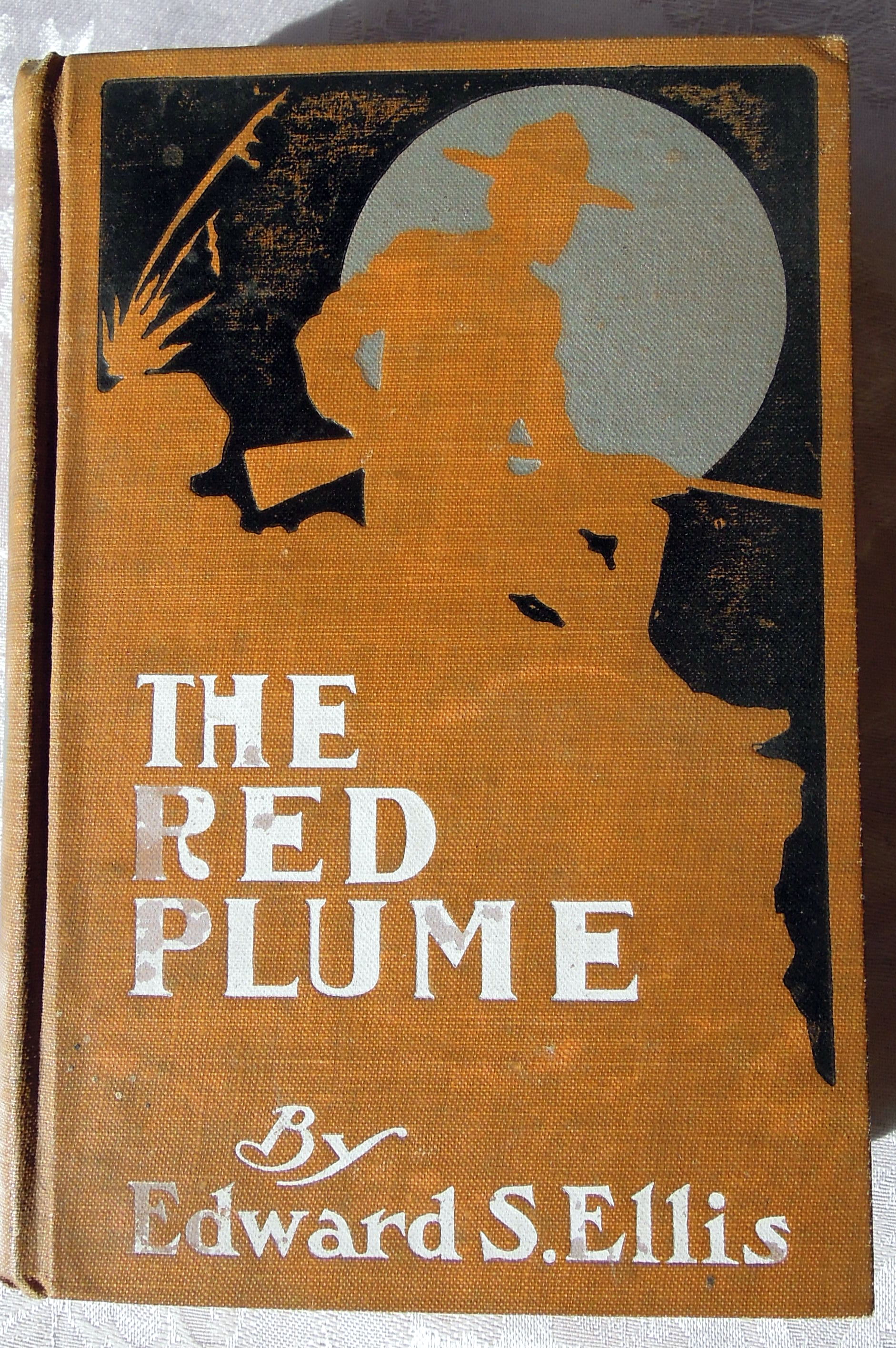
  • Red Plume (novel, 1900): Re-issued as The Red Plume and Red Plume: A Tale of a Friendly Redskin
  • Red Feather: A Tale of the American Frontier (juvenile novel, 1908).

The dust jacket (left) and embossed cover (middle) of a New York: Grosset & Dunlap reprint of Ellis’s Red Plume. Priced at 40 cents, this hardcover, bearing the original 1900 copyright by The Mershon Company, was printed after that date. At left, a Chicago: M. A.  Donahue & Co. imprint bearing two copyright dates: The Mershon Company 1900, and Thompson and Thomas 1902.

To authenticate his Minnesota fiction –to make it believable –Ellis, who may never have stepped foot in the state, had to study potential plots and settings. No direct evidence survives of his research for novels like Indian Jim and Red Plume; being fictional, they required no citations.

But Ellis’s bibliographies in his non-fiction histories report that his main source on the Dakota War of 1862 was Isaac V.D. Heard’s History of the Sioux War and Massacres of 1862 and 1863. Perhaps not coincidentally, the real-life inspiration for Ellis’s earliest Dakota War fiction, Josephine Huggins’s story, is contained in Heard’s non-fiction book.

I had never heard of Edward Sylvester Ellis when I first met Zabelle and she pitched me her ideas for The War in Words. In fact, I remember thinking that her proposal to discuss fiction like Ellis’s Indian Jim in a work largely devoted to non-fiction Dakota War narratives might be confusing for readers.

Now I understand that Zabelle was making a new point about the historiography of the Dakota War: that popular understanding of history is not necessarily formed by the books that are the most heavily footnoted, but by the books that are the most widely read.

That means the change-makers in public history have always been the authors who can write best-sellers. For better or worse, those are usually non-historians like Edward Sylvester Ellis. Or in the modern day, authors like Dee Brown (Bury My Heart at Wounded Knee, 1970), Duane Schultz (Over the Earth I Come, 1994) and Curt Brown (In the Footsteps of Little Crow, 2012).

In the 19th century, Edward S. Ellis’s fiction was probably more widely-consumed than the the now-better known work of non-fiction writers like Isaac Heard. That makes me very curious to see how Ellis reinvented Josephine Huggins’s story. In her lifetime, more people may have read Ellis’s gloss on her story than her own, understated, words.

So how many people helped write Josephine Huggins’s story? I’d argue we need to add Edward Sylvester Ellis to the list.

*****

Photo credits: Ellis, the University of Minnesota Hess Collection; Seth Jones cover, liveauctioneers.com; Indian Jim frontispiece and title page, The Newberry Library; Red Plume covers, my collection.

“Through the Heart of New Ulm: The persistence of place in stories of the 1863 Dakota women’s march” appeared in Trails of Tears: Minnesota’s Dakota Exile Begins (Park Books, 2008).

Posted in Edward Sylvester Ellis, Fiction, Josephine Huggins | 2 Comments

Fodder for Pulp Fiction

If Mary Butler Renville’s A Thrilling Narrative of Indian Captivity has the distinction of being the earliest extended Dakota War  narrative to appear in print, Josephine Huggins’s has another: It is the earliest to be co-opted for novelization.

Cover, Dime Tales, Traditions and Romances of Border and Revolutionary Times no. 2

“Mrs Huggins, The Minnesota Captive” first appeared in the Beadle and Adams series Dime Tales, Traditions and Romances of Border and Revolutionary Times, no. 7. The entire 12 volume series, edited by Edward Sylvester Ellis, appeared between 1863 and 1864.

While I have yet to find an original of volume 7 to examine, a Beadle and Adams bibliography tells us Ellis did not spin Josephine’s story to dime novel-length (about 100 pages). Instead, he anthologized it with three other short stories within the same volume. Printed and bound in the cheapest paper manufactured in the 19th century, this genre eventually became known as “pulp fiction.”

Until eight years ago when my friend, literature and pop-culture critic Zabelle Stodola, introduced me to the dime novel, I’d never read one. But I recognized the dime novel’s modern cognates: serial detective stories  (Nancy Drew and the Hardy Boys, anyone?), Westerns, and Romance novels.

Cover, Boys’ Book of Romance and Adventure no. 18

A decade later, Edward Sylvester Ellis recycled Josephine Huggins’s story in Beadle and Adams Boys’ Book of Romance and Adventure no. 10, July 1874.  Recycling stories, sometimes slightly altered, sometimes copied wholesale, was common in this genre. “Dimes” were published so cheaply that most did not survive; ten years later, a story was new again.

Edward Sylvester Ellis was one of the most prolific –and most popular –authors of the 19th century. What did he do with Josephine Huggins’s 1862 captivity story? Until I find a copy, I can only guess.

But Ellis himself is quite a character. Zabelle introduced me to him during her research for The War in Words. (Chapter 3 is “Edward S. Ellis and the Captivity Narrative Tradition.”) Since then, I continue to bump into his unseen influence on the received story of 1862.

In fact, Ellis may be the most influential source on the Dakota War you’ve never heard of. More about that in the next post.

Photo credit: Northern Illinois University Dime Novel archive

Posted in Edward Sylvester Ellis, Fiction, Josephine Huggins, Zabelle Stodola | 1 Comment

Josephine’s Experience Becomes a Story

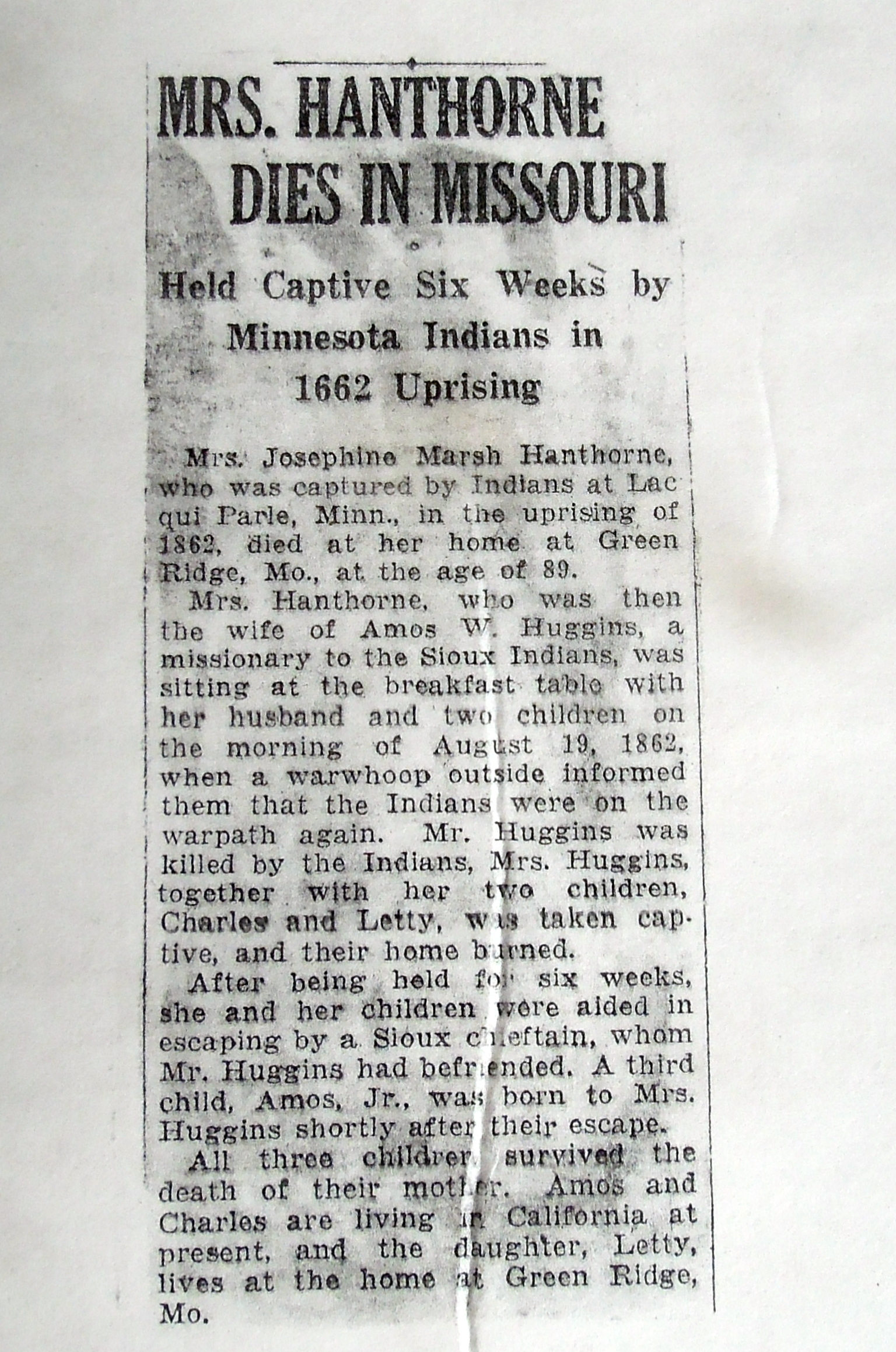
Obituary clipping: Josephine Marsh Huggins Hanthorne c. 1927. Thomas Hughes Papers, Mankato State University, Mankato, MN. Newspaper not identified.

*****

Eliza Huggins’s letters, which I transcribed in the previous post in this series about  Josephine Huggins’s 1862 captivity story, told us something new: Even though Josephine Huggins has gone down in history as the sole author of her text, it seems she had some assistance from her sister-in-law Eliza Huggins, her friend Stephen Riggs and his daughter Isabella Riggs, and, maybe, the editor of the St. Paul Press.

Who did what to Josephine’s story? How much of the story is written in her voice? Which elements (if any) reflect the intervention of others?

Establishing a publication history for a story by placing the known evidence in chronological order, allows us to detect when (if at all) the story changed. Finding a change should make us ask: Why?

This is what we know about the publication of Josephine Huggins’s story.

Letter “A” Jane Sloan Huggins Holtsclaw to Stephen Riggs September 17, 1862, Riggs Papers, MHS

  • Josephine is still captive; Jane worries about how to rescue her

Letter “B” Eliza Huggins to Stephen Riggs January 16, 1863, Riggs Papers, MHS

  • Riggs previously asked for a letter from Josephine about her captivity
  • Eliza says Josephine does not like to write
  • Eliza promises to help Josephine write the letter soon

Holograph Manuscript (Missing)

  • Presume from Eliza’s intent in Letter “B” the content of Letter “C” that Josephine and/or Eliza wrote Riggs a letter including the story of Josephine’s experience in 1862.
  • Because we have examples of Eliza’s handwriting (Letters “B” and “C”) and of Josephine’s handwriting (Letters “D” and “E”) we could assess who wrote the holograph original even if it is unsigned.
  • However, the holograph is not extant.

Published Form #1: St. Paul Press (Daily) February 3-5, 1863 (three installments?)

  • according to note in Woolworth file on Josephine Huggins
  • needs verification from microfilm

Published Form #2: St. Paul Press (Weekly) February 12, 1863

  • See digital image of clipping in the Alexander G. Huggins Papers at MHS.
  • See modern transcription by Lois Glewwe.
  • Stephen Riggs is, at this time, a correspondent for the St. Paul Press

Letter “C” Eliza Huggins to Stephen Riggs February 18, 1863, Riggs Papers, MHS

  • Eliza demurs “we” did not write the story for the public eye. (This is a common disclaimer on captivity narratives; with the holograph missing it is hard to judge the author’s intended audience.)
  • Eliza thanks Stephen Riggs and Isabelle Riggs for “the trouble” they have taken with Josephine’s story (implied: Preparing the story for publication)
  • Eliza asks for additional copies of the newspaper containing the story (implied: They accept the changes and want to preserve and share the story as published despite the revisions.)

Published Form #3: Newburyport, MA Daily Herald March 13-14, 1863

  • according to Minnesota Historical News No 266 March 1944; copy in Woolworth file
  • needs verification via microfilm
  • what is the family’s tie-in to Newburyport, MA?
  • Did the Herald reprint the St. Paul Press story?

Letter “D” Josephine Huggins to Stephen Riggs December 14, 1863, Riggs Papers MHS

  • requests Riggs send her a copy of “Mr. Heard’s book” as an 1862 war story; does not mention if she is aware her story is in the book
  • apologizes that her eyes are too weak to write well

Published Form #4: Isaac Heard, History of the Sioux War… (1864; copyright 1863) (1865 reprint p. 209-228)

  • Heard harvested much of the material in his book from the St. Paul Press

Letter “E” Josephine Huggins to Stephen Riggs February 9, 1864, Riggs Papers MHS

  • thanks Riggs for “the book that you sent me;” does not say if it is Heard’s
  • apologizes that she tends to procrastinate answering letters; mentions sickness as one reason why

Published Form#5: “The Minnesota Captive” in Edward S. Ellis, editor, Beadles Dime Tales, Traditions, and Romances of the Border and Revolutionary Times No. 7 (late 1863-early 1864)

  • What form did Beadle & Adams publish? A reprint or a fictional re-invention?

Published Form #6: “Mrs. Huggins, the Minnesota Captive” in Boy’s Books of Romance and Adventure No. 10 p. 5-17 (Beadle & Adams dime novel series began March 20, 1874). Cites: WorldCat; and J. Randolph Cox, The Dime Novel Companion: A Source Book Greenwood Press: 2000 p. 301.

  • Said to be a republication of Form #5 above
  • Is it an exact copy or did Ellis rework it for currency?

Published Form #7: Mrs. Huggins, the Minnesota Captive vol. 86 in the Garland Library of North American Indian Captivities, 1978.

  • Is the Beadle & Adams story the source for the Garland Library version?

*****

We need to let Josephine’s story percolate awhile. While I have information indicating there were at least seven published forms of Josephine’s story, I only have two of them (#2 & #4) on file.

I had to laugh standing at the information desk at my local library yesterday afternoon, WorldCat print-out in hand, requesting a copy of volume 86 in the Garland Library from one of the six libraries that owns it in the United States.

“Isn’t it weird,” the librarian observed, searching for a library who would loan it for free, “that with a title like The Minnesota Captive, nobody owns it in Minnesota? It’s this woman’s biography, right?”

(WorldCat states the genre is  “biography.”)

“That’s the million dollar question,” I said. “See how WorldCat also says she was a captive during the “Ojibwa Wars 1862-65”? There were no Ojibwe wars in Minnesota between 1862 and 1865. The supposed author was a real person. But she was captive during the Dakota War of 1862. That’s why I need to see this book. This ‘biography’ may actually be a piece of fiction.”

Updated 10/13/12 to add 1863/64 dime novelization.

Posted in Doing Historical Research, Josephine Huggins, Primary Sources | 1 Comment

Josephine Huggins: “It is impossible for me to name the innumerable blessings”

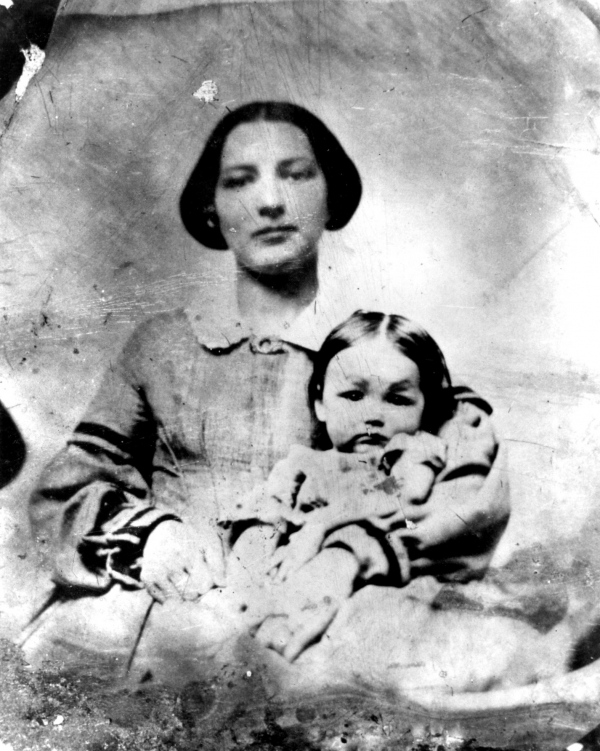
Sophia Josephine Marsh Huggins Hanthorne 1838-1927.

Part three in a series about new documents commenting on Sophia Josephine Marsh‘s 1862 captivity story.

*****

Letter “D”

Oak Grove Dec 14th/63

Mr. Riggs

My Dear friend

Your kind letter with the draught [draft] was received in due time. I should have written immediately as you requested but I thought I would get the draught cashed first. I sent it to Abingdon, but the merchants there did not want it. I took it to Knoxville today and got the money. At Mr. Runcle’s Bank he said that I would be responsible for it if the Am. Board does not have the money on hand.

Everyone seems very fearful about Banks and Dfts. now. Last summer Uncle Jonas sent me one and the Bankers hesitated quite a while about taking it. I think I prefer a Dft. rather than run the risk of having it lost by the way. If it is not convenient to  get one do as you think best you know better than I about it.

I was very gladly surprised when I received your letter although I had been thinking of my claim a short time before but more surprised when I learned that they had set if off so little. I feel very thankful for it it will be a great help to me.

I often think of those poor Indians on the Missouri. I wonder if Emma Day is there, poor child. I shall never for get her. I should like to do something for her if she is living.

We are all in usual health. My sisters are going to school. And I am trying to keep house. Father has failed very much since I was here four years ago he is troubled with Rheumatism very much. Charlie’s neck has swollen again we got it lanced today he seems quite well and is fleshy. Baby is growing very fast he creeps & walks around by chairs.

If Mr. Heard’s book that you mentioned gives correct account [sic] of the massacres and is worth its price I will be please[d] if you could get one for me without putting yourself to too much trouble. I should like to see a book of the kind. I do not know how would be the best way of sending it.

Please excuse this poor scribbling my eyes are quite weak. I thank you for your kindness to us always and close

yours very truly

S. J. Huggins

P.S. Please retain ten dollars of the money & except it [sic] as a present from a friend.

*****

Letter “E”

At Fathers IL,

Feb. 9th 1864

My Dear Friend

Mr. Riggs

I received your kind letter containing the Draft which I got cashed without any trouble.

I also received the book that you sent me, for which I thank you very much.

I should have let you know I had received them long before this if it had not been for that habit of procrastinating and sickness.

The children have all been quite sick they are better now Charley has had a hard cough ever since new year day. I hope he will get better when warmer weather comes.

When writing to Uncle Jonas Pettijohn sometime ago I mention the fact [sic] that Mr. Gilfillan had given you $150 to send to me and retained $50 for himself.

I received a letter from Uncle Jonas since in which he says “As soon as I got your letter I wrote to Mr. Gilfillan immediately reminding him of a promise that he made me in a letter that he would not exact the 25 percent of you.”

He received a reply soon after and what do you think he says?

He says that he is glad that he reminded him of it. And to prove that he was glad He sent Uncle Jonas a draft for $50.

I think it was a very kind act in Mr. Gilfillan [sic] I thank him for it.

Uncle Jonas has been exceedingly thoughtful and kind to me. I feel that I can never repay him for his kindness to me. Nor the rest of my dear friends.

You and your family will always retain a fresh and vivid place in my memory. Oh how good and kind God has been to me in giving me kind friends & shielding me from harm while with the Indians. It is impossible for me to name the innumerable blessings that he has bestowed on me.

Give my kindest regard & love to Mrs. Riggs & Martha. I should like very much to get a letter from Martha but have not the boldness to ask her to write when I have several of her letters & Isabellas unanswered. I prise [sic] them very much.

Please remember me in your prayers.

Respectfully yours,

S. J. Huggins

*****

Holographs of both letters are in the Stephen R. Riggs Papers at the Minnesota Historical Society.

Next up: The publication history of Josephine’s story. The surprises aren’t over yet!

Photo credit: Patricia Huggins via Dakota Soul Sisters

Posted in Josephine Huggins, Primary Sources, Stephen R. Riggs | 1 Comment

Eliza Huggins: “We thank you for the trouble you… have had with Josephine’s narrative.”

“Adventures Among the Indians: Narrative of the Captivity and Rescue of Mrs. Sophia Josephine Huggins,” as reprinted in the St. Paul Weekly Press February 12, 1863, page 3. 

In Rescuing Josephine Huggins, I opened the story of a new collection of primary sources commenting on the 1862 captivity story of Sophia Josephine Huggins, who was recently profiled by historian Lois Glewwe.

Two of the new letters, both written by Josephine’s sister-in-law, Eliza Huggins, and found in the Stephen R. Riggs Papers at the Minnesota Historical Society, are transcribed below. Lois’s profile is so thorough that it provides the annotations I would otherwise supply on these letters.

The short version of Josephine’s story is that she was living at Lac qui Parle in western Minnesota 1862. Josephine’s husband, Amos (Eliza Huggins’s brother), was killed and Josephine and their children taken “captive” –in this case, sheltered by Spirit Walker and his family in an Upper Dakota camp west of the theater of war.

The new letters raise new questions. Lois and I have hypotheses I’ll supply here in case you have information commenting on them.

Where is “Shady Nook?”

My first hunch was that it was the name of Josephine Huggins’s family home outside Abingdon, Illinois. Based on Huggins family memoirs, we have believed that Josephine’s father, Thomas Marsh, came to MN and took Josephine and her children home to IL immediately following her release from captivity. But based on Eliza Huggins’s letters below, it seems that Josephine perhaps did not go to IL until the early spring of 1863, but spent the winter of 1862-63 at “Shady Nook.” Shady Nook may be the Traverse des Sioux/St. Peter-area home of Jane Huggins Holtsclaw (who worried about rescuing “Sister Josephine” in my previous post). Alexander Huggins’s home at Traverse (Alexander was Eliza’s father) was called “Hickory Hill.”

Who is “Isabella” in the first letter?

I immediately thought of Isabella Riggs, daughter of Stephen Riggs, who is most likely the Isabella mentioned in the second letter. But I was bothered by the implication that Isabella #1 missed the worst of the Dakota War because she was with the Huggins in Traverse/St. Peter, east of the theater of action, while we have never had any reason to doubt that Isabella #2, Isabella Riggs, was at home at Hazlewood on the Upper Reservation when the war broke out and escaped with her family in the so-called Riggs Missionary Party.

Lois pointed out that Isabella Riggs was not entitled to any annuity money (as the letter references for Isabella #1) and speculated Isabella #1 might be a Dakota girl who was boarding in the Huggins family while attending school.

I think Lois is right. The best candidate for Isabella #1 may be Isabelle Martin Renville, “Belle” in A Thrilling Narrative, the adopted daughter of John and Mary Butler Renville. Mary much later recalled that Belle was not with them in captivity during the war because she was in St. Anthony, MN, attending school. But what if Mary’s “St. Anthony” (where the Renvilles resettled for a few years after the war) was a mental slip and Belle was actually in St. Peter when the war broke out? Isabella #1, Eliza wrote, left the Huggins family on October 15, 1862, the right timing for John and Mary Renville to have picked her up on their way downriver from Camp Release.

So with that introduction, here are Eliza Huggins’s letters. How many people does she name as having had a hand in writing Josephine Huggins’s story as it appeared in the St. Paul Weekly Press in 1863?

*****

Letter “B”

Shady Nook

Jan 12 –1863

Mr. Riggs, Dear friend,

Isabella came here the 24th of May and left the 15th of October making the number of weeks that she was here to be twenty and a few days over.

Before we started down, Mrs. Riggs gave me five dollars to pay Isabella’s passage but as we came by land her expenses were only seventy five cents. The rest of the five dollars we used and is that much paid to us.

This with the fifteen dollars we have received from Mr. Ketchum makes $19.25. This lacks, I suppose, but about half a dollar being the amount due.

When Mrs. Riggs and I talked about it we calculated on Isabella’s annuity money but of course that cannot be had now.

When you write Amos’ obituary will you please have some notice of Rufus’ death in the same papers either in the same piece that you write of Amos or in a separate notice which you think best.

If you will be so kind as to have them sent, we would like to have a few perhaps a half dozen of the papers.

I send you what I wrote up for the St. Peter Tribune. The editor added the last clause, We do not like it. Rufus was so forgiving to all who had injured him he seemed to be so free from harboring revenge we were sorry that this thought came in here. It does not seem to be the right place to call the attention of the world to the Indians wickedness.

We are all in tolerable health. I have been sick for a week past but am better now.

Charlie seems to be getting well very fast.

Josephine does not like to write and has not yet commenced her letter to you about her captivity. I have promised to help her as soon as I can, that is when I am a little stronger than I am now. I guess the letter will be forthcoming before a great while. I do not try this winter to do much to benefit any one except to be patient and cheerful and thus help others to be so. I am hoping to be able for something again next summer but what or where, I do not know.

Give my regards to Mrs. Riggs and love to Isabella and Martha.

Your humble friend

Eliza W. Huggins

P.S. Uncle Jonas’ family are well

*****

Letter “C”

February 18 –1863

Mr. Riggs, Dear friend,

I received your letter yesterday. I thank you for your kindness in writing. We also thank you and Isabella for the trouble you have had with Josephine’s narrative. If we had been trying to write her story for the public eye, we would have written differently but perhaps it would not have been really any better.

Some of the defects of this would have been remedied, but there might have been other deficiencies as bad, or worse than these. If you can get them for us conveniently we would like to have half a dollar’s worth of the Press that contains the narrative. If it is not convenient to get so many, half as many copies will do us very well.

I wrote to you something more than a month ago and told you of our having received $15 from Mr. Ketchum. You did not say that you had received the letter, but I suppose you did receive it.

I cannot say that we are all quite well though more of us are really sick. Father keeps well. He is very busy this winter. This is his birthday. He is sixty one years old. None of us had thought of it until he spoke of it in family worship this morning.

Perry Holtsclaw is here now, quite an invalid, lungs affected.

We hear from Eli almost every week. His health is generally good.

Yours affectionately

Eliza Huggins

*****

The publication history of Huggins’s 1862 captivity story follows in the next post, along with transcriptions of Josephine’s own letters to Riggs.

Photo credit: Minnesota Historical Society.

Posted in Belle Martin Renville, Captivity, Josephine Huggins, Primary Sources | 3 Comments

Rescuing Josephine Huggins

Letter “A”

St Peter Sep 17/62

Rev S. R. Riggs

Dear Sir

I am continually thinking of ways to get Sister Josephine out of her present danger we have no team that would be of any use in a flying trip across the prairie and if we had I do not know that there would be a mounted company raised for a guard, now it seems like a presumption for me to make any suggestion to you but my great anxiety must plead my excuse. Could not a mounted company reach Lacquiparle unseen by any body of Indians by keeping entirely back from the Minnesota river as there are no settlements, nothing to tempt the Indians either by getting plunder or killing whites is very likely that they will watch that prairie very closely, if it were possible to send and get her away we would be very thankful. I cannot give up the Idea of having her rescued but we seem to be so hampered with sickness we could do nothing if anything could be done. My husband has been quite unwell ever since you were here. Perry is on the sick list now. Rufus is doing as well as could be expected. I am mending slowly but am not really able to write so please excuse the appearance of this. I know you can do nothing more than bring this subject up before the military commanders and perhaps they may see some way for a rescue. I will not ask you to write to us as I know your time must be much occupied.

I remain yours truly

Jane S. Holtsclaw

*****

Recently Lois Glewwe posted a biographical sketch of Sophia Josephine Marsh Huggins along with a PDF transcription of her 1862 captivity story on Dakota Soul Sisters. In Fargo last week, Lois and I talked about research leads on Huggins’s story. But I had forgotten about a file I’d created on her containing gleanings from the Riggs Papers at MHS.

Besides the letter above, written while Josephine was still captive, I flagged four other letters written in 1863-64: two written by Josephine’s sister-in-law, Eliza Huggins and two written by Josephine commenting on the circumstances under which Huggins’s story was composed.

It’s unusual to find period documentation illuminating the composition process, which in this case appears to have been a collaboration between Josephine and her sister-in-law, Eliza, with quite possibly, invisible editorial assistance from Stephen Riggs. As Zabelle argued in The War in Words, collaboration and mediation are common in 18th and 19th century stories. Unusually, in Huggins’s case, we have new evidence of those elements at work in the process of bringing Huggins’s story to press.

It is also unusual in the Dakota War literature to find an eyewitness account that does not indiscriminately vilify Dakota people. Huggins’s story is one; Mary Butler Renville’s is the other. So this week I want to give you a chance to do real history: consider the primary texts (the letters), which I’ll transcribe here, and the secondary versions of Huggins’s story linked on my Sources tab here.

What do you notice? What do you think? What else do you know about this family and their story? Comments are welcome!

Posted in Josephine Huggins, Primary Sources | 2 Comments

The Peace Party Fought for Mni Sota Makoce, Too

Minnesota History Center, St. Paul, Minnesota, in winter

January 29, 2013, I am booked as the History Lounge speaker at the Minnesota Historical Society. I’m excited because after spending this past summer of commemoration talking about food –who was starving in 1862 (Dakota traditionalists) and why (Federal programs ensured Dakota farmers would not go hungry) –I get to move on to how that played out in the choices Dakota people made during the war.

Here’s the publicity blurb:

They Fought for Mni Sota Makoce, too: The Story of the 1862 Dakota Peace Coalition

Most Dakota people living in Minnesota did not anticipate or participate in the U.S. Dakota War of 1862. Yet the received story, based on early sources which sought to justify the seizure of Dakota lands in the wake of the war, is almost silent about the Dakota majority who did nothing to deserve exile or extermination. Some of these Dakota went even further in 1862, working from the inside to thwart the war effort. Their story, too, has been marginalized: by attribution to a handful of token Dakota Christians. Historian Carrie Reber Zeman recovers the diverse voices of the Dakota resistance movement historically known as the Peace Party, using their own narratives to illuminate who they were, what galvanized their opposition, what they accomplished, and what happened to them after the war. She argues that the Dakota men and women who actively worked to end the war were motivated by their desire to stay in Mni Sota Makoce, the Dakota homeland.

That story is at the heart of Mary and John Renville’s story, A Thrilling Narrative of Indian Captivity, and it is the reason Zabelle Stodola and I worked to bring it back into print.

Please join me at the Minnesota History Center at 7:00 PM on January 29, 2013 and share what you think. This is part of the origin story of the place many of us call home, and we need to start talking about it.

*****

It seems MHS does not like to photograph its History Center in winter. So the photo credit goes  to Meghan Likes and Molly McNeil who had the imagination to get photos for a January 28, 2012 post on http://www.mnfoodbloggers.com/.

Posted in A Thrilling Narrative, Dakota Peace Party | Leave a comment

Other Wise

Odobenus rosmarus

Daughter, beginning student of Latin: “Mom, does that mean the walrus smells good?”

*****

Recently, I heard a scholar explain his inability to supply information with what I think of as the “oral history excuse:” knowledge on that subject must be closely held within a Native community because he’d never heard of it.

I tried not to smile as the thought flew through my head: That’s the inverse of  the “white purge excuse:” primary sources can’t possibly exist because of the long-standing conspiracy to cover up.

Both paraphrase: “I can’t find any evidence for or against my theory, but it is pointless to inquire when the sources are controlled by secret forces.”

*****

The ground is shifting beneath our feet in the research world. On good days it feels disconcerting. On bad days it feels scary. Or maybe I was just naive. Five years ago someone with a PhD assured me that I could write a book, and if I did a solid job of research, count on the story having “ten-year legs.”

Thanks to digitization and connectivity, stories change every day.  To get to my next book I will have to rig mental blinders to block out leads that were not available to me two years ago, researching the first one.

Doesn’t that sound like another excuse? “Been there, done that. Onward and upward.”

It’s the conundrum others try to explain away with the idea that nameless, faceless Boogeymen control the sources. To produce a product –presentation, documentary, book –we must call an end to information collection.

Who wants to think that the research was stale even while it was being conducted? Far gentler to posit that we are smart people thwarted by a more powerful, invisible Other.

Otherwise we’ll have to own up to the fact that none of us is an authority. And if we are not an authority, why would anyone hire our services? Consider our grant? Read our book?

*****

There is dawning recognition that what is good for us (as authors) is also good for history. The perceived prestige of  authorial “authority” is beginning to cede to the good –to the breadth –of our work.

We can’t not collaborate. Unless the point is to produce a dry, wholesome cracker of a story. Even if we manage to sell it, we’ll have our socks revised off by the people with whom we might have collaborated to our mutual benefit.

Why? Not because sources are so rare we must hoard them or so difficult only professionals can interpret them. Rather, there are so many sources to consider that if we don’t open our arms to give and  to receive, it will be hard for any of us to tell a meaningful story.

Collaboration is also a path of reconciliation. It says, “I want to listen. Your stories enrich mine.” Even if it takes years.

It is the opposite of making excuses that let us off the hook –excuses that leave us, walrus-like, insulated in the blubber of our own authority.

Posted in Doing Historical Research, Opinion | Leave a comment