The Book Launch Party

On Sunday June 29, 2012, my friends on the board of the Pond Dakota Heritage Society hosted a book lauch celebration at the Gideon Pond House in Bloomington. It was a lovely afternoon in every way!

During the years I spent researching the book, my goal was simply to uncover enough of the story to be able to write it. Then during the years I spent writing, the goal was simply to finish the manuscript on time. When the book went into production a year ago, the goal became seeing the manuscript in print. Each of those goals was discrete: meet it, check it off, move on to the next step.

But in the week leading up to the book release party, I realized the goal has become more nebulous: will the words work?  Perhaps the people who attended the party are an unusually discerning :). But from the feedback so far, it seems people are reading it in the spirit I wrote it. I’m relieved and pleased.

For those of you who weren’t there, I’ll share some pictures and the text of my remarks. The theme of the afternoon was the process and the effects of the collaboration on A Thrilling Narrative. Zabelle over-viewed the project, including how she met Gwen. Then it was my turn to go back and fill in parts of the big picture with a few stories.

Zabelle tells a nice story! Projects like this one would be easier if from the beginning if we could see the path mapped out for us: that the connections would happen, that we would like the people with whom we collaborate, that anyone would ever read the book!

This is my first book project and I’m thrilled with the way both the process and the product worked out. But honestly: it has been very humbling. There were so many times I thought this book would never happen.

My husband, daughters, sister and her sons camped out at the back –near the lemonade and cookies :).

Four wonderful reasons are in the audience today: my daughters. In December of 2005, when a routine trip through the Riggs Papers at MHS turned up a letter from Mary Renville, who, for the first time I recognized as the author of A Thrilling Narrative, I had three children. My oldest was five, and my youngest two were at opposite end of being two. Three years later, Zabelle and I were editing the proposal for an annotated new edition of A Thrilling Narrative when I flew to Korea to bring home my youngest daughter. She was two when Raymond J. DeMallie and Mary Wingerd recommended University of Nebraska Press offer us a contract. Nebraska did; we accepted.

Then things got really interesting because I had a book to finish in six months’ time! However I have a wonderful husband who not only funds my hopeless addiction to research, he works from home and gamely pitches in running carpool, changing diapers, cooking dinner, and emailing me photos of the girls all those Saturday trips to zoos and parks and museums he orchestrated so I could have a few quiet hours to write.

Without him and a cadre of aunties and grandmas and cousins pitching in with childcare and dishes and entertainment –without all of them helping me, none of us would be here today because the book would not yet be done.

If you ask my girls, they will tell you it took a long time. Six weeks ago, when a friend emailed that her copy of the book had just arrived, I said to the girls, “Can you believe it? Someone actually has the book in her hands and is going to start reading it tonight!”

My seven-year daughter old enthused, “Well, it is about time somebody read it! It only took you like a million years!”

“It did not take a million years,” my eight year old said. “It only took about…” she paused to calculate, “about one half of your whole life so far!”

Continued in Part 2.

Photo credit: Sheila Strobel Smith
Posted in A Thrilling Narrative | 1 Comment

“Revisiting a war that shaped Minnesota”

This morning, the St. Paul Pioneer Press ran a front page article on the opening of the new 1862 exhibit at the Minnesota Historical Society. The e-version of the article is available on the Pioneer Press website, here.

Posted in Commemorating Controversy, Minnesota Historical Society | Leave a comment

What’s Missing

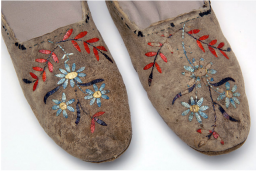
Dakota quilled moccasins. The Minnesota Historical Society.

In the process of designing the new 1862 exhibit at the History Center in St. Paul, the Minnesota Historical Society stuck its neck out.

You know the old joke: What happens when you stick your neck out? You make it much easier for people to sock you in the chin.

Institutionally, MHS has been risk-averse for years. So much so that last summer, the mildest reaction was polite disbelief when many of us in the local research community received a list of objects under consideration for the 1862 exhibit, with an invitation to view them in person and comment.

“There must be a catch somewhere,” a colleague mused. “When is the last time MHS asked what we think?”

I was in the historians’ email loop. At the risk of oversimplifying, the consensus reduced to: “These museum objects have no context in this proposal. People need stories to make sense of what they see. Flesh out the stories.”

Independent historians were not the only ones invited in. The Historical Society also reached out into the Dakota community for help. I was not part of that group. But a friend to who received the invitation said it amounted to, “We want Dakota input. If you’re interested, please come in, look at the objects we’re considering, and tell us what you think.”

I wasn’t privy to the Dakota discussions. MHS reported the bottom line: their Dakota consultants said they did not want historical Dakota objects on display.

The Minnesota Historical Society listened. They pulled the Dakota objects from the potential exhibit list.

Then MHS did what they could with the objects they had left  –mostly documents authored by non-Dakota people: MHS  fleshed out the war’s stories.

The exhibit opens this Saturday, June 30, 2012. It has been weeks since I last saw the exhibit text. Like everybody else, I will be going over to the History Center to step into the gallery and see what’s there.

And what isn’t.

What’s missing has already come back to haunt MHS. That is, in fact, why it is missing.

The ghost of colonialism past will haunt the third floor gallery just as surely as accusations of colonialism present would have taunted the Historical Society if MHS had ignored the objections of their Dakota advisors: 150 years ago, the majority of “Dakota War” objects deemed worthy of collecting were Dakota objects.

White soldiers did not pick up a doll with a bisque head, arms and legs on the New Ulm battlefield and cart it home as a souvenir. Dakota people did not carve an American-manufactured rifle bullet out of the corpse of a Dakota warrior and transmit the trophy for preservation to their local historical society.

The common objects of frontier settlers’ material culture on August 18, 1862 were not as collectible. A soldier marching through the Upper Reservation found a copy of a book inscribed to Mary Butler in 1857, but only bothered to mention it because he assumed it belonged to a “massacred” woman. He did not keep the book.

But what if instead of the book, he had found a pair of baby moccasins beaded by one of Ella Renville’s Dakota aunties?  (Ella was the daughter of John Baptiste and Mary Butler Renville.) Soldiers’ diaries confirm that moccasins and other Dakota-made objects were highly collectible in 1862-63.

If they had been collected, might Ella’s moccasins eventually have been donated to the Minnesota Historical Society? Perhaps –accessioned with a donation letter correctly identifying them as Dakota, but imagining provenance more “authentic” than the unromantic truth: that they belonged to the daughter of two eastern-educated school teachers, one Dakota and one white, who lived in a house and worshiped in a church building.

Yet had Ella’s moccasins been donated to MHS, they would have been deselected from the 1862 exhibit list as being Dakota objects. And with that deselection, the moccasins’ stories also would have been removed from the public dialogue.

That reduces the public dialogue –the 1862 exhibit –to what some may perceive as an oddly stilted representation of the past.

We cannot talk about what isn’t there. Can we?

To be clear: Dakota people showed courage in accepting MHS’s invitation and in voicing their opinion about the Dakota objects under consideration for the exhibit. They are not the enemy here. Our collective history is. Is it possible for an institution like MHS to escape the gravitational pull of its own past and tell a meaningfully balanced story?

Photo Credit: Minnesota Historical Society Fort Snelling website via Google Images.
Posted in Commemorating Controversy, Minnesota Historical Society, Opinion | 2 Comments

Comparatively Speaking, it’s a Deal!

The Minnesota Historical Society’s Reserve copy of the first (1863) edition of A Thrilling Narrative of Indian Captivity.

Those unaccustomed to University Press-produced books may wonder. But compared to a first edition that sold at auction in 2010 for $12,000, the 2012 edition is a great buy!

Of course, I hope you think it is a great read, too :).

Thank you to the 70 plus of you who shared the book release celebration with us Sunday afternoon! It was a lovely event and I owe you a recap as soon as I can find the photographer who took the Alan Woolworth photos. Hint, hint :).

Posted in A Thrilling Narrative | Leave a comment

Clubs, Hatchets, Knives and Beams Part 7 and PDF

The conclusion of a seven-part series on European American/Native American War Artifacts and the Ethics of Display by Zabelle Stodola, professor of literature and cultural studies at the University of Arkansas, Little Rock. The series begins here

Part 7: “Showing Basic Human Decency”

The Minnesota Historical Society is doing its part in admitting past cultural insensitivities, conversing with descendants of natives and non-natives affected by historical wrongs,  fostering inclusiveness, and committing to tell “the whole story, even the ugly,” as Steve Elliott, executive director of the MHS, said recently.[i]

But telling the whole story does not necessarily mean displaying everything. Patricia Cohen, author of a recent New York Times story on the controversy surrounding what to exhibit at the September 11 Memorial Museum at Ground Zero, puts it succinctly, “Everyone agrees that it is the museum’s job to tell the truth. The question, though, is how much truth.”[ii] Sensitive items may be held and made available for research, but not placed for all to see. The Blue Earth County Historical Society is also weighing the pros and cons of putting the purported scaffold beam on show even if it is authenticated.

I find it hard to believe that an organization’s mindful decision not to display inflammatory objects amounts to censorship. Entire collections are always pre-selected by the donors and/or the beneficiaries; exhibits more so. Ironically, for that reason, even if a museum showed all of its holdings on a specific subject, that grouping would still be biased and prejudicial. At the very least it would be incomplete. Therefore, when an organization withholds some items from open display, it’s not necessarily pandering to political correctness as some detractors claim.[iii] It’s showing basic human decency.

–Zabelle Stodola

A complete copy of this seven-part series is available in PDF form hereZabelle Stodola Clubs Hatchets Knives and Beams the Ethics of Display

*****

Notes to Part 7

[i] Quoted in Scott, “The No-Win War.”

[ii] See Patricia Cohen, “At 9/11 Museum, Talking Through an Identity Crisis,” New York Times (3 June 2012), 1, 20-21.

[iii] Incidentally, although I use the term “political correctness” here because that’s what many skeptics use, I loathe the phrase for its negative connotations. I much prefer “cultural sensitivity” since it better reflects the quality of genuine social empathy.

Posted in Blue Earth County Beam, Commemorating Controversy, Minnesota Historical Society, Zabelle Stodola | Leave a comment

Clubs, Hatchets, Beams and Knives, Part 6


Minnesota’s State Capitol, on permanent exhibit in the architecture of the Minnesota Historical Society History Center, St. Paul, Minnesota.

*****

Part six in a seven-part series on European American/Native American War Artifacts and the Ethics of Display by Zabelle Stodola, professor of literature and cultural studies at the University of Arkansas, Little Rock. The series begins here.

Part 6: US-Dakota War Artifacts in a Wider Context

Now I’d like to widen out the significance of local (read, mostly European American) historical societies and museums making decisions about display objects from European American and Native American wars. I’ve already mentioned several of these organizations: the Fruitlands Museum, the Haverhill Historical Society, the Blue Earth County Historical Society (where the 1862 scaffold beam is in storage), and the Minnesota Historical Society.

The problem is that all these groups originated in either an overt or covert desire to preserve and reflect history, yes, but also to reinforce colonial ideology.[i] Many of the objects the institutions now own—whether they originally belonged to natives or non-natives—were collected and preserved by non-natives as curiosities, art, spoils of war, family heirlooms, trophies, or anthropological oddities and then donated to museums or local historical societies.  Pity these institutions now required to make very complex and sensitive decisions about access which they may be unprepared and untrained to do.  Rather than digging in their heels, they must reach out for advice and do the best they can.

Dan Spock, the Minnesota Historical Society’s museum director, acknowledges, “not only is the MHS not necessarily an expert on the events of 1862, but, given the organization’s roots, it can’t even pretend to be an unbiased arbiter.”[ii] Therefore, the museum is not trying to establish an “’official narrative’” for the war because, as Spock points out, doing so would be “kind of an anachronism.”[iii] Few places these days try to construct a master narrative of history. Instead, MHS is trying to tell many stories from many perspectives. This approach is in line with the efforts of anthropologists and art historians from the late twentieth century on who have encouraged museums and archives to contextualize native objects in particular, to consult the native nations from whom the objects were removed, and in some cases to return them to their culture of origin.

Of course native leaders themselves have also been increasingly active in demanding voice and representation. For example, Dakota scholar Gwen Westerman reiterates the needs for a range of approaches when she says, “With multiple perspectives on a story we can come closer to knowing the answers to those questions we have about our shared history.”[iv] Further, decisions about displaying European American artifacts are now being made within a wider contextual and ethical net.

–Zabelle Stodola

*****

Notes to Part 6

[i] For more information, see “Our (Museum) World Turned Upside Down: Re-presenting Native American Arts” (part of “The Problematics of Collecting and Display, Part 1”), by art historians Janet Catherine Berlo and Ruth B. Phillips, The Art Bulletin, 77.1 (March 1995): 6-10.

[ii] Quoted in Scott, “The No-Win War.”

[iii] Quoted in Scott,“The No-Win War.”

[iv] Gwen N. Westerman, “Foreword,” in Renville, A Thrilling Narrative, edited by Zeman and Derounian-Stodola, xiii.


Posted in Blue Earth County Beam, Commemorating Controversy, Minnesota Historical Society, Zabelle Stodola | Leave a comment

Clubs, Hatchets, Knives and Beams Part 5

Part five in a seven-part series on European American/Native American War Artifacts and the Ethics of Display by Zabelle Stodola, professor of literature and cultural studies at the University of Arkansas, Little Rock. The series begins here.

Part 5: Sarah Wakefield’s Story

The Minnesota Historical Society is currently in the final stages of assembling its Dakota War of 1862 exhibit, but one item that will not be included is a famous hangman’s noose. It is said to be the actual noose used to hang Chaska (We-chank-wash-to-don-pee), a Dakota man who protected captive Sarah Wakefield and her two children during the six-week war.[i] Chaska was not on the final execution list, nor was another man named Wasicun; neither should have been hanged. A soldier on duty that day said he stole Chaska’s noose and the attached length of rope and kept them for seven years before donating it to the Minnesota Historical Society.[ii]

Shortly after the execution and theft, Sarah Wakefield was outraged when she learned that her protector had been killed. She wrote a captivity narrative titled Six Weeks in the Sioux Tepees partly to exonerate him and partly to explain her sympathy for Dakota people (something that seemed misplaced to most of her contemporaries).[iii] Recently, the Minnesota History Center invited Sandee Geshick, who is Dakota, to view artifacts being considered for potential display in the exhibit. When someone asked her how she felt when she saw the noose, she replied, “Well, how would you like to see an ax that your mother was bludgeoned with?”[iv]

–Zabelle Stodola

In the last two installments, Zabelle begins to pull together the themes connecting these objects and their museum-owners’ dilemmas about public display. A PDF of the full article will be linked in Part 7. CRZ

*****

Notes to Part 5

[i] For an excellent overview of Wakefield’s story and the noose controversy see Curt Brown, “150 Years Later War’s Wounds Still Cut Deep,” Minneapolis Star Tribune (29 January 2012), available at http://www.startribune.com/local/138264074.html?page=2&c=y.

[ii] For a further discussion of the evidence surrounding the noose and other US-Dakota War artifacts, see Carrie Reber Zeman, “A Veiled Cabinet of Curiosities: A Preliminary Report on Minnesota’s 1862 Gallows Artifacts,” 26 April 2012, available at https://athrillingnarrative.com/wp-content/uploads/2012/04/execution-artifacts-report.pdf.

[iii] See Derounian-Stodola, War in Words, 65-76. Thank goodness, one item that I have not seen mentioned of late  as a possible exhibit item is a watch chain woven from one of Chaska’s braids that John F. Meagher cut off after the execution. He donated it to the Minnesota Historical Society in 1887.  I discuss this atrocity on pages 72 and 73 of The War in Words. Zeman’s report “A Veiled Cabinet of Curiosities” (see above) discusses the watch fob at length and indicates that it has not been seen since the 1920s.

[iv] Quoted in Scott, “The No-Win War.”

Posted in Captivity, Commemorating Controversy, Minnesota Historical Society, Zabelle Stodola | Leave a comment

Clubs, Hatchets, Knives and Beams, Part 4

Part four in a seven-part series on European American/Native American War Artifacts and the Ethics of Display by Zabelle Stodola, professor of literature and cultural studies at the University of Arkansas, Little Rock. The series begins here.

Part 4: Hannah Dustan: Commemoration and Controversy

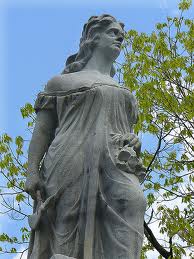
Hannah Duston Memorial Statue in Boscawen, New Hampshire, on the island where she killed her captors. Dedicated in 1874, it was the first permanent statue to a woman in the United States. Her right hand holds the hatchet and her left hand holds several scalps. 

It’s the hatchet and the knife that really get people going. When I visited the Haverhill Historical Society over twenty years ago, it displayed the (or I should really say, “a”) hatchet blade and also sold a postcard of it.  I still have the postcard which reads, “Hatchet Used by Hannah Duston to Kill the Ten Indians in March, 1697.” A booklet called “The Story of Hannah Duston,” prepared by the Duston-Dustin Family Association in 1984, was also on sale in the gift shop. It contains a photo of a knife with the caption “Knife used by Hannah Duston in escape” and of an accompanying, presumably authenticating, document. Both sources make definitive claims about authenticity, but not on a very firm basis.

Here’s what the website RoadsideAmerica.com says in its profile “Hannah Duston’s Whackin’ Hatchet”:

“Long after she was dead, the ‘Heroine of Haverhill’ was honored with a statue in town as a symbol of motherly rage (the Indians brained her baby). Haverhill also hung onto her relics. The Buttonwoods Museum [at the Haverhill Historical Society] displays several in a special case, including the hatchet head used by Hannah to kill her captors, and the knife she used to scalp them.

The curator told us that at least five other hatchet heads claim to be Hannah’s, but she was fairly certain that the one in the museum is genuine. She wasn’t as sure about the ‘scalp bag’ in which Hannah carried home her grisly human trophies, so it’s only displayed during the Duston Family’s annual reunion in Haverhill. The rest of the year the museum just displays a piece of cloth from the bag. Hannah wove it herself!”[i]

Although there are pictures of the purported hatchet that you can locate via Google or another search engine, I have decided not to include them in this posting. Further, I don’t know when RoadsideAmerica wrote its culturally insensitive profile (if you click on the link to the Haverhill statue provided in the above quotation, you’ll see they have added the punch line “I’m gonna get you, suckah!”).  Hopefully  not recently. Access the Buttonwoods Museum homepage today and you won’t see a single mention of Haverhill’s most infamous resident: not under “About,” not under “FAQ,” and definitely not under “Photo Gallery.”

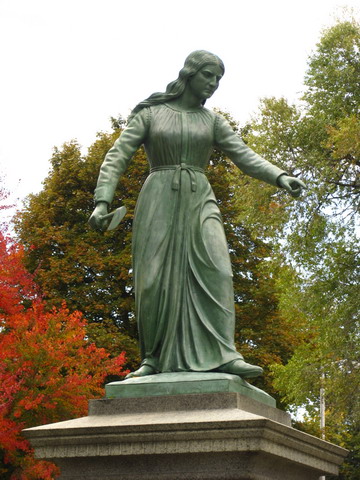
Dustan’s story has been absorbed into popular culture, and she herself has been the subject of many artifacts, including two statues as well as a 1973 Jim Beam commemorative bottle in the company’s series of bottles shaped like statues of American women. The design for the Dustan bottle is taken from the Boscawen statue (above) and is made of china, not glass. Shockingly, it uncorks at her breasts, following the decolletage shown in the statue, thus adding sexual titillation to the mix.

Hannah Dustin statue in Haverhill, Massachusetts, erected in 1879. The hatchet is in her right hand. 

Hannah Dustan and her story continue to cause controversy. In August  2006, Eastman’s Online Genealogy Newsletter ran a feature titled “Hannah Dustin Controversy in Massachusetts,” which opened with these lines, “A debate is brewing in Haverhill, Massachusetts, over an appropriate symbol to signify the city’s rebirth. City fathers have seized upon the story of Hannah Dustin as a symbol of bravery. Others in the city are not so sure she deserves the honor.”[ii]

More recently, in 2008, when the New Hampshire Historical Society began selling bobblehead dolls of Hannah and of Chief Passaconaway, the man who formed the Penacook Confederacy and was a friend to the English, a furor broke out (I’m not including a picture of those dolls either). One employee quit and another resigned in protest. Interestingly, the New Hampshire Eagle-Tribune on 29 July 2008 had this to add, “Haverhill historian Thomas Spitalere works at the city’s Buttonwoods Museum, which began selling the dolls last week. He said the dolls promote local history and he has no problem with them.”[iii]  Hmmmmm.

–Zabelle Stodola

*****

Photo Credits: Boscawen statue: http://people.usm.maine.edu/jdustin/hannah/statue/index0002.html, Google Images. Haverhill Statue: not sourced, Google Images.

Notes to Part 4

[i] See “Hannah Duston’s Whackin’ Hatchet” at http://www.roadsideamerica.com/story/22888 and “Hannah Duston Hometown Hero  Statue” at http://www.roadsideamerica.com/story/21105. Both stories carry the author information “Field Review by the Team at RoadsideAmerica.com.”

[ii] See “Hannah Dustin Controversy in Massachusetts,” Eastman’s Online Genealogy Newsletter (27 August 2006), http://blog.eogn.com/eastmans_online_genealogy/2006/08/hannah_dustin_c.html, which contains other links to this debate.

[iii] Quoted in “Hannah Duston Bobblehead Sparks Controversy,” New Hampshire Eagle-Tribune (29 July 2008), at http://www.eagletribune.com/newhampshire/x1876442987/Hannah-Duston-bobblehead-sparks-controversy?keyword=secondarystory, which also includes an account of the controversy.

Posted in Uncategorized | Leave a comment

Clubs, Hatchets, Knives and Beams Part 3

Part three in a seven-part series on European American/Native American War Artifacts and the Ethics of Display by Zabelle Stodola, professor of literature and cultural studies at the University of Arkansas, Little Rock. The series begins here.

Part 3: Hannah Dustan’s Story

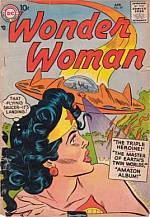
Wonder Woman Comic Issue 89, 1957, “Fabulous Females.” What’s Wonder Woman got to do with it? Read on.

Mary Rowlandson and Hannah Dustan share some similarities: both were seventeenth-century Puritan women captured with one or more children in a violent raid on their home, both were devastated when one of those children died from its wounds, and both were the subjects of famous captivity narratives (Rowlandson wrote her own but Dustan, who was probably illiterate, told her story to others).

However, that’s where the correspondences end. Rowlandson bore her captivity as patiently as she could, believing that it was a special providence sent by God to test her faith.  Dustan had not been formally received into the Puritan church at the time of her capture, so theologically and temperamentally she felt justified in literally taking matters into her own hands.

Here’s what happened. In March 1697, Abenakis descended on Haverhill, Massachusetts. Thomas Dustan, Hannah’s husband, was able to shepherd seven of their children to safety when the house came under attack. But he couldn’t prevent the Indians from capturing Hannah and Mary Neff, the midwife who had attended the birth of Hannah’s baby girl only a few days earlier, and marching them towards Canada after killing the newborn.

Held on an island near Penacook, New Hampshire, Hannah masterminded a plan with Neff and another English prisoner to kill their captors (mostly women and children) and succeeded in slaying ten of them with a hatchet. But instead of immediately fleeing to safety in a canoe, they spent precious time scalping the corpses. Was it out of revenge, righteousness, fear, or greed?  Probably some combination.

What we do know is this: from 1694 to 1696, the Massachusetts Bay Colony had a bounty for Indian scalps on its books. Even though the bounty had been repealed a few months before Hannah was captured, Thomas Dustan successfully petitioned the authorities for a cash reward for his wife and her accomplices. She received twenty-five pounds—a huge amount at the time— and her partners each received half that sum. The Court also presented Hannah with a pewter tankard as thanks for her actions.[i]

The pewter tankard given to Hannah Dustan by the Great and General Court of Massachusetts. Held in the Buttonwoods Museum, Haverhill, Massachusetts.

Hannah Dustan’s story is so extraordinary that it has been retold and refashioned countless times, but it has always been controversial. Was she an example of “outraged maternity” driven to extremes by the brutal death of her baby (a heroine), or was she a violent, greedy vigilante (a villain)?[ii] From contemporary versions of her story by the eminent Puritan minister Cotton Mather, to accounts by classic writers like Nathaniel Hawthorne and Henry Thoreau, to a 1957 portrayal in the Wonder Woman comic series, Dustan has captured the popular imagination with a vengeance (sorry about those puns).[iii] 

–Zabelle Stodola

The controversies over memorializing Dustan’s story are developed in Part 4.

*****

Information on this and other versions of the story at http://tinyton.org/hannahbio.htm.

Photo Credits: Comic: http://tinyton.org/hannahbio.htm, via Google Images; tankard: http://minerdescent.com/2012/04/06/hannah-dustin-hero-or-cold-blooded-killer/  via Google Images.

Notes to Part 3

[i] See Derounian-Stodola, Women’s Indian Captivity Narratives, 55-57.

[ii] There’s been some interesting work done on the fact that Hannah (Emerson) Dustan came from a very violent family which may have predisposed her towards violence too. Puritan culture allowed parents considerable license in using corporal punishment to discipline children, believing that it promoted greater civic control. Even so, Hannah’s father, Michael Emerson, was hauled before the authorities in 1676 and fined for abusing his daughter Elizabeth, then aged eleven, whom he had brutally beaten. In 1692, still single, Elizabeth had an affair with a married man, gave birth to twins, and was accused and convicted of killing them, though she protested they had been stillborn. She was hanged in 1693 after a sensational trial. See, for example, Julie Fay, “Hannah and her Sister: The Facts of Fiction,” Prospects: An Annual of American Cultural Studies  23 (1998): 1-21.

[iii] See these links for more information on the controversy about Dustan’s actions as well as the many different versions of her story http://www.hawthorneinsalem.org/ScholarsForum/MMD2128.html and http://www.hawthorneinsalem.org/Literature/NativeAmericans&Blacks/HannahDuston/Literature.html. See also http://minerdescent.com/2012/04/06/hannah-dustin-hero-or-cold-blooded-killer/ for a really excellent overview  with pictures of Dustan artifacts.

Posted in Captivity, Commemorating Controversy, Zabelle Stodola | Leave a comment

Clubs, Hatchets, Knives, and Beams, Part 2

Part two in a seven-part series on European American/Native American War Artifacts and the Ethics of Display by Zabelle Stodola, professor of literature and cultural studies at the University of Arkansas, Little Rock. The series begins here.

Part II: Mary Rowlandson, “King Philip’s War Club,” and Other Ritual Objects

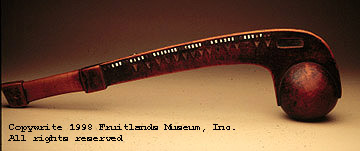
The artifact known as “King Philip’s War Club,” held by the Fruitlands Museum, in Harvard, Massachusetts.

I’m not alone in putting together hostage accounts and material objects. David Watters, an English professor at the University of New Hampshire, has constructed lesson plans showing how “ritual artifacts” can illuminate the teaching of literature, and he takes as his main case study Puritan grave markers and Mary Rowlandson’s seventeenth-century captivity narrative.[i]

But what exactly are ritual artifacts? Watters explains that they fall into two categories, the religious and the social, “People perform rituals to create a sense of order or meaning in their lives. Just as a religious ritual artifact—such as a Catholic rosary or a Jewish prayer shawl—might be used to express and enforce an individual’s religious beliefs, a social ritual artifact can express and enforce the social beliefs that permeate and organize the secular world. The program for a municipality’s annual Fourth of July parade and fireworks display, for example, may reveal a ritual emphasizing how patriotism, civic pride, and community involvement provide meaning and order for residents.”[ii] These examples suggest that societies imbue their chosen artifacts with symbolism and significance. Now let’s look at some of these ritual artifacts and try to unpack their meanings.[iii]

A 1720 imprint of Mary Rowlandson’s 1682 captivity narrative, marketed: “Written by her own Hand, for her private Life, now made Publick at the earnest Desire of some Friends for the benefit of the Afflicted…. Second Edition Carefully corrected and Purged from Abundance of Errors which escaped in the former Impression.”

The most famous of all American captivity narratives is by Mary Rowlandson, a Puritan minister’s wife. In 1675-76, during King Philip’s (Metacomet’s) War, a confederation of Nipmucs, Narragansetts, and Wampanoags captured her and her three children in Lancaster, Massachusetts. One child died as a result of being wounded in the initial attack, but the other two and Mary herself returned to their own culture several months later (Mary and one child were ransomed, the other child escaped).

Her narrative, The Sovereignty and Goodness of God . . ., was a Puritan bestseller and came out in four editions in 1682: three in New England and one, under the title A True Narrative . . ., in London.[iv] It has been regularly republished ever since, especially during turbulent times when mainstream American society needed a renewed sense of order and identity.

Rowlandson’s immediate captors were two native sachems, Quinnapin and one of his wives, Weetamoo, but she met the powerful King Philip (Metacomet) while she was a hostage, and he was responsible for allowing her to be ransomed for twenty pounds. The “war club” is presently housed at the Fruitlands Museum in Harvard, Massachusetts. [v] But Michael Volmer, the museum curator, admits “When and where the club, presently assumed to be Philip’s, came from is something of a mystery.” Although some oral and written provenance exists, all he can conclude is that in his “estimation the club was manufactured during the seventeenth century, in all likelihood by a Native American.”[vi]

Yet despite the club’s unconfirmed authenticity and iffy provenance, it figures in one part of the museum’s public program about its collections. That part is titled “Native American” and is described as being an “Introduction to New England ethnohistory. Several of the early accounts describing southern New England before 1650 will be presented and discussed. Object examination will include King Phillip’s [sic] war club, the James the Printer deed and Mary Rowlandson pamphlet.”[vii]

But not only don’t we know if the object belonged to King Philip (Metacomet), we don’t know if it really is Native American or, for that matter, if it’s even a war (as opposed to a ceremonial) club. Further, Rowlandson’s narrative never refers to Metacomet holding such a club. Nevertheless, the program links an artifact that likely reinforces negative stereotypes of Native Americans as savage and violent with Rowlandson’s seventeenth-century publication describing many of them in similar terms, as “Barbarous Creatures,” “bloody Heathen,” “Crew of Pagans,” and “hell-hounds.” [viii]

The “Native American” program at Fruitlands is on a small scale, but it raises some of the same questions that the Minnesota Historical Society faces as it puts together a commemorative US-Dakota War exhibit set to open at the end of June, 2012. What to do with “highly sensitive” and “highly emotional” objects?[ix] How to strike a balanced and ethical approach involving a range of constituents and perspectives?

*****

Photo credits: “King Philip’s War Club” Fruitlands Museum, Inc., Google Images; Rowlandson Second Edition, Encyclopedia Britannica, Google Images.

Notes to Part 2

[i] See Artifacts and Fiction, Workshop 7, “Ritual Artifacts,” at  http://edmedia.opb.org/lit/Ritual_Artifacts_Session_Guide.pdf.

[ii] Quoted from the “Ritual Artifacts” website.

[iii] Art historian Ruth B. Phillips also touches on the links between captivity narratives and collections of native artifacts in “Reading and Writing Between the Lines: Soldiers, Curiosities, and Indigenous Art Histories,” Winterthur Portfolio 45.2/3 (Summer/Autumn 2011): 107-24.

[iv] For fuller information on publication history see Derounian-Stodola, Women’s Indian Captivity Narratives, 3-6; and Neal Salisbury, ed., The Sovereignty and Goodness of God with Related Documents ([Bedford Series in History and Culture] Boston: Bedford, 1997).

[v] In the mid nineteenth century Fruitlands was the site of a utopian experiment in communal living by the Transcendental educator Bronson Alcott (father of Louisa May, of Little Women fame) and his family. But the experiment was short lived. Idealism gave way to the realities of a freezing winter in the middle of nowhere and after some months Alcott’s disciples and family left. Soon even he conceded  defeat, not of his ideas but of their implementation. See http://www.alcott.net/alcott/home/fruitlands.html for more information.

[vii] See http://www.fruitlands.org/a-closer-look. James the Printer (Wowaus) was a Nipmuc Indian who assimilated to Puritan culture and who probably typeset or helped to typeset the second edition of Rowlandson’s narrative in 1682.

[viii] These phrases come from the introduction and the parts of the narrative that Rowlandson labels the First and Second Removes, but she scatters similar racist tags throughout.

[ix] The phrases are taken from Gregory J. Scott’s excellent article “The No-Win War” in the May 2012 issue of Minnesota Monthly which you can access at http://www.minnesotamonthly.com/media/Minnesota-Monthly/May-2012/The-No-Win-War/. See also Tim Krohn, “US-Dakota War Exhibit Raises Issues,” in Native American Times (10 February 2012), available at http://www.nativetimes.com/life/art/6804-us-dakota-war-exhibit-raises-issues.

Posted in Captivity, Commemorating Controversy, Zabelle Stodola | Leave a comment