A Fable Agreed Upon, part 2

Solon J. Buck’s mistake went uncorrected. At the outset, it wasn’t influential. The Bulletin was read by MHS members and collected by libraries. But I doubt anyone lost sleep over an annotation error.

Indeed, without any correction, there wasn’t any error, was there? Members then, as now, likely vested some trust in Minnesota Historical Society products and publications.

William Watts Folwell thought so. That’s why he spent the best years of his retirement researching and writing his four-volume A History of Minnesota, as a gift to the people of the state, published and distributed by the Minnesota Historical Society (MHS). Folwell took no royalties; he waived them to benefit MHS.

*****
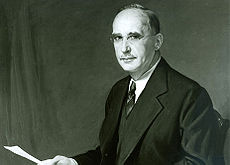
Dr. Solon Justice Buck (1884-1962) about 1941, in his official portrait as Second Archivist of the United States. Buck was Superintendent of the Minnesota Historical Society 1914-1931 and the editor of Folwell’s A History of Minnesota. Buck was lauded in an obituary: “He was a perfectionist with an infinite mastery of detail. He held all his associates to his own high standards of perfection. He was merciless on incompetents, but held the respect of those who worked with him.”

*****

It is no coincidence that Buck, who misinterpreted the John P. Williamson letter, similarly annotated Folwell’s comparatively moderate opinion of Thomas J. Galbraith.

In his manuscript for the second volume of A History of Minnesota, after lamenting the politically-forced retirement of J.R. Brown, Folwell wrote, “Into his place came Thomas J. Galbraith, a man of character and ability, who obtained the appointment not on account of actual qualifications for the position but because he had been a staunch Republican wheel horse in late political campaigns….”[i]

Buck allowed this paragraph to stand as Folwell had written it. But Folwell’s manuscript is missing the annotation which appears at the bottom of page 222 of the book. At this juncture, Folwell’s editor inserted an excerpt from notes Thomas Hughes had made from an interview with Martin J. Severance. Hughes recalled that Severance had said that Galbraith, “was a red-headed man and was a hard drinker. His excessive use of liquor had brought about a serious impairment of his mental faculties and he was wholly unfit to manage a turbulent lot of savages…”[ii]

Ever since, this footnote has been credited to Folwell as the book’s author. In fact, it appears to have been the commentary of Solon J. Buck. The Severance allegations Hughes repeated are so sensational that ever since MHS put them in print, historians have overlooked the disparity between the moderate text and this scathing annotation.

Severance’s interview with Hughes came to the Historical Society’s attention in April 1922, when large portions of Volume 2 of A History of Minnesota were already set in type.[iii] This left editor Buck little time to investigate Severance’s credibility. But he probably felt comfortable inserting the note for several reasons:

  • Hughes was a respected regional historian;
  • in the usage of the day, footnoted material was considered to be unsubstantiated (hence there is no supporting evidence in the note);
  • Buck had the mistaken impression that a highly credible source, John P. Williamson, hoped never to see Galbraith again.

The Severance footnote is not in the pre-galley draft Folwell approved. However, give and take between the two men on other points suggests Buck and Folwell probably discussed adding the Hughes/Severance quote. In the process, Folwell almost certainly would have raised the similarities between Severance’s story about Galbraith and the drunken incident Timothy Sheehan had alleged more than a decade before. (Sheehan’s allegations that Galbraith abused alcohol are the subject of the the third part of this post.)

The seeming concurrence of this triad of sources —Sheehan, Williamson and Severance —combined with the pressure of Volume 2’s being behind schedule may have led Buck to ignore a cardinal rule of history: check your source’s biases.

No one vetted Severance. His involvement in the scandal that, if the 1862 war had not intervened to overshadow it, would have defined Galbraith’s agency —the appointment and subsequent machinations of Severance’s friend A.C.T. Pierson as Superintendent of Schools —easily knocks Severance out of the pantheon of unbiased sources.[iv]

Most damning, what Severance told Hughes contradicted what Severance had said and done in the 1860’s. In February 1861, Severance wrote Minnesota’s Republican Senator Wilkinson demanding that Galbraith (who at the time was in a pool of contenders) be the one appointed agent.[v] In 1862, Severance advised Clark Thompson on two separate occasions to block Galbraith’s intended resignation from the Agency —strange behavior if Severance truly believed Galbraith was unstable, inebriate,  and wholly unfit.[vi]

It is impossible to overstate the effect the Minnesota Historical Society’s two-part mistake —not checking Severance’s reliability and misinterpreting the Williamson letter —has had on historical interpretations of Galbraith’s character. Had Galbraith been mild-mannered, a-political, strongly religious and a teetotaler, historians would find no grist for the rumor mill. But Galbraith was not. He was strong-minded, political, bombastic, moody, a Freemason, and like most in his day, probably drank sometimes.

To be continued

Image credits: “Emotional Snowball,” Google Images; Buck portrait and obituary quote from the North American Review, Wikipedia, Solon J. Buck.


[i] Folwell, A History of Minnesota Vol. 2, p. 221-222. Holograph manuscripts are in the Minnesota Historical Society Institutional Archives.

[ii] A History of Minnesota, Vol. 2, p. 222 note15. Source of the footnoted quote: “Report of Mr. Thomas Hughes’ interview with Judge Martin J. Severance November 27, 1903” William Watts Folwell Papers, MHS. Original in the Thomas Hughes Papers, Southern Minnesota Historical Center, Memorial Library, Minnesota State University, Mankato.

[iii] A letter from Hughes to Folwell in the Hughes Papers indicates that Hughes loaned Folwell historical notes shortly before April 22, 1922. The copy of the Severance manuscript in Folwell’s files indicates an MHS secretary typed it from the original on April 27, 1922.

[iv] Severance, a friend of Pierson, went to Galbraith to plead for clemency when Galbraith fired Pierson from his position as Superintendent of Schools. Pierson tried to bribe Thompson and Galbraith into retaining him, threatening to ruin their reputations. Severance failed to prevent Pierson’s firing. Decades later, when Hughes interviewed him, Severance made gross allegations about Galbraith’s character uncannily similar to those Pierson swore to perpetuate in revenge.

[v] Martin J. Severance to M. S. Wilkinson February 15, 1861. Records of the Indian Division of the Sectetary of the Interior, Field Office Appointment Papers, Minnesota, Thomas J. Galbraith. National Archives.

[vi] Martin J. Severance to Clark W. Thomspon May 18, 1862. Clark W. Thompson Papers, MHS; Severance to Thomas Hughes November 27, 1903, Hughes Papers.

Posted in Minnesota Historical Society, Primary Sources, Solon J. Buck, William Watts Folwell | 1 Comment

A Fable Agreed Upon

Napoleon Bonaparte is said to have mused, “What is history but a fable agreed upon?” 

*****

In July, 1918 the Minnesota historical community was buzzing: the Minnesota Historical Society (MHS) Bulletin had just published a recently discovered letter written by John P. Williamson to his father, Thomas S. Williamson, from Crow Creek, South Dakota in May, 1863. The letter read in part:

“…Whether Agent Galbraith is going to come around here [to Crow Creek] & be our Agent I doubt some, though some who saw him said he expected to come around in a week or so afterwards. And Dr. Wakefield told me he was coming around with him, though I hope to never see him out here & all the Indians wish the same thing most heartily.”[i]

The buzz was about not about the letter, but about the annotation written by MHS Superintendent Solon J. Buck. It read:

“The reference is probably to Galbraith rather than to Wakefield. Galbraith was a political appointee without any special qualifications for the position of Indian Agent. His incompetence may have been a factor in bringing about the outbreak in 1862.”

William Watts Folwell, at the time researching volume two of A History of Minnesota, sniffed the whiff of a story, sat down at his trusty typewriter and pounded out a query to one of his favorite sources on the Sioux Agency, Samuel J. Brown. Brown had been Galbraith’s interpreter at Crow Creek in 1863.

Brown  replied to Folwell on July 25, 1918:

“I was very much interested in Rev. John P. Williamson’s letter to his mother w. published in the last number of the Bulletin. I arrived at St. Joseph’s (Mo.) about a week after he left, and with Major Galbraith, Dr. Wakefield and others, went up from there with the Winnebagos [sic] arriving at Crow Creek early in June — 7th I think. I was sorry, however to see a certain footnote to John’s letter. This not only did injustice to Mr. Williamson, but also to Major Galbraith. The Doctor’s immoral conduct was too well known not to believe that John meant him and not Galbraith. Besides, Major Galbraith was a prominent and well-known citizen of Minnesota and a leading lawyer of Shakopee in the Territorial days — was a member of the Board of canvassers at the time of the adoption of the state constitution &c. — along with my father.”[ii]

This was not simply Samuel J. Brown’s late-in-life opinion of Galbraith. In an undated letter dating to late May or early June, 1863, he had written from Crow Creek:

“Maj. Balcombe is acting as Agent for the two tribes; he is rather severe on the Sioux but kind to the Winnebagoes. I wish Galbraith was here. The Indians wonder why he don’t come.”[iii]

Two other letters from John P. Williamson back up Brown’s reading of Williamson’s intent. Williamson wrote to his father from Crow Creek on June 9, 1863, “I’m glad Mr. Galbraith has come around here. I still have more confidence in him than any man we are likely to get.” On June 18, 1863 he repeated, “I do not know what course Galbraith will pursue, but I am afraid he will not remain agent and on the whole I am sorry for it. I think he is a better man than we are likely to get & if that were not so he is now used to the Indians which is more than half.”[iv]

Further, in another long-lost letter from Crow Creek, John P. Williamson discussed his low opinion of Wakefield. On June 9, 1863 Williamson informed Stephen R. Riggs:

“These Indians have been dying very fast since we started [for Crow Creek] of bowel diseases principally. There have 28 died. All the weakly ones are falling off; We have no doctor with us and almost no medicine. I am sorry to say Dr. Wakefield has come out with the Agent.”[v]

Unfortunately, published sources are more accessible, and therefore more influential, than those in manuscript form. From 1918 onward, the Minnesota Historical Society’s interpretation of the Williamson letter as dunning Galbraith became the accepted thought on that subject –even though the holograph lay in a file with two of the three letters refuting that interpretation.

Despite the fact that the MHS Bulletin received reader letters disputing the annotation. When Marion P. Satterlee challenged Solon J. Buck to defend his interpretation, Buck admitted, “The remark in the letter could certainly be interpreted as applying to [Wakefield] and in view of what you say about him, I presume it was so intended.”[vi]

The Minnesota Historical Society did not publicly correct Buck’s mistake. As we will see, that mistake snowballed as the twentieth century rolled along.

To be continued.

Image credit: arttechies.blogspot.com October 23, 2007 via Google Images


[i] Minnesota Historical Society Bulletin Vol. 2, No. 8, p. 422-425.

[ii] Samuel J. Brown to William W. Folwell July 25, 1918. William Watts Folwell Papers, MHS.

[iii] [Samuel J. Brown] letter fragment, no date. Joseph R. and Samuel J. Brown Papers, MHS.

[iv] John P. Williamson to Thomas S. Williamson June 9 & 18, 1863. Thomas S. Williamson Papers, MHS.

[v] John P. Williamson to S. R. Riggs June 9, 1863. Williamson Collection. The DakotaPrairieMuseum, Aberdeen, SD.

[vi] Satterlee to Buck July 19, 1918 and Buck to Satterlee July 25, 1918, both in the Marion P. Satterlee Papers, MHS.

Posted in Minnesota Historical Society, Primary Sources, Thomas J. Galbraith, William Watts Folwell | 2 Comments

“I am pained by the severe criticisms…upon Mr. Galbraith.”

Missionary Mary Ann Longley Riggs wrote to her husband on September 18, 1862, “I am pained by the severe criticisms of the St. Paul Press upon Mr. Galbraith…. I am sure we have never had as good an agent since the Upper Sioux have received annuities.”

This is part three in a series framing Thomas J. Galbraith’s September 12, 1862 defense of allegations in the media that he was responsible for causing the Dakota War of 1862.

The first installment contains a collection of quotes written before the 1862 War on the subject of Thomas J. Galbraith as Sioux Agent. We should always consider sources and their potential biases, including these. But note that these opinions were independently authored in private communications (not public reports), before the Dakota War of 1862 cast a backward shadow over everything that preceded it.

Historians’ tendencies to tidy up loose ends means the received story skips the fact that not all Galbraith’s contemporaries left him hanging out to dry, “hoist on his own petard” as William Marshall put it, quoting Shakespeare.

(Marshall, quoted below, was the editor of the Republican paper, the St. Paul Press, which published the scathing September 12 editorial laying responsibility for the war at Galbraith’s feet. Marshall wasn’t editing the paper at the time; he was on the frontier leading citizen soldiers in the war.)

Instead, just as provocative media stories do today, “A Question of Responsibility” evoked opinions private and public:

Mary Ann Longley Riggs, September 18, 1862: “I am pained by the severe criticisms of the St. Paul Press upon Mr. Galbraith. We who know him, know he would never have left his family in the Indian Country if he had thought there was really any danger. Can you not write as much as that in his behalf. I am sure we have never had as good an agent since the Upper Sioux have received annuities.”

 (Mary Riggs to Stephen Riggs, September 18, 1862. Oahe Mission Collection, Center for Western Studies Collection, Augustana College, Sioux Falls, SD.)

William Marshall, editor of the St. Paul Press, front page December 3, 1862: [W]e desire to say, by way of correcting a misunderstanding occasioned by some strictures we found it necessary to make on a former occasion to the present Sioux agent, that we had no intention at that time to question the official integrity of that gentleman. Anxious always, and first of all, to avoid injustice, we take pleasure in stating that we believe his administration of Indian affairs forms an honorable exception in this particular to the general course of precedents in the same office. The charge of ‘criminal negligence’ in not providing for an anticipated outbreak, was, as we explained at the time, not made by us; and if it fell, as a necessary logical consequence of his own statements and those of his friends, upon Mr. Galbraith, they cannot justly complain if they are ‘hoist on their own petard.'”

 Henry B. Whipple, Bishop of the Episcopal Church in Minnesota, December 5, 1862: “As to present officials, I believe Maj Galbraith has tried to do his duty and had he fallen at Fort Ridgely I should have vindicated his reputation so far as in my power but Maj Galbraith will agree with me that on some one in the Indian Bureau there rests a fearful responsibility for the delay in the payment, the use of annuity funds for other purposes and the refusal to give him any information to satisfy these men as to what had been done with the proceeds of their lands.”

 (Henry B. Whipple to F. Driscoll December 5, 1862. Whipple Papers, MHS.)

 John P. Williamson, writing from Crow Creek , June 1863: June 9: “I’m glad Major Galbraith has come around here [Crow Creek]. I still have more confidence in him than any man we are likely to get.” June 18: “I do not know what course [Galbraith] will pursue, but I am afraid he will not remain Agent & on the whole I am sorry for it. I think he is a better man than we are likely to get & if that were not so he is now used to the Indians & that is more than half.”

 (John P. Williamson to My Dear Father June 9 & 18, 1863. Thomas S. Williamson Papers. MHS. )

Samuel J. Brown, writing from Crow Creek, 1863: “Maj. Balcombe is acting Agent for the two tribes [at Crow Creek]; he is rather severe on the Sioux but kind to the Winnebagoes. I wish Galbraith was here. The Indians wonder why he don’t come.”

 (Undated letter fragment in Samuel J. Brown’s hand, Joseph R. and Samuel J. Brown Papers, MHS. The content dates this letter to late May or early June, 1863. In 1863, most Dakota and Winnebago Indians were exiled to a barren shoulder of the Missouri River at Crow Creek in southeast Dakota Territory. Balcombe, the Winnebago Agent, temporarily assigned to also oversee both tribes. Galbraith was in St. Peter, Minnesota, ordered to assist the Sioux Commissioners hearing depredations claims arising from the Conflict.)

 Henry B. Whipple 1864:  If the agent is an honest man, whose sole desire is to elevate a degraded people, he will be powerless [p. 452]…. Their agent, Mr. Galbraith, whom we believe to be an honest man [p. 458].…”

 (Henry B. Whipple in “The Indian System” in the North American Review Volume 99, Issue 205, October 1864.)

“But wait!” I can hear some protesting. “Everyone knows Galbraith was a red-headed alcoholic, a sinister fraud! Roy Meyer said he had more to do with bring on the Dakota War than any other person! How could people like John P. Williamson and Bishop Whipple defend him?”

I submit, rather simply, that they while they knew Galbraith personally,  those allegations hadn’t been invented yet. I will be returning to that story in a couple of future posts  because the capstone in that myth is something none of us escapes (including Galbraith): the power of the Minnesota Historical Society.

Photo credit: Google Images. 

Posted in Doing Historical Research, Minnesota Historical Society, Primary Sources, Thomas J. Galbraith | Leave a comment

Thomas J. Galbraith Defends Himself: September 12, 1862

St. Paul Daily Press April 26, 1861. Galbraith was in Washington D.C. giving his bond as Sioux Agent on April 12, 1861 when the Confederates opened fire on Fort Sumter, prompting recruiting notices like this one in newspapers across the North. Galbraith said he would have enlisted on the spot if he hadn’t believed, then, that the war would be over by Christmas. A year later, the war was still on and Galbraith gathered his first batch of Civil War recruits from the Minnesota frontier. On August 18, 1862, the day the Dakota War broke out, Galbraith was marching his second group of volunteers, the Renville Rangers, toward Fort Snelling. 

*****

One hundred and fifty years ago, Thomas J. Galbraith was smarting. He’d lived through the siege of Fort Ridgely with no reason to doubt the report that his wife and children had been “massacred” at their home at Yellow Medicine. Later, he learned his family had escaped, sheltered overnight by Dakota people in the Upper Agency warehouse, then led off the frontier by a Dakota guide, John Otherday.

After Sibley relieved Ridgely, Galbraith accompanied the burial party of soldiers and civilians who fanned out through Renville County, burying settlers killed in the opening days of the war. Galbraith was wounded when Dakota warriors besieged the burial party’s camp at Birch Coulie on September 2-3.

Galbraith was sent to St. Paul to recover, where we find him on September 12, 1862.  His leg wound likely still throbbed that morning as he opened the St. Paul Daily Press for the latest from two war fronts. Instead, he found himself the target of an editorial titled, “A Question of Responsibility.”

Whomever wrote the article did not interview Whipple, or Williamson, or anyone else about their pre-war perceptions of Galbraith as agent. Less than four weeks into the Dakota War of 1862, those assessments were eclipsed by the bald fact that Galbraith was Sioux Agent on the day the war broke out: the captain at the wheel of the Titanic the night it hit the iceberg.

The question was, and is, cogent: was Galbraith simply the man on watch when the inevitable happened? Or did he, by acts commission or omission, steer the Sioux Agency into catastrophe?

The next post will feature period reactions from people who weighed in on that question.

Today, we get Galbraith’s first reaction to “A Question of Responsibility.” It is classic for him. While Galbraith could compose solid rhetoric when time and his mood suited it, when he was mad, his words flowed, steaming, off the top of his head.

Thomas J. Galbraith to the Editor of the Saint Paul Daily Press September 12, 1862. [St. Paul] Pioneer and Democrat September 14, 1862, p.2.

Letter from Major T.J. Galbraith

From the St. Paul Press Saturday

                                                                                                St. Paul September 12, 1862

To the Editor of the Saint Paul Daily Press

            In the Saint Paul Daily Press of this morning there is an editorial article headed “The Question of Responsibility,” in which occurs the sentence following: “You raise the question, Mr. Agent, answer it;” and “Who then is responsible? You have raised the question, Mr. Agent, answer it now if you dare;” and “The Indian Agents through the organ which they have subsidized to represent them and other attaches of Cyrus Aldrich, have chosen to raise the question of official responsibility in connection with the outbreak of the Sioux. They have dared to raise the question, now let them answer it.”

            Now, who the Indian Agents and other attaches of Cyrus Aldrich are I do not know. But I do know who “Mr. Agent” is. It is my humble self, and I “dare” answer it.

            In the first place, then, I never through any newspaper, or “organ,” or otherwise, raised the Question of Responsibility above referred to; not have I any connection, direct or indirect, with any “organ” or any such question; nor had I any knowledge in regard to said Question of Responsibility whatever.

            I, therefore, as far as I am concerned, pronounce the above quoted paragraph purely and simply imaginary and false, and the writers and dictators of them calumniators and falsifiers.

            In the same article occurs the following: “families perished from starvation, cold and hunger, and inhuman neglect, while Indian traders and officials were growing fat and insolent on the spoils pillaged from the Indian.”

            Indian “families” are of course intended above….

            Full text of letter in PDF: Galbraith Defends Himself 12 September 1862

*****

Image credit: Minnesota Historical Society Civil War Day Book via Google Images.

Posted in Primary Sources, Thomas J. Galbraith | 1 Comment

Thomas J. Galbraith, Believe It or Not


Lobby card for the movie, Titanic, 1953. Twentieth Century Fox. “Based on the actual logs and incidences and persons aboard the doomed ship, screenwriters Charles Brackett, Walter Reisch and Richard Breen came up with an Academy Awarding winning Best Writing, Story and Screenplay combination of facts and great drama.”

*****

There’s no getting around the fact that Thomas J. Galbraith was the man at the helm of the Good Ship Civilization when it collided with the iceberg of Dakota resistance on August 18, 1862. That story, like the Titanic’s, has long been the subject of “facts and great drama.”

Modern allegations are nothing new. The 1862 war was barely three weeks old,  when the media found its whipping boy, Galbraith. A native of Pennsylvania, in early 1861, Thomas J. Galbraith was a Minnesota Republican state senator appointed Agent as a political favor in the wake of Abraham Lincoln’s election.

The centerpiece of this three-post series will appear tomorrow: Thomas J. Galbraith’s empassioned 1862 defense of the allegations flung at him in the period press.

To frame that piece, I’m supplying some period sources suggesting what people thought of Galbraith as Agent before the war colored public opinion. In the third and final post in this series, I’ll supply some period reactions to the media fray over Galbraith’s alleged culpability for bringing on the 1862 war.

John P. Williamson, August 1861: “The new Agent — Hon. Thos. Galbraith — is not a religious man, but appears honest & upright & friendly to the Mission. He made the Annual Payment immediately after his arrival here, which he conducted with energy & accuracy.”

(John P. Williamson to S.B. Treat August 2, 1861. ABCFM Papers, MHS. Williamson, a Presbyterian missionary at the Lower Agency, the son of missionaries Margaret P. and Thomas S. Williamson, had been born and raised among the Dakota.)

George E.H. Day December, 1861: “Enclosed I forward you a letter of Major Galbraith a man of the largest capacity of any Agent I have found yet. After a long consultation with him he thought it far better if I could go to Washington & he offered to write a letter which I accepted. He is an able man & agreed with me … that the whole [Indian] system should be revised & changed.”

(George E.H. Day to William P. Dole December 28, 1861. OIA Special File 228. In August 1861, Day was appointed a Special Agent by the Secretary of the Interior, at the request of the Senate and House Committees on Indian Affairs, to investigate allegations of fraud, nepotism, and the misappropriation of funds by officers of the Northern Superintendency of Indian Affairs between 1857 and May, 1861, and future frauds which he suspected could be perpetrated under the then-current system.)

Samuel D. Hinman, October 1861: “….I send you a copy of the Agt’s Circular in which he speaks kindly in regard to the Sioux Missionaries. Indeed the whole document shows system. It is but due to the Agt to say that so far everything has been done honestly and above board and that I am more than satisfied with his manly stand in regard to Ind. Affairs….”

(Samuel D. Hinman to Henry B. Whipple, Oct. 31, 1861. Hinman was the Episcopal Missionary at the Lower Sioux Agency.)

Thomas S. Williamson and Stephen R. Riggs, January 1862: [Proposing Indian system reforms to Congress] “….The only law for the protection of the property of Indians and of whites living among them with which we are acquainted was passed about the year 1834 or 35…. It ought to be repealed…. As the present Agent (Mr. Galbraith) appears to be an honest, judicious man it might be well to empower him to promulgate and enforce such regulations for the protection of the timber, fields and cattle of these Indians as their present circumstances require.”

(T.S. Williamson and S.R. Riggs to The Senate and House of Representatives of the United States in Congress Assembled, January 2, 1862 OIA Letters Received, St. Peter’s Agency. (Soft brackets) in original. Riggs and Williamson had been Presbyterian missionaries among the Dakota for more than a quarter century in 1862, and had personally known every Sioux Agent since Lawrence Taliaferro.)

Stephen R. Riggs, March 1862: [Writing to Galbraith] “…I ought not to close this letter without saying distinctly, that in my intercourse with you, you have uniformly trusted me with all the kindness and consideration I could deserve. My views of various things have much more frequently coincided with your own than I had previously any reason to expect. And may I be permitted to express the hope that this good understanding and kindly feeling will not soon be interrupted.”

(Stephen R. Riggs to Thomas J. Galbraith, March 13, 1862. Stephen R. Riggs Papers. MHS.)

Bishop Henry B. Whipple, July 1862: “Maj. Galbraith has entered fully into my plan [to reform the Indian system] & seems to be a faithful public servant.”

(Henry B. Whipple Diary, entry July 8, 1862 on a visit to the Sioux Reservation. Protestant Episcopal Church, Diocese of Minnesota Papers MHS.)

*****

Photo credit and caption quote: WalterFilm via Google Images.

Posted in Primary Sources, Thomas J. Galbraith | 2 Comments

What’s Pocahontas Got To Do With It?

The subjects of Zabelle Stodola’s talk, “Mary Schwandt and Maggie Brass (Snana): A Minnesota Pocahontas Story?”

Kris Wiley of the Traverse des Sioux Library System has been coordinating a summer-long speaker series on the Dakota War which culminated Friday August 24, 2012, in a day-long Dakota War Symposium sponsored by a consortium of New Ulm-area organizations.

Speakers: Julie Humann Anderson, Zabelle Stodola, Elden Lawrence, Mary Wingerd, Walt Bachman

It was my pleasure to introduce Zabelle, who has made her talk, “Mary Schwandt and Maggie Brass (Snana): A Minnesota Pocahontas Story?” available as a PDF linked below. I made these introductory remarks:

Good morning.  I am Carrie Reber Zeman and it is my pleasure to introduce my co-editor, Zabelle Stodola. Before I list some of the qualifications that bring her here today, I want to very briefly introduce you to her subject. Twice this week people who’ve seen today’s symposium program have asked me, essentially, “If this is a Dakota War symposium, what’s Pocahontas got to do with it?”

Zabelle will acquit herself beautifully on that question in a few moments. But when Alan Woolworth first put Zabelle in contact with me nine years ago, I had similar questions. After all, she proposed writing a new book on the Dakota War via its captivity narratives. I’m a historian and among primary and secondary sources on the Dakota War, the captivity narratives are a little strange: dramatic, emotional, stereotyped. I had a hard time reading them as historical evidence.

Working with Zabelle on The War in Words, I began to appreciate the unique characteristics shared by many Indian captivity narratives (ICNs). Once you know how the wider genre functions, the 1862 ICNs become understandable. But most of us have not made a career of studying them as Zabelle has. So let me establish a bridge via a genre many of us understand.

Raise your hand if you have heard a Garrison Keillor tell a Lake Woebegone story. That’s most of us. Okay: does it bother you that in every single story, the women are strong, the men are good-looking, and the children are… above average? No! In fact, that familiarity is part of theses stories’ charm, right? Keillor is innovative and creative —but within predictable boundaries we’ve come to expect and enjoy.

So a Lake Woebegone story has its own formula and stock characters. Indian captivity narratives do, too –except that they are not written or read much these days so we are unfamiliar with the formula.

Roughly half of the entire body of DW literature written by eyewitnesses is composed in the ICN form, a genre that was wildly popular in the 19th century. So it is high time that we modern consumers understand it.

That’s what Pocahontas has to do with the Dakota War. The 1862 captives and the readers who read their stories knew Pocahontas the way Minnesotans know Lake Woebegone and Paul Bunyan. If Babe the Blue Ox showed up pulling a fleeing settler’s cart in an 1862 story, or a Tupperware bowl of lime Jell-O appeared in Ebell’s famous photo, “Breakfast on the Prairie,” we’d notice! But Pocahontas, to us, today, is little more than a Disney movie. Our relative unfamiliarity with the popular literature of early America means Zabelle has many insights to offer.

That’s one reason why I asked her to be my co-editor on our newly released edition of Mary Butler Renville’s 1862 captivity story, A Thrilling Narrative of Indian Captivity. Zabelle brings three decades of experience as a professor of English at the University of Arkansas, Little Rock, has authored or edited six books and a dozen journal articles. Please help me welcome one of my mentors, now a friend and literary partner, Zabelle Stodola.

Zabelle Stodola, August 23, 2012

PDF: Mary Schwandt and Maggie Brass A Minnesota Pocahontas Story ?

Posted in Captivity, Zabelle Stodola | Leave a comment

Two New Dakota War Letters

page 1 of the Emeline Foot Blood letter in the Clements Library at the University of Michigan linked below

It will be a long time until digital history replaces traditional archival research (if it ever does). Not because paper is superior to pixels. But because the digitization of primary sources is expensive and requires a human being to identify and prioritize the material to be digitized.

Scholars who make in-person visits to archives have the ability to sift and prioritize primary sources for themselves, not depend a curator’s sense of importance. Collections are so vast that it may be decades before the majority are available in their entirety as digital images to be sifted by anyone with an Internet connection.

In the mean time, little finds like the two new letters below are popping up on the Net regularly. A research tip is that if an institution has set up the metadata correctly, Google Images finds the links –because digitization projects host images –with more regularity than content-based search engines do.

(This is probably not true for searches conducted through meta-search engines available by subscription at research institutions. But the average researcher does not have access to these from a home computer.)

Two letters in the University of Michigan’s Native American History Collection, hosted on-line in its American Encounters exhibit, are today’s example:

Although we don’t know who Charlie was beyond what he tells us–he was ill and sent to Minnesota for his health, where he happened to be an observer in St. Paul to the exodus of settler refugees from the frontier and the newspaper coverage of the war –the Emeline Foot letter adds news layers to the saga of the Silas and Adeline Foot family, already a fixture in the lore of the Dakota War of 1862.

Digital images plus transcriptions in the Native American History Collection at The Clements Library at the University of Michigan.

Posted in Doing Historical Research, Primary Sources | Leave a comment

“Cincapi” means “children”

Last week I was honored to get a fat manila envelope in the mail from a new friend at Sisseton. The envelope contained a host of treasures, including copies of files showing that the Bureau of Indian Affairs recognized one of John and Mary’s Renville’s adopted children as John’s legal heir.

In the enevelope was a photo of Ella’s grave marker in the abandoned cemetery at Ascension. Ella Renville, John and Mary’s daughter, lived through their 1862 captivity as a toddler and died at the age of twenty-two of tuberculosis. She was their only biological heir.

My friend told me stories about the cemetery: how after the new cemetery was opened,  the old, unfenced cemetery on the hill above the church became pasture land. How grazing cows had tipped over the stones. With time, the trees from the coulie took over the pasture. So now the fallen stones lie partially buried in woods.

Just like Ella’s stone, which Mary said was always in view when she looked out the windows of her house. The stone dates to around 1882. Once limestone white, a four-year old snapshot shows the stone and its epitaphs disappearing into the forest floor, nearly as green with moss as the ivy that twines around it. Only a few of the largest words are legible: Rev. J.B. Renville, Mary, Ella.

The cemetery map created in 2008 noted it as a headstone marking three graves: John B. Renville, his first wife, Mary, and their daughter, Ella.

But staring at the headstone photo all weekend, other words began dancing up out of the moss. First, the word “cinca.” Cinca, pronounced “chin-cha,” is the Dakota word for “child.” Of course. Ella was John and Mary’s child.

The line above Ella’s name slowly resolved into “now with Jesus.” Then above that, a partial date emerged, “12, 1862.” That stopped me cold: Ella was born in 1860 and died in 1882.

I went back to the beginning and read the stone photo from the top down. This time I saw that “cinca” had a “p” on it, followed by the hint of another, brief character.

cincapi

Not “child,” in Dakota but, “children,” (“chin-cha-pee”).

Ella’s tombstone says she was not John and Mary’s only child by birth. They had a baby girl, Mary, who died on the day of her birth in 1862. A baby whose grave they left behind at Hazlewood after Little Crow’s soldiers burned the village and forced his captives west during the war. A grave at Hazlewood that was so new it was probably not marked by anything more substantial than a wooden cross.

Baby Mary “now with Jesus.” Buried in a place her family never lived again. Whose life is remembered only in one place: on her older sister’s tombstone in the old cemetery at Ascension.

Yesterday I showed the photo to Gwen, who confirmed the Dakota on the stone. It reads:

Rev. J. B.

& M. A. Renville

cincapi

Mary

______ 12, 1862

now with Jesus

Ella M. R.

March 20, 1860

[line illegible]

Feb. 14, 1882

[line illegible]

[line illegible]

[line illegible]

[line illegible]

[line illegible]

Gwen was the first to ask the question, two years ago: why was Mary Butler Renville so frail in her 1862 story? Why couldn’t she lift? Why couldn’t she walk any distance? Why did she lose days of functioning –and of writing in her captivity journal –bedridden? Was Mary one of those nervous Victorian women who could not function without sofas and parlors?

It was a great, relevant question. When we meet Mary in her 1862 journal and 1863 letters she doesn’t seem physically suited to rigors of frontier life.

I answered the question by inserting a few sentences in the book reflecting my sense that Mary had not yet recovered from childbirth. In the absence of any other information, I guessed that Ella’s birth in 186o had been physically traumatic –an idea buttressed by the fact that they had no other biological children. Or so I thought.

Ella’s tombstone says she had a baby sister who died in 1862. Mary Butler Renville was recovering from childbirth and the death of a baby when she was taken captive. Unless baby Mary was born and died September 12 —in captivity. The answer to the question,”When?” is engraved on Ella’s and Mary’s head stone. If we can locate it again, I will be in the company of John and Mary’s family when we discover the answer.

Photo credit: Google Images

Posted in A Thrilling Narrative | 3 Comments

“Let Them Eat Grass” Revisited

Andrew Myrick insulted Dakota people the summer of 1862. What he said, and what he meant, have been matters of debate for a century.

Last summer, just in time to update A Trilling Narrative before it went into production, I discovered the earliest known rendition of this story. According to a source dated September 8, 1862, Myrick said hungry Dakota people could, “eat grass or their own dung.”

Does it matter? A callously hurled, “For all I care, they can eat grass” is insulting even without the smelly punch-line.

No matter what he said, Andrew Myrick is not the central character in this story; he simply got the most quotable line. A Dakota story of resistance to oppression has been masked by a century of rehashing the metaphorical meanings of Myrick’s insult. We’ve missed a major point: we might have taken Myrick literally.

First, the sources, then the story.

Little Crow to Henry Sibley 7 September 1862. Order Book, Volume 103 in the Henry H. Sibley Papers, the Minnesota Historical Society. Emphasis mine.

Yellow Medicine, September 7th, 1862

Dear Sir–

     For what reason we have commenced this war I will tell you. It is on account of Major Galbraith. We made a treaty with the Government, and beg for what little we do get, and then cannot get it till our children are dying with hunger. It is with the Traders that commence. Mr. A.J. Myrick told the Indians that they would eat grass or there [sic] own dung. Then Mr. Forbes told the Lower Sioux that they were not men. Then Robert he was working with his friends how to defraud us of our money. If the young braves have push the white men, I have done this myself. So I want you to let Governor Ramsey know this. I have great many prisoners, women & children. It ain’t all our fault the Winnebagoes was in the engagement, two of them was killed. I want you to give me answer by the bearer. All at present.

Your truly friend,

his

Friend Little  X Crow

Mark

With the holograph of this  letter missing, this is the earliest report of the “grass” insult. Little Crow was there when Myrick uttered these words –although not at the Upper Agency and not on August 4 –and Little Crow repeated them in this letter copied into Sibley’s order book six weeks later.

But Andrew Myrick himself was the first one to tell us that “grass” was the subject of hot debate on the Lower Reservation in 1862. On July 26, 1862 he wrote to his brothers, complaining, “[Y]esterday about 98 mounted Indians and 25 or so on foot all armed soldiers of the soldiers lodge… formed a line of battle marched to all the stores and made the following pertinent and [ ] speech ‘You have said you have closed your stores for 2 Sundays and that we should have to eat grass. We warn you not to cut another stick of wood or to cut our grass’, feeling themselves probably much relieved departed.” [National Archives, RG 75, Special Files series.]

What was this soldiers’ lodge injunction about? Stephen Riggs offered ethnographic commentary when he said in June 1860 (emphasis mine): “It did not matter that we had …worked for them day in and day out almost the whole spring –we were white men and could afford to do it…. [I]t did not in the estimation of these lords of the soil free us from the obligation to pay for the wood we burned and the grass our cattle plucked. When the time of want came, as it did, often more than once a year, the old men with their pipes and the young men with their guns came to demand or take the tribute.” [Northwest Missions Manuscripts, MHS]

As I summarized in my historical essay introducing A Thrilling Narrative, “[S]tories like these show that Lower Dakota men were not the hapless victims of abuse at the hands of authorities that some secondary sources [on the Dakota War] imply. While clearly  oppressed by the federal system, throughout the summer of 1862 some Dakotas continued to purposefully and vigorously resist the coercion to acculturate, including thwarting the machinations of the traders.” [p. 58]

These period sources suggest that Andrew Myrick wasn’t merely having a bad day when he told the Dakotas that they could eat the grass they forbade him cutting. Riggs was right when he termed Dakotas “lords of the soil” and “hay” and “grass” are the same word in Dakota. The grass growing on the reservation, and on this day 150 years ago, ripening into prime hay, was a Dakota resource. Whites could not use it without Dakota permission.

We know the summer of 1862 was a “time of want”(hunger), especially for Dakota traditionalists on the reservation. And we also know the traders had their backs to wall, threatened with the non-renewal of their trading licenses in 1863.

Am I excusing Andrew Myrick’s insult? No. I am suggesting there is a big difference between Myrick, whose spelling and grammar suggest had an average education, having an inexplicable Marie Antoinette moment, and Myrick, probably feeling a little smug, retorting (my paraphrase):

“Fine. You can have your grass. And eat it, too.”

Photo credit: Grasslands National Park, UBC Botanical Garden and Center for Research, via Google Images.

Posted in Andrew Myrick, Commemorating Controversy, Little Crow, Primary Sources, Uncategorized | 4 Comments

The Fifth Winter: July 5, 1862

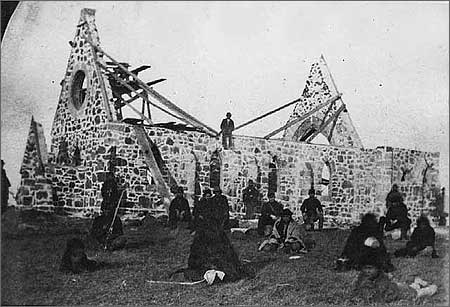
St. John’s Episcopal Church, Lower Sioux Agency, Minnesota, construction arrested by the Dakota War, photographed by Adrian Ebell in late fall, 1862. 

On July 4, 1862 Episcopal Bishop Henry Whipple laid the cornerstone for St. John’s, the Episcopal chapel at the Lower Sioux Agency. Sunday the 5th, he had a long talk with Lower Chief Wabasha, whose home was a farm on the Lower Reservation east of the Agency. The dates in Whipple’s diary suggest he recorded Wabasha’s words within hours of hearing them.

Wabasha, who was pro-acculturation and who, in the weeks of war to come would become the leader of the Lower Dakota peace party, was not out of touch with how Dakota traditionalists were faring under the government’s “civilization” program.

Listen in as Wabasha tells Whipple how it feels to be a Dakota living on the reservation on the eve of the Dakota War of 1862.

Excerpt, Henry B. Whipple Diary, Vol. 4: 1862. Episcopal Church Diocese of Minnesota Papers. Minnesota Historical Society. Paragraphing mine.

Visited Wabasha & had a long conversation in which I expressed my love for the Dakotahs, told him all I had in my heart spoke of their foolish dances & especially of the opposition of their Medicine men to the mission — lately they have taken pains to get up a dance on every Lord’s Day to keep the people from Church — They say their religion is in dances & these are a part of the Grand medicine ours is in praying — they will have theirs & we may keep our own — The design is to keep all wild Indians from religious worship —

Wabasha listened with great attention & especially to my words of love & my description of my letter to their great father at Washington and the law passed by congress to secure his home by a patent — he then made this very beautiful speech which was expressed with much grace —

“Your words have made my heart very glad. You have spoken to me as a father speaks to the child whom he loves well — You have have [sic] often come to see us & you know that the Indians are not like their white brethren — they have not your ways nor have you our ways — Our Great Father at Washington bought our homes and promised to help us to become like our white brothers he said to us when in Washington go home & try to live like your white brothers & in five years we will help you more than we have ever done — Four winters have passed & the fifth is nigh at hand — we think our Great Father may have forgotten his Red children & our hearts are very heavy — the Agents he send to us seem to forget their father’s words before they reach here for we often think they disobey what he has said.

You have said you are sorry to see my young men engaged still in their foolish dances. I am sorry — I wish they would be like white men — sometimes I think they have these old customs hung around them like a garment of their wild life — is because their hearts are sick. They don’t know that whether these lands are to be their home or not. They have seen the red man’s face turned towards the setting sun and feel afraid that many more long journeys are for themselves & children — This makes them weary and they never try to be different.

If the Great Council at Washington would do as they promised then my people would see they meant what they said. The good Indian would be like the white man & the bad Indian would seek another home — I have heard of your wise words to our Great Father and that he will now give the Indians who live like white men deeds for their land, and my heart is glad — You have none of my blood in your veins but you have been always a true friend to the Dacotah — I will repeat your words to the wise men of our people & often when I sit alone in my tepee they will come back to me and be like sweet music to my heart” —

Photo credit: St. Cornelia’s Church [sic] Minnesota National Register Properties Database, the Minnesota Historical Society, via Google Images.

Posted in Commemorating Controversy, Primary Sources, Wabasha | Leave a comment