Excerpt of A Thrilling Narrative

The University of Nebraska Press now hosts a digital excerpt of A Thrilling Narrative. You can read the Table of Contents, a note on our  editorial procedures, and the first twenty two pages of my Historical Introduction.

Warning: The excerpt ends at a historical cliffhanger, maybe on purpose! In book marketing, the excerpt is supposed to entice you to buy the book, or prompt you to suggest your local library buy a copy so you can keep reading :). In either case, the Flyer linked on the “About the Book” tab above contains a description of the book, excerpts from reviews, and a 20% off-cover price coupon.

Unfortunately, the excerpt does not capture any of my co-editor Zabelle Stodola’s Literary Introduction. So let this excerpt from historian Mary Lethert Wingerd’s review be your preview: “Derounian-Stodola gives us an almost lyrical meditation on the meaning of home, homeland, and the connection between place and identity as well as useful cultural context. She writes beautifully and creates an emotional understanding for reading the subsequent text that is unusual in historical works…. [M]y admiration for this work is wholehearted.”

I hope you enjoy the excerpt –and share the link with your friends :).

Posted in A Thrilling Narrative | 1 Comment

Dreaming in Digital

Lydia Pettijohn Huggins, who, last night, told me something in my sleep.

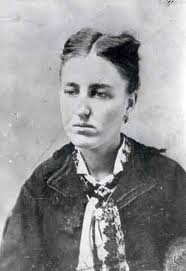
Lydia was the daughter of abolitionists in Highland County, Ohio. She married Alexander Gilliland Huggins, the son of abolitionists, and hid a fleeing slave in their home at Traverse des Sioux, Minnesota.

*****

Talk to scholars who work on the Dakota War of 1862 and many will admit that for every lost letter, diary or lost book we recover, dozens more wait to be discovered.

That’s one of the most exciting aspects of this commemorative year: not the sense that we’ve arrived, but the understanding that we’ve pushed the boundaries of what we knew. The edge of our known world is in a new place. And from that place, I, for one, am humbled by the vistas of how much we have yet to learn.

Digitization is a fresh wind in the sails of our collective storytelling.

I’m on my way to Ohio this week on an old-fashioned research trip. Sitting down on a wooden chair in a library is currently the only way to read the  papers of Wilbur Siebert, an Ohio historian who was a contemporary of William Watts Folwell. Siebert’s burning ambition was to correspond with every last living person who worked on the Underground Railroad.

Because the Ohio State Historical Society in Columbus has digitized their 149-page finding aid to the Siebert Papers, I can tell from my desk that there appears to be a lot of new information about the families of missionaries who came to Minnesota from Ohio: people who dove into the Indian Reform pool from the high board of the Abolition movement.

However, the Minnesota Historical Society paved my way to Ohio by digitizing the Alexander Huggins Family Papers. Five years ago I would have had to drive to MHS and read the collection in person. Instead I’ve spent the past few weeks flipping through page views on my lap top screen, printing letters of high interest.

Unlike researching in person at MHS, in between page views I have: started loads of laundry, tucked children into bed, weeded thistles out of my garden, and planned a research trip to Ohio. Digital history fits my real life.

As much as I love old paper and ink, and with almost every golden research moment happening on a hard wooden library chair, I guessed I would not easily be won over to doing digital history. But last night, for the first time, I dreamed in page views. I magnified holographs, deciphered Lydia Huggins’s handwriting, and sent pages to print.

If only I’d found copies on the printer this morning telling me what I found in my sleep.

Photo credit: The Minnesota Historical Society via Google Images.

Posted in Doing Historical Research, Underground Railroad | 4 Comments

The Beam Mystery Proceeds Apace


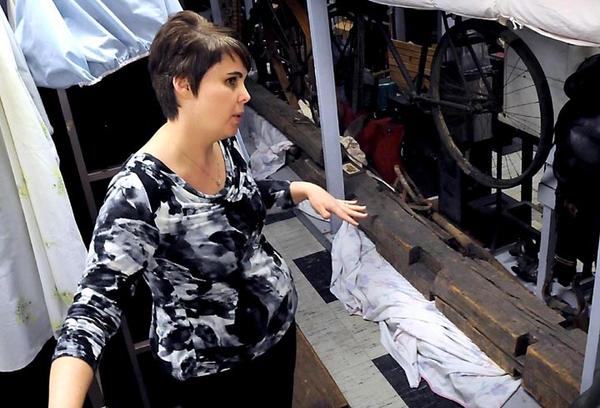
Jessica Potter, director of the Blue Earth County Historical Society, hasn’t simply waited out this spring’s media storm about identity of the “timber” in their store-room (above). Potter announced in her column in the Summer 2012 edition of The Blue Earth County Historian, that BECHS has consulted with the Minnesota Historical Society to develop a research plan to illuminate the story of the beam, believed to have been part of the scaffold that executed 38 Dakota men in Mankato on December 26, 1862. Potter is working on funding for the investigation, and is overseeing the tedious archival work of uncovering more clues.

The latest revelation: The scaffold was not auctioned off in 1863 as the legend reports. According to an August 27, 1864 article in the Mankato Record cited in the Summer 2012 edition of the BECHS newsletter, the scaffold timbers were not sold until August 1864. That’s what I  speculated in my report when I found no mention of the reputed auction in 1863 Mankato newspapers. It also seems that Meagher did not own the building in which he installed the timbers until 1864, which also fits better with an actual auction date of 1864.

The new twist is that the August 27, 1864 Mankato Record reported the scaffolding timber was purchased that month by a “Dr. Brown,” not John F. Meagher, the subsequent owner/donor who has gone down in history as the man who purchased the scaffolding timbers at auction in 1863.

Can you imagine: the gallows loomed for twenty months over the Mankato waterfront –plenty of time for visitors to carve off souvenir fragments like the one in a tiny glass bottle said to be from the 1862 scaffold donated to the Brown County Historical Society in New Ulm.

The Blue Earth County Historical Society has declined to exhibit the beam publicly. But I was recently fascinated to talk to a woman who, four or five decades ago, made a field trip to the BECHS museum in Mankato where she and her school friends took turns triggering the drop on the scale model reconstruction of the gallows: “Hands-on history”  a la the centennial commemoration of the Dakota War of 1862.

Photo Credit: Mankato Free Press via Google Images.

Posted in Blue Earth County Beam, Commemorating Controversy | Leave a comment

Gwen Westerman: “We Are Still Here”

Gwen’s event at the Minnesota History center, “We Are Still Here: Minnesota is a Dakota Place” Wednesday July 25, 2012 at 7:00 PM, has been on my calendar for months. But today I learned is ticketed, free event. I just reserved four seats via this link. If you have not yet reserved seats, do!

Posted in Gwen Westerman | Leave a comment

Why “Our Children Are Dying With Hunger” in 1862

Eleven months ago, for the first time I publicly presented Thomas S. Williamson’s 1856 malnutrition paradigm, suggesting it supported Little Crow’s 1862 claim that Dakota children were “dying with hunger.” One month later I presented a shorter paper  on the same subject at the Northern Great Plains Conference in Mankato.

In between the two presentations, I made my final edits on the copy edited manuscript of A Thrilling Narrative and returned it to the University of Nebraska Press. When I got up to speak at the NGPHC and saw Gary Clayton Anderson in the audience, I thought, “Well, I may as well present this with confidence because it’s too late to change the book now!”

I was relieved these ideas were well-received last summer. And this year, now that people are reading the Historical Introduction to A Thrilling Narrative, I’ve been asked to present twice on Dakota hunger in 1862:

By way of introduction, this is the story I told at my August 21, 2011 presentation at the Pond House in Bloomington: “Why ‘Our Children Are Dying With Hunger’ in 1862.”

*****

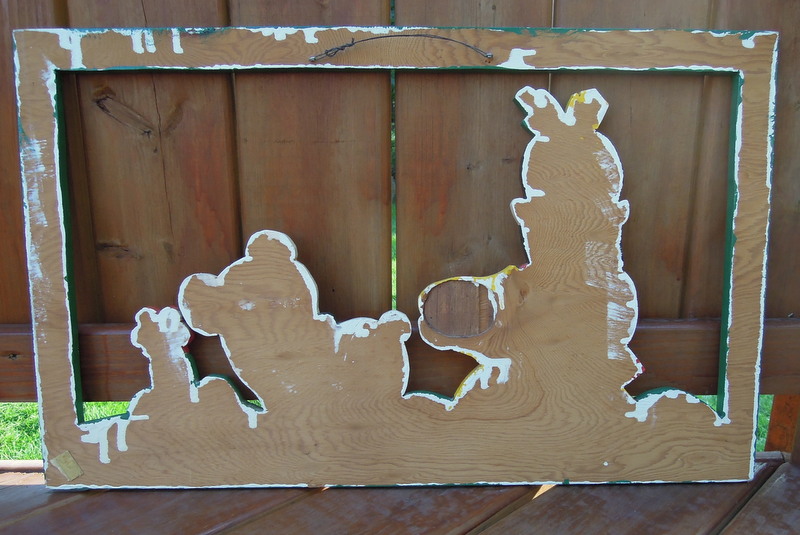
 When I was born in 1966, my mom and dad had just purchased their first house. Decorating your home with objects of your own making was the craze. You probably remember: driftwood lamps; macramé owls; hand-painted ash trays.

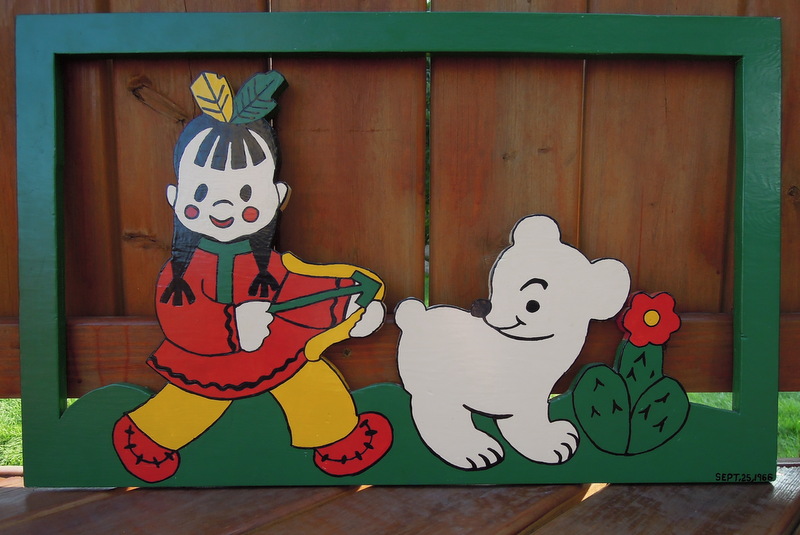
My dad loved wood working and in the spirit of the day, decided to craft something to commemorate my birth. This is the result. It hung on the wall of my room beside my bed for 18 years.
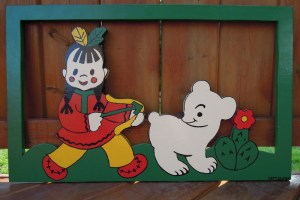
I was a teenager before it occurred to me that there is something seriously wrong with this picture. Do you see it?

That’s what struck me after a decade and half of staring: this Indian child is hunting a polar bear in a desert.

I took the picture down off my wall and carried it to my mother, who, the family story said, had painted the picture.

“Why in the world did you paint this as a polar bear?” I asked. “If this is a cactus, then this is a desert, right? Or maybe the plains? So how’d a polar bear get there? Shouldn’t this bear be an antelope or a buffalo?”

My mom laughed. “I didn’t really paint the picture,” she said. “When your dad brought it up from the shop, it was already painted. But he had saved the details for me –the black lines. Like I couldn’t imagine a sinister hunting scene hanging over your crib. So I gave the Indian child and the bear smiles, like they are playing. But he was already a polar bear. I just made him a happy polar bear.”

I think in collective memory, the story of the U.S.-Dakota War of 1862 is something like my picture of a polar bear on the desert in the sixteen years this picture hung over my bed: so familiar we have a hard time imagining it any other way. Look at it again.

We tend to see what’s there. It is harder to see what’s missing–like the open space. New histories tend to embellish what we already understand: maybe change the bear’s expression, or perhaps even his color. But not change the bear into an antelope. That would be too unfamiliar.
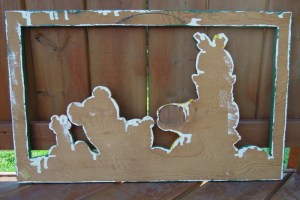
But look at the reverse.  See how much of this composition is negative space? Big chunks of this picture are missing.

What if we stripped the paint off the Dakota War and reconsidered the polar bears in our deserts? We need to go back and fill in the missing pieces in order to begin seeing the grain of the wood before historians started shaping the story for our consumption.

That process of reconstructing the context of the Dakota War has preoccupied me for fifteen years. I am absorbed by what came before the war –the sheet of plywood from which the story has been carved: its context in Federal Indian policy, and in the nascent Indian Reform movement (embodied in the presence and work of the Dakota missionaries like the Ponds here at Oak Grove.)

Today I’d like us to consider a familiar stereotype: a Dakota child starving to death on the eve of the 1862 war, subsisting as Sarah Wakefield told us, on unripe berries and the pith of marsh grass. The little Indian boy in my picture, perhaps. Except he isn’t smiling; on August 17, 1862 there is no bear meat at hand.

I propose we peel off the paint, reconstruct the period context, and try to leave with a deeper understanding of the causes, the extent, and the effects of malnutrition on the Dakota Reservations 149 years ago.

Let’s start by considering the earliest and most authoritative statement on starving children, Little Crow’s letter to Henry Sibley on September 7, 1862. Then we’ll consider the historical context of Little Crow’s claim of fatal hunger. Next we’ll look at how modern research on malnutrition in developing countries helps us understand what we see in period sources. That will lead us back to reconsider Little Crow’s claim again in conclusion –I hope with new empathy for what the children of Dakota traditionalist may have been experiencing in 1862.
Posted in A Thrilling Narrative | Leave a comment

Honored Guests

John Peacock, Sandra Geshick, Michael Simon, Clifford Canku, Oak Grove Presbyterian Church, Bloomington, MN July 15, 2012 sharing Dakota history from a Dakota perspective: the Dakota Prisoner of War Letters and their own stories.

If you weren’t able to join us to hear them today, mark November 17, 2012 at 2:00 PM on your calendar for a book release event at the Minnesota Historical Society for a reprise!

Posted in Commemorating Controversy, Dakota Language | Leave a comment

Honor Canku and Simon With Us!

I was thrilled to learn this morning that Dr. Clifford Canku and Rev. Michael Simon plan to join us tomorrow afternoon for John Peacock’s talk about the letters written in the Dakota language by Dakota men imprisoned in the wake of the 1862 war. We are honored to have them as our guests and have added them to the program!

Unfortunately we don’t have time to advertise their appearance, so please help us by spreading the word and join us for an unforgettable afternoon!

Details: 2:00 PM July 15, 2012 at Oak Grove Presbyterian Church,  2200 West Old Shakopee Road, Bloomington, Minnesota, 55431. Map.

Posted in Dakota Language | Leave a comment

The Dakota Prison Letters Project

Eight years ago, “the DPL” –the Dakota Prison Letters project was a rumor in the local research community: that Dakota people had identified and were in the process of translating a subset of Dakota language letters from the Riggs Papers at MHS, those written by Dakota men imprisoned in the wake of the Dakota War.

A conversation with Dr. Elden Lawerence at Sisseton in the days I was searching for a first-language speaker to translate John B. Renville’s letters confirmed the project was real. But, Elden added, the project had run out of funding and he didn’t know when the translations would be available.

Then last summer, in conversation with John Peacock, I was thrilled to learn that the DPL was not only back on track, it had a publisher, the Minnesota Historical Society Press.

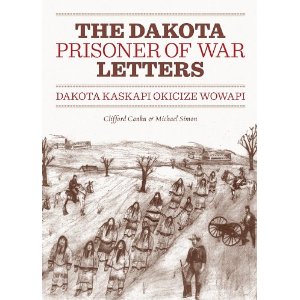
Compared to the decade invested in getting the book to press, with a release date of November, 2012, the DPL book, The Dakota Prisoner of War Letters: Dakota Kaskapi Okicize Wowapi, is almost here.

I am excited that this Sunday, July 15, 2012 at 2:00 PM, at Oak Grove Presbyterian Church in Bloomington, MN, Dr. John Peacock, who made the last level of translation into English and who wrote an introduction to the book, will be overviewing the project for us, focusing on the language and translation process. (For details, see below.)

Then last Sunday at Lac qui Parle, I was honored to meet Dr. Clifford Canku again and to meet Rev. Michael Simon for the first time. Both men are not only first-language speakers of Dakota who translated the letters in the book, they also are descendants of some of some of the men who wrote them. Their enthusiasm for the Dakota language is contagious and we hope we will be honored to have them join our speakers’ calendar in 2013.

Watch for this book and please join us this Sunday if you can! Here are the details for John Peacock’s appearance:

The Dakota Prisoner of War Letters Sunday, July 15 2:00 pm at Oak Grove Presbyterian Church, 2200 West Old Shakopee Road, Bloomington, MN

In the wake of the Dakota War of 1862, Dakota men imprisoned at Davenport, Iowa wrote letters to relatives in their own language. 150 years later, their voices have been recovered in a book of translations made by two of their descendants, Dr. Clifford Canku and Rev. Michael Simon (MHS Press, Nov 2012) Dr. John Peacock, who wrote the Introduction for the book, will discuss the project. Dr. Peacock is Professor of Native American Studies at the Maryland Institute College of Art, Baltimore, and is an enrolled member of the Spirit Lake Dakota Nation.

This event is sponsored by the Pond Dakota Heritage Society, the  Plymouth American Indian Initiative, the Traverse des Sioux Library System, Oak Grove Presbyterian Church, and the Bloomington Historical Society.

Posted in Books, Dakota Language | 1 Comment

Lac qui Parle

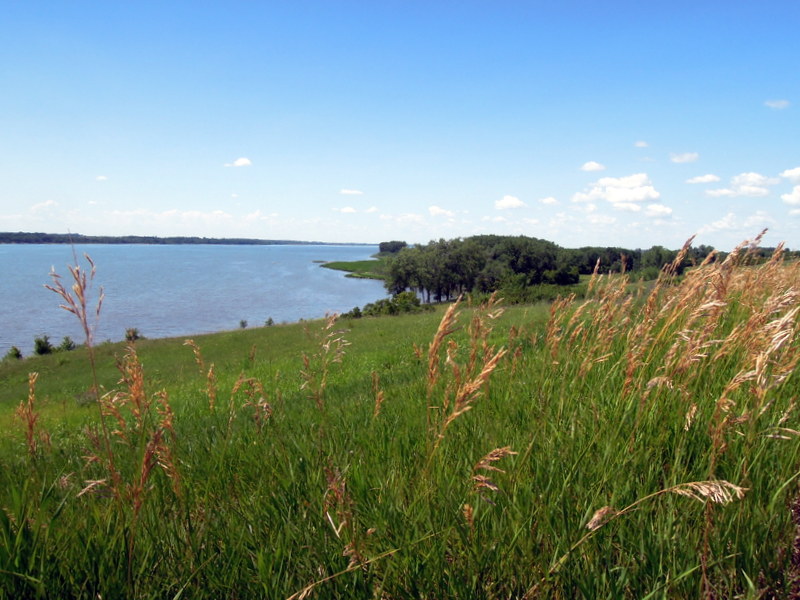
Mde Ia Udan (Lac qui Parle), July 8, 2012. For the first fourteen years of his life, John Baptiste Renville woke up to this view every day.

Yesterday, Sunday July 8, I was privileged to speak in the historic reconstructed chapel at Lac qui Parle.

More than 70 people gathered for the morning worship service which kicks off a yearly reunion of descendants of Dakota Christians and the missionaries who founded a Protestant mission here in 1835 at the invitation of Joseph Renville, John B. Renville’s father.

The worship service is always lead by a Dakota Pastor from the Dakota Presbytery, which ordained John its first Dakota pastor in 1866. This year’s pastor was Rev. Enright Bighorn of Ascension Church.

Members of the choir from Ascension Church, where John pastored for 30 years on the Sisseton and Wahpeton Reservation in South Dakota, led us in hymns in the Dakota language, accompanied by the Ascension organist on the chapel’s pump organ.

After a pot-luck lunch by the lake, people began drifting back up the the chapel for the “reflective” –according to the MHS PR department –talk. This year, I was the speaker.

There were about a dozen people in the chapel when I arrived, which struck me as about right. As you might imagine from the fans in the photos, this little building has no air conditioning but its windows and 1:00PM on the second Sunday in July has a deserved reputation of being unbearably hot here –especially when seated on a backless wooden bench.

So this annual afternoon talk attracts a handful of hardy people who take turns speaking and listening for the love of this place. I’m told there were 48 people in the audience as I spoke.

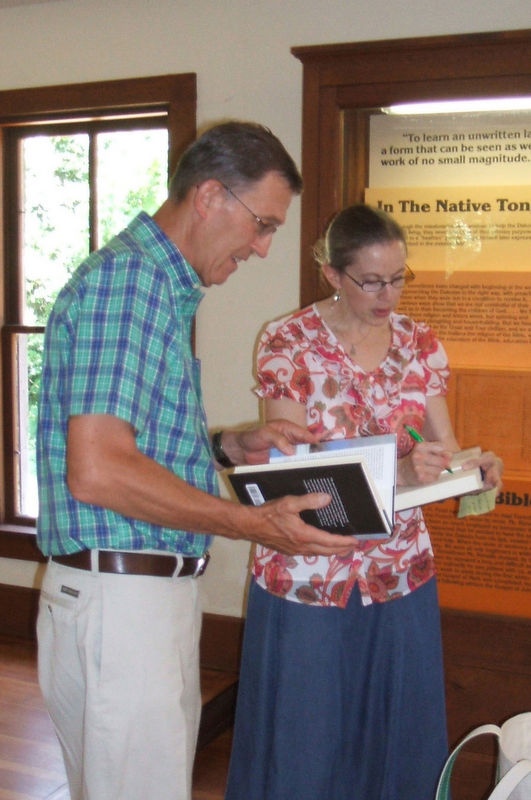
Most humbling, three of them are current pastors in the Dakota Presbytery, like Rev. Michael Simon, pictured with me above. By far the most meaningful part of the day for me was connecting with John’s spiritual descendants and hearing how John and Mary Renville are still alive in oral history.

I am also quickly learning the rudiments of book-signing, like writing down the inscription first, before the ensuing conversation erases the name of the “To”–the relative or friend of the person presenting the book!

Lac qui Parle today lies in Chippewa County, Minnesota, northwest of the city of Montevideo.

Photo credits: Chapel, Minnesota Historical Society via Google Images. Mde Ia Udan, Carrie Zeman. Program photos, Lois Glewwe.

Posted in A Thrilling Narrative, Commemorating Controversy | 1 Comment

The Book Launch Party, Part 2

In which I continue the story of the book launch party begun in Part 1. The next section of my remarks are a tribute to one of my mentors, to whom we dedicated the book: Alan Woolworth.

Alan Woolworth, who is about to celebrate his 88th birthday, arrived early to get a front-row seat, proudly wearing one of his “Nebraska” caps. Alan did the undergraduate work that led to his career in archaeology, museums collections, and research, at the University of Nebraska.

Now I need to tell you another story. Zabelle is right. Alan did not technically contribute to this book. But I have to tell you why: it because even before I started he had already loaned me his entire private collection of Minnesota captivity narratives.

It started with a binder. Alan knew I had little children because they came along with me on many visits to his office at the Minnesota History Center. These visits started when there was only one child. Then there were two. Then there were three. Those were the days before Alan’s research collections were available in the Library and even though he was supposed to be retired, he’d come into the office just about any time anybody asked.

Alan loves children. But I think he took pity on me. Because one particularly crazy morning at home my phone rang and Alan said, “I’m on my way into the office and I have something I think you could use. Can I drop it off on my way?”

A few moments later he was standing on my front porch in his long warm coat and woolen muffler with a very large binder in his arms. “This is from my house,” he told me. “It’s the same collection of my Dakota biographies that’s on my office shelf. Keep it as long as you need it. Photocopy what you want. Then return it sometime.”

I stammered my thanks and he was gone. Later, when my husband came home for lunch my oldest said, “Daddy! Daddy! Did you see them? Did you see them?! Those are Mr. Woolworth’s footprints in our snow!”

The binder was just the beginning of wonders loaned or gifted from his personal collection: material he’s collected at home over the years. Rolls of microfilm MHS does not own. Obscure old books. Boxes of research files.

But more than simply share information, Alan trained into a generation of novice, impressionable scholars like me that what we do with history is share it. If we are blessed to find something, it may be because tomorrow we will meet someone who needs that very thing. Alan’s spirit of humility and generosity permeates our local research community. Outsiders like Zabelle often remark on how readily we share.  If we do, it is because Alan has taught us so well. Not by lecturing. But by modeling how it done. Alan, we are grateful!

To be concluded in Part 3.

Posted in A Thrilling Narrative, Alan Woolworth | 2 Comments