1862 Trial 2: Te-he-hdo-ne-cha

For an overview of this series publishing the trial records of the 38 Dakota men executed at Mankato Minnesota on December 26, 1862, see the first post.

Tehehdonecha’s trial is the first of forty trials in this series.

Transcript: Trial 2 Te-he-hdo-ne-cha

Page Images: #2 Te-he-hdo-ne-che

Whiting-Ruggles Summary December 5, 1862

No. 2. TE-HE-HDO-NE-CHA.—Engaged in the massacres; took a white woman prisoner and ravished her.[1]

*****

Trial Record September 1862

[Trial #2 Te-he-hdo-ne-cha]

Proceedings of a Military Commission convened at CampRelease opposite the Mouth of Chippewa River by virtue of the following order:

Order No. 55                           viz:

                                                                                    Head Quarters Camp Release

                                                                                                September 28th 1862

             A Military Commission composed of Colonel Wm Crooks of the 6th Reg., Lieut. Col. Marshall of the 7th Regiment, Captains Grant & Bailey of the 6th Reg. And Lieut. Olin of the 3rd Reg. Will convene at some convenient point in camp at 10 o’clock this morning to try summarily the Mulatto, and Indians, or mixed bloods, now prisoners, or who may be brought before them, by direction of the Col. Commanding and pass judgment upon them, if found guilty of murder or other outrages upon the Whites, during the present State of hostilities of the Indians, the proceedings of the Commission to be returned to these Head Quarters immediately after their conclusion, for the consideration of the Col. Commanding.

The Commission will be governed in their proceedings, by Military Law and usage.

(Signed) H. H. Sibley

Colonel Commanding

[Frame 44?]

CampRelease opposite the

Mouth of Chippewa River, Minn.

Sept. 28 1862

The Military Commission met pursuant to the above order-

Present

Col. Crooks – 6th Reg. M. V.

Lt. Col. Marshall, 7th Regt. M.V.     Members

Capt. Grant, 6th Regt. M.V.

Capt. Bailey, 6th Regt. M. V.

Lt. Olin – 3rd Regt. M. V., Judge Advocate

Adjutant Heard – McPhail’s Mounted Rangers – Recorder

The Military Commission was then duly sworn and Te-he-dho – ne – cha a Sioux Indian was arraigned on the following specifications

Viz-

Charge and specification against Te-he-hdo-ne-cha, a Sioux Indian –

Charge –Murder –

Specification – In this that the said Te-he-hdo-ne-cha, A Sioux Indian did go upon a war party against the white citizens of the United States and did participate in, or by his presence and participation, direct and indirect, cause to be

[Frame __]

killed the Father, husband, and nephew of Martha Classen (sp??) on or about the 19th day of August, and the 28th day of September 1862 – This at or near Beaver Creek, Minnesota

Charge 2nd –Rape-

Specification. In this that the said Te-he-dho-ne-cha did forcibly ravish Margaret Cardinell, he, having been of the party who killed her father and brother in law on or about the 10th  [20th?] day of August 1862, when she was taken prisoner by the same party.

Witnesses –

Margaret Cardinell                                          By order of Col. H. H Sibley –

Harriet Vallant                                                                        S. H. Fowler

Lt. Col. – State Militia

A.A. Adjut.

And therefore the prisoner was asked what he had to say in answer to said charge, to which he made the following statement –

I don’t remember of killing any white persons, or committing any depredations, and that is the reason I am not with the other Indians.  I knew nothing of the killing of white at the Lower Agency until two days afterwards and then I went down there.  Myself and nine other went East of Beaver Creek.  Saw a wagon load of white people – the men ran off, and

[Frame 46?]

the other Indians ran after them.  This woman (Margaret Cardinell) is one of them.

I think there were ten (??) women and children there and the Indians wanted to kill them and I prevented it.  If I killed any she will know it.  I was compelled to go to the Fort and New Ulm.  Didn’t participate in the fight.  Went to the Fort twice but killed no one – was out of bullets at Birch Coolie, but came home  without firing again – was at Yellow Medicine at late battle, but did not fire a gun.  If I had killed a white man I would not be here.

I slept with this woman once.  I did bad towards her once – I tell you the truth – Another Indian may have slept with her.

Margaret Cardinal, a witness for the prosecution being then in Court, was duly sworn, and testified as follows:

The prisoner has slept with me.  He has raped me against my will –when I was taken prisoner and the third night afterwards.  This man was the same man who took me prisoner.

I did not see him kill anybody.

There were five Indians who came up where we were.  Three white men a woman and a little child ran into the woods, and this Indian and another staid by the wagon and every time there was a

[Frame 47]

war party this man went with. He was as ready to go as any of them and perfectly delighted –

Harriet Vallant, also a witness on the part of the prosecution was then called into court and sworn, and testified as follows –

I have heard the testimony of the last witness.  I was with her when she was taken – we were together at Mrs. Classen’s house – The three Indians, who ran off, came back, and said that they had killed two – This Indian was then present – He acted as if pleased at their success.  The party took away our provisions and would not give us any –

The testimony being closed the Commission was then cleared and proceeded to the findings and sentence –

The Military Commission after mature deliberation on the testimony adduced find the prisoner as follows:

Guilty of the specification of the first charge.

Guilty of the first charge.

Guilty of the specification of the second charge.

Guilty of the second charge – and do therefore sentence him the said Te-he-hdo-ne-cha, a Sioux Indian

[Frame 48]

to be hung by the neck until he is dead.

[Signatures of Commissioners and Recorder][2]

*****

Riggs Synopsis December 1862

1. Te-he-do-ne-cha. (One-who-forbids his house,) says he was asleep when the outbreak took place at the Lower Agency. He was not present at the breaking open of the stores, but afterwards went over the Minnesota river and took some women captives. The men who were killed there, he says, were killed by other Indians, whom he named.[3]

Transcriptions by Walt Bachman and Carrie Reber Zeman. Page views supplied by John Isch.


[1]Whiting-Ruggles Report to Abraham Lincoln December 5, 1862.

[2] Dakota Trials Records. Microfilm and holograph records in Center for Legislative Archives, U.S. Senate Records, National Archives. Transcription by Walt Bachman. See corresponding digitations of microfilm by John Isch.

[3] Mankato Independent December 26, 1862, “Confessions of the Condemned” p. 2. Editorial introduction reads: “Rev. S. R. Riggs has kindly prepared for us the following synopsis of conversations held with each one of the condemned prisoners, wherein is contained much interesting information.”

Posted in 1862 Dakota War trials | 2 Comments

38 Trials Project

One hundred and fifty years ago today, while some residents of Minnesota celebrated the advent of Christmas, near the levee on the Minnesota River in Mankato, Minnesota, soldiers and local citizens were constructing a monstrosity of a scaffold, about 24 feet square and about 18 feet high, large enough to execute 40 Dakota men at one time.

Across the street, more than 300 Dakota men chained to the prison floor, listened to the saws and hammers at work. The men were all accused of and had been tried for participation in the U.S. Dakota War of 1862. Most had been convicted and sentenced to death. Some, acquitted of the charges against them, were still in jail.  39 of them had been selected out and removed to another building.

Outside the prison somewhere, someone fashioned rope –at least 400 feet of it emergency-ordered from a rope maker upriver –into nooses.

Outside the prison, somewhere else, someone sewed pale muslin into long, blind hoods.

Outside the prison, behind closed doors, doctors were probably already discussing the impending chance to harvest dozens of fresh, frozen bodies for the medical cadaver trade.

thullen-scaffold

For 150 years, speculation has swirled like gusts of snow that eddied the dirt in the street beneath the Mankato scaffold. Those 38 Dakota men executed on December 26, 1862: What were they actually accused of? On whose testimony were they convicted? On what grounds did President Lincoln allow their death sentences to stand?

The Trial Record

The answers to some of those questions lie inside the original trial records, which remain inaccessible to many, housed in Senate records at the National Archives in Washington, D.C. Decades ago, the National Archives produced an unnumbered microfilm edition of the 1862 trial records owned by a few libraries and researchers determined enough to track down and order a copy.

Answers to other questions, like guilt and innocence, depend upon how we interpret the extant record. To collectively consider these bigger questions, we all need access to those records.

Walt Bachman, a retired trial lawyer and historian, owns a copy of the microfilm and has twice examined the original records from which the film was made. Bachman has shared his parts of his unofficial transcription of the trial records with researchers and Dakota descendants for years.

Retired professor John Isch this summer published an annotated transcription of the 1862 trial record. Isch’s 558 page book, The Dakota Trials, is available from the Brown County Historical Society.

The 38 Trial Project

As we publicly commemorate the executions of the 38 Dakota warriors December 26, 1862, Isch and Bachman have agreed to help publish the trial records of the executed men to the Internet, making three key primary sources widely available for the first time:

  • The December 5, 1862 Whiting-Ruggles Report summarizing the cases of the Dakota men whose execution Lincoln subsequently authorized
  • The 1862 Military Commission file on each case presented in two forms: 1.) a PDF file of images made from the trials microfilm and shared by John Isch; 2.) Walt Bachman’s transcription of the corresponding case
  • The so-called “Confessions of the Condemned,” Stephen Riggs’ synopsis of interviews he conducted with each man in the days preceding the execution

My contribution has been to supply the Whiting-Ruggles and Riggs transcriptions from my files, and to make a first-pass edit of Bachman’s transcriptions by comparing them with Isch’s PDFs. The lion’s share of the work has been Bachman’s and Isch’s and this project would have been impossible without their cooperation.

The result is a rough beginning. Records of this import are worthy of exacting transcription, annotation, and cross-referencing to other sources by a team of scholars, with critical attention paid to the Dakota names. But on the eve of the 150th commemorations of the executions, this project makes the trial records of the 38 executed men available, an important first step.

Each trial will be an individual post, making the content keyword-searchable, and allowing comments readers make on a specific trial to remain attached to that case.  I will also collect the records on the “38 Trials” page on my Sources tab to make them easy to find in the future.

The 38 Trials series will begin on December 24, 2012 and continue until the cases of all 39 men whose execution Lincoln authorized (and the related cases of the two men wrongly executed) are posted, hopefully by December 31, 2012.

A note on name spellings

150 years later, there is no single, accepted English spelling of each man’s Dakota name. Multiple spelling schemes have been advanced by Dakota and non-Dakota scholars over the years, but none of them has stuck. I believe the question is ultimately up to Dakota people to decide, so have arbitrarily chosen the Whiting-Ruggles spelling, which in most cases is very close to the spelling recorded in the trial record. Bachman and Isch, working from the trial record both use the trial-record spelling.

This isn’t a satisfactory compromise. But questions like,”How should we spell this name?” have bedeviled representations of the trial record since 1862 and we have to start somewhere. Reproducing the recorded spellings, as wretched as they are, is a starting place.

An important convention has emerged in the scholarly community of referring to each Dakota tried in 1862 not only by his recorded name, but also by his (or, in one case, her) trial number. Using the trial number is the only way to accurately track a defendant across multiple period documents despite the many variant spellings of his name.

The transcription vs. the images vs. the holograph originals

This project has not used OCR software, so keyword searches will hit on the hand-generated transcription, not on the page images. However anyone interested in the particulars of a case should consult the PDF images as the transcriptions are abridged in minor ways, like noting a list of signatures rather than reproducing them.

However, the original case files in the National Archives contain margin notes and other jottings too faint to have registered on the microfilm from which Isch made the images. Lincolnarchives.us is in the process of making new digital images of the 1862 trials records directly from the holographs. When those appear, the images will very likely supersede the microfilm images.

In the mean time, I’m grateful that Bachman and Isch agreed to pool resources with me to make the trial records of the Dakota 38 public information.

*****

 Image Credit: painting by J. Thullen, 1884, in the collections of the Minnesota Historical Society, Google Images.

Posted in 1862 Dakota War trials | Tagged | 9 Comments

Whitewashing History, Part 2

Gluttony

Gluttony by Robert Kingsly, 2009

“Then he berated me and my children something terribly. But I was totally silent, and when he was done I said to him what my kids have done. It is not my fault, I have not set a bad example, and they are not whore-children like yours, and I have kept myself in control, unlike you. You committed adultery. You have eaten, boozed, and farted. I tell you in the name of God that if you do not repent in front of God, so you are lost, and also have given me poison.”

Justina Kriegher, Letter to her children, 1907, translated by Romy H. Hall, 2005

*****

Did Romy Hall find the real voice of Justina Kriegher in the tortuous old Prussian German of her 1907 letter? If he did, what does it tell us?

In 1907, Justina Kitzman Lehn Kriegher Meyer Yonke was about 72 years old, in poor health, and, it seems, not surrounded by people who loved her. (“Mrs. Kraus came to me and gave me water. Said to me, You are so old it would be good if you are dead already.” Hall, p. 4) Justina was married to her fourth husband, August Yonke/Jannke, who she had married in 1896. By 1907, she believed he was trying to poison her to death, again.

Justina’s life had been hard. If the collected biographical notes in her file at the Brown County Historical Society are accurate, she married her first husband, Daniel Lehn, when she was sixteen and had three children by the time Lehn died when Justina was around age twenty one.  Justina immigrated to America with her children and some of her siblings when she was twenty two.

She married her second husband, Frederick Kriegher in 1857, when she was twenty two or twenty three. They both brought children from previous marriages to the family, and had three more children together by 1862.  Kriegher and two of their three children died in (or as a result of) the Dakota War.

Justina was wounded and wandered, lost, on the prairie for weeks before being discovered by two white soldiers. She was the only woman in the army camp at the protracted battle and seige of Birch Coulie.

John Meyer, one of the soldiers who found her, also survived Birch Coulie, having lost his wife at the opening of the war. Meyer became Justina’s third husband, making her the mother of children from at least five different mother-father combinations. All of her children were traumatized by watching a parent, siblings, and neighbors die at the hands of Dakota warriors.

Justina Kriegher experienced so much trauma in her lifetime, and for so many years was surrounded by people who had also experienced horrific trauma, that it is impossible to guess what the tenor of her 1907 letters suggests. Had Justina always been paranoid? Or after so many cumulative hardships, did she lose the ability to find good in people? On top of her many griefs, was Justina now being poisoned to death and reached out to her children, the only people she could trust? Or, perhaps more simply, were her children the only ones who understood her?

Two Plaster Saints

In any case, it seems like the real Justina Krieger was not the plaster saint either biographer made her out to be. Both Bryant and Huelster selectively retold her story to support an agenda. Compare their respective depictions of the “massacre” scene at the opening of the 1862 war.

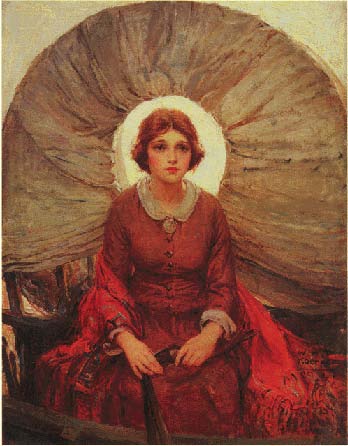
MadonnaPraire

W. H. D. Koerner, Madonna of the Prairie, 1921

“I stood yet in the wagon, refusing to get out and go with the murderers, my own husband, meanwhile,  begging me to go, as he saw they were about to kill him. He stood by the wagon, watching an Indian at his right, ready to shoot….”

Charles S. Bryant, 1864, attributed to Justina Kriegher

Bryant painted a tableaux of pioneer martyrs nobly defending their wagon (that icon of westward colonial expansion) and the children inside it, against an onslaught of murderous “savages”–a trope going back to the earliest colonial Indian wars in the East.  The words Bryant put in Justina’s mouth were calculated to justify the eradication of the (supposed) Native American menace in southern Minnesota to make the region safe for –to his way of thinking –his own superior, white, race.

*****

Praying Madonna Filippo Lippi c1465

Praying Madonna by Fillipo Lippi c. 1465

“….we were on our knees praying, when my husband sank to the ground, hit by a bullet. The horrible cries of the wild men, the pitiful weeping of the parents and their dying children was something that could never be imagined…..

Three nights and two days I was delirious, and I dreamed that I was on a narrow path, a large door was open before me and as I neared it I heard someone say: “You must suffer even more.””

August Huelster c.1908, attributed to Justina Kriegher

In contrast to Bryant’s secular slaughter, Huelster appropriated and reworked Justina Kriegher’s story for the edification of the faithful: Christian readers who, faced with imminent peril, might, like Kriegher’s family, stop and read a passage of scripture before fleeing for their lives, then fall into a prayer huddle at the feet of would-be executioners, fully prepared to meet their God at the hands of “wild men” who disregard the sanctity of the martyrs’ last rites.

Miraculously, in Huelster’s story Justina survives, marked by God as a noble woman chosen to bear much suffering. In his hands, Justina’s story becomes a sermon on superior Christian moral fortitude, closing:

“Since those days of dreadful experiences, God has led me through many storms and tests, but he has always remained faithfully at my side, and when I will eventually be taken from this life, then I shall see my loved ones who have gone before. This remains my joy and life.”

*****

Justina Kriegher was not highly educated or highly literate. She was comfortable using explicit, earthy language, a woman who helped slaughter animals and who kneaded raw headcheese and liver sausage with her bare hands.

But in the hands of two different storytellers, the raw ingredients of Justina’s 1862 story were remolded. She emerged a refined, cultured, Christian gentlewoman, all the better contrast to the dark, heathen provocateurs who, these authors said, had bedeviled southern Minnesota in 1862, a pestilence upon the “fair [pale complected] state” the fictionalized Kriegher represented.

With this emerging knowledge of how the 1862 story was shaped by 19th century obsessions like race, how can we modern historians go along with whitewashing race out of the 1862 story? At the other extreme, how can we continue to take 19th century atrocity stories at face value?

As we approach the end of the 150 commemoration year, we have not arrived at a new, enlightened understanding of the 1862 war –except, perhaps, in beginning to understand how much we have yet to learn.

Image credits: Kingsly, artistkingsly.com; Koerner, Picturing U.S. History; Lippi, Google Images.

Posted in Commemorating Controversy, Doing Historical Research, truth-telling | 3 Comments

Whitewashing History, Part I

Norman-Rockwell-tom-sawyer-whitewashing-the-fence

“Tom Sawyer Whitewashing the Fence” by Norman Rockwell (detail)

So: What is wrong with Justina Kriegher’s stories?

Not much, if we take them as they are: as stories. Quite a bit if we take them as we have: as history.

In high school we learned that history books are secondary sources, not primary ones. So anything Charles S. Bryant wrote in his own voice, we naturally read with skepticism. (Bryant published the best known version Kriegher’s 1862 story.)  These are the opening words in Bryant’s Preface to his 1864 book, A History of the Great Massacre by the Sioux Indians:

“The massacre in Minnesota, by the Annuity Sioux Indians, in August, 1862, marks an epoch in the history of savage races. In their westward march across the American continent, in the van of higher civilization, the native red men have, at different times, given sad and fearful evidences of their enmity to the dominant white race; but from the landing of the Pilgrim Fathers on the rock-bound coast of New England, in the winter of 1620, until their descendants  had passed the center of the continent, and reached the lovely plains of Minnesota, no exhibition of Indian character had so afflicted and appalled the soul of humanity, as the fearful and deliberate massacre perpetrated on them in August, 1862. And, in the following work, it has been the sole object of the authors to present, for the benefit of the present and future generations, the astounding truths connected with this bloody drama in our history.” (p. iii)

That rhetoric is boiler-plate for 19th century history books; most people today don’t take it seriously.

Yet, many still treat material that appears in direct quotes within a secondary source, like Kriegher’s story, as if it is primary evidence. Bryant assured his readers they could do that very thing: “Much of the matter relating to the massacre will be found in the language of those who had themselves escaped from the horrors they so graphically describe.” (p. iii)

Bryant was shrewd. Justina Kriegher was a real person who experienced part of the 1862 war.  She also actually testified before the Sioux Claims Commission in 1863, where Bryant claimed to have written down her words as rendered in English by a translator. Although Bryant’s claim to have been present lacks confirmation, it is plausible; an Iowa reporter also claimed the settler-survivor stories he published were reproduced from notes  taken while attending Sioux Commission hearings in St. Peter, Minnesota.

All of those factors lent the stories in Bryant’s book verisimilitude –an air of truthfulness –back in 1864. The question is whether stories like these should figure in to our understanding of the U.S. Dakota War of 1862 today. The answer hinges on what we think the master narrative ought to say.

To Tell or Not to Tell

What is our purpose in telling and retelling stories? Or in not telling them?

Two opposite view points  –two proposed master narratives –have captured media attention in 2012.

Many sincere scholars see danger in the modern interpretive trend to airbrush atrocities out of 1862 stories in favor of a kinder-gentler (and less accurate) re-visioning of our collective past. This, they warn, dismisses the experiences of settlers whose lives were shattered by the Dakota War and underestimates the pain and rage that fueled post-war attitudes and actions toward Dakota people.

Scholars in this camp generally view themselves as  guardians of endangered history. They cross-reference Kriegher’s stories and  compare them to similar atrocities reported in other period sources. (We learned that in high school history, too: three or more sources, they say, constitutes historical credibility.)

As they understand the Dakota War, very specific numbers of white people (and one black man) were killed at specific places on specific dates, many of them by specific Dakota bands or individuals.  Almost every victim has a name, a gender and an age. Most have known families and stories. In many neighborhoods, whites who were injured but survived, and those who escaped (and where they escaped to, and how) are also documented facts. There’s nothing vague about this data or the ways it can be crunched to produced detailed stories of what happened where.

In the opposite corner are people who reject the stories of atrocities committed on settlers in 1862. Some propose that  traditional warfare was brutal and that unarmed civilians were legitimate targets. This normalizes acts that in another place and time might be called ‘war crimes’ –a back-handed way of acknowledging that at least some  of the so-called atrocities were real. Others believe that atrocity allegations and settler deaths are, at minimum, grossly inflated, if not outright untrue. So they reject them entirely.

In stories sourced in this camp, vague numbers of people die (like, “hundreds on both sides”). War-time victims are euphemistically re-christened “settlers” and “newcomers,” erasing racial identity. Settlers/newcomers die in vague, unspecified ways in the wings, while Dakotas take center stage and die in specific (atrocious) ways: starved, bayoneted, drowned, in concentration camps, by execution. White deaths are studiously attributed to no one (certainly not to the 38 Dakota men convicted of and executed for murder; in this script, the 38 are innocent victims).

The authors of this narrative cast themselves as truth-tellers on a spiritual mission: stamping out 150-years of racism enshrined in history; speaking up for unacknowledged atrocities perpetrated on Dakota people. Kriegher’s stories, to them, are fictional inventions by historians like Bryant whose goal, they say, was to prop up a white male power structure hell-bent on genocide.

Despite their differences, both camps share something in common: their most visible, vocal advocates selectively embrace and/or reject stories to support their agenda –their own master narrative of how the rest of us, in the present, should view our past and our future.

Calling Out the Middle Ground

Then there are people like me. I don’t claim the middle ground is more virtuous territory. I simply recognize that I am one of the swing-voters in the contest for the emerging story.

As I have traveled across the Midwest this year, visiting with descendants of  white and Dakota people, I have found most fall into neither camp. That may be no accident; maybe we’re drawn toward each another by our mutual curiosity, our mutual dissatisfaction with the received story of 1862.

We stand somewhere in the wide middle ground between the two camps, taking it all in, trying to sort history from rhetoric, trying to answer to our own satisfaction big questions like: Were the Dakotas interned at Fort Snelling in a concentration camp? Were the Dakota men executed at Mankato innocent? Can we accurately apply terms like “war crimes” and “genocide” to the 1862 story?

With the bewildering array of “evidence” on the table will we ever arrive at a coherent story to pass down to our children?

With time, we will. We start by critically considering the stories we hear —all of them. We lay down the broad brushes of  racial guilt and racial pride that historically were used (and continue to be used) to whitewash our side of the story-fence. That means nobody gets a break for claiming descent from a historically oppressed people group, and nobody is allowed to rest on the moral laurels of their oppressor-ancestors.

Like the intent-onlooker in the Rockwell painting, we consider the paint-job carefully, observing how the stories we’ve inherited have been whitewashed, and by whom, and to what end.

Except we will not be taken in by Tom Sawyer like that boy was, and pick up the whitewashing where Tom left off.

*****

For contemporary, critical analysis of Charles S. Bryant as a historical source on the Dakota War of 1862, see Kathryn Zabelle Derounian-Stodola, The War in Words: Reading the Dakota Conflict through the Captivity Literature University of Nebraska Press, 2009, Chapter 4.

Rockwell painting detail: Google Images.

Posted in Commemorating Controversy, Doing Historical Research, Primary Sources, truth-telling | 3 Comments

History Is a Fun House Mirror

Before I began writing history, I loved reading it: the feeling that a good history book was a window I could look through to see the past.

But actually doing history is more like looking into a fun house mirror:

Fun-House-Mirror

It’s a historian’s job to look at the inflated  red guy in the mirror (a story), and from that, deduce what the small red stick figure (the real thing) looked like.

fun house mirror green

Obvious distortions in the mirror make our job easier; we naturally look for distortions in any image reflected off its curves.

Fun-House-MirrorBut the mirror in the first graphic is flat, not curved.  Without the stick man for comparison, there are no tell-tales that this mirror is not accurately reflecting a McDonalds Happy Meal super-hero action figurine.

*****

This analogy was stirred up by a coincidence: reading a befuddling number of variations of Justina Krieger’s story (I presented three of them here) a few hours after I arrived home from a conversation at a historical society that ended like this:

“….The story you published contains factual errors. Like the man you have named as his father was actually his uncle. His father’s name was _______.”

“I will check that,” the author sincerely replied. “But everything I wrote comes from published sources. In fact I cited them.”

*****

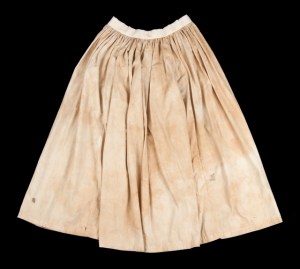
427, front

The story of the Dakota war of 1862 is shot-through with that very problem. Way more than Mary Schwandt’s petticoat (above).

It is more like the blanket Justina Kriegher was wrapped in during the battle of Birch Coulie. Unfortunately this miraculous blanket has not survived. Bryant claimed Justina testified under oath that her blanket sustained two hundred holes while her body only received five scratches from the same bullets.

Could it be that German immigrants on the Minnesota frontier were spinning and weaving Kevlar fiber by 1862, but that knowledge was lost in the war and only rediscovered by DuPont scientists in 1965?

*****

Fun-House-Mirror

Return again to our Happy Meal Action Hero.

Imagine: For the next 150 years, historians faithfully describe the image they see. Historian B observes that Historian A placed great emphasis on the figure’s small head size. So, striving for originality, Historian B calls attention to the formidable fists. Historian C points out the challenge of balancing so powerful an upper body on such undersized hips.

Picking up the suggestion that Action Hero achieved great notoriety despite these well-documented challenges, Historian D researches and describes the difficulty of ambulating with this upper body muscle mass on his right clubbed foot. Because Historian D is alive and working in the Internet age, his theory goes viral and generates lively debate in which Historian E points out that, given that Action Hero is only known via a mirror image, the now-famous “right clubbed foot” was actually a left clubbed foot.

Historian E is nominated for a Pulitzer because her “mirror image” insight revolutionizes the way we understand roles played by people like Action Hero in history. Graduate students in history everywhere scramble to apply “left is right and right is left” theory to their periods/regions of study. This results in a spate of dissertations (which become their authors’ first books) innovating on Mirror Image Theory, which is advanced at professional conferences and in history departments everywhere for the next three or four decades –until that generation of historians retires.

Politicians advance solemn declarations and advise revising laws based in their good faith understanding that real insights have been gained by re-imagining the past as a mirror image.

Fun-House-Mirror-001

After 150 years of polishing the fun house-mirror story, no one living can imagine Action Hero might have been a tall, skinny guy with a proportionately sized head whose cognitive capacity would have gotten him a lot farther than his muscles did.

As to his pointed feet….Well, he could be an ancestor of Hasbro’s Barbie, or possibly, of Mikhail Baryshnikov.

Or maybe he’s simply irate, every muscle strained as he pounds on the glass box in which he is trapped, trying to get the attention of the masses who are convinced that Action Hero is an accurate reflection of him.

Image credits: Mirrors, Google Images. Mary Schwandt’s skirt, Minnesota Historical Society Collections database.

Posted in Commemorating Controversy, Doing Historical Research, Opinion, truth-telling | 2 Comments

Will the Real Justina Kriegher Please Stand Up?

I’ve been working Louis Thiele’s story for several years. My last post on Thiele sat in my drafts folder for weeks, awaiting a quick polish before its turn at the top of my home page. Or so I thought.

The draft had a small hole: I needed to fact-check a few sentences about Thiele’s encounter with Justina Kriegher, the settler woman he almost shot when he mistook her for an Indian.

So I pulled Charles Bryant’s 1864  A History of the Great Massacre  By the Sioux Indians in Minnesota off my shelf. Bryant’s version of Kriegher’s story has stood as the Justina Kriegher story for 149 years. But I knew I’d encountered other versions so pulled some files and sat down to read.

Tttt color

I’m relieved to report I don’t remember To Tell the Truth in black and white. 

The exercise made me feel like a panelist on one of the TV game shows of my childhood: To Tell the Truth. Except at the end of this episode, I can’t guess who the real Justina Kriegher is. Can you?

The text in blue below is a direct quote.

Host: Contestants, on what authority do you rest your claim for telling Justina Kriegher’s story?

Contestant Number 1

“Here we propose to give the personal narrative of Justina as reported by a sworn German interpreter attending on the Sioux Commission, and taken down by the author, with the permission of the commissioners, for such use as might, in the future, seem proper. –EDITOR” [Charles S. Bryant, 1863]

Contestant Number 2

I knew her as Augusta Meyer. By the end of her life her name was Augusta Justina Kitzman Lehn Krieger Meyer Yonke. Mrs. Meyer related this story to me in German, which is my first language.  I wrote it down and published her story in German in 1908. It was translated into English in 1959. I served the St. Paul and St. Peter Mission of the German Evangelical Church in Minnesota from 1857 to 1859. Our Evangelical Association had a congregation at Beaver Creek, where Mrs. Meyer lived in 1862 and I visited with her after the war. [Rev. August Huelster]

Contestant Number 3

“My name is Romy and I am a native of Germany. I have been working on Justina’s letters for a while…. I am self-taught in the Old German script [Justina used]…. After having worked on a number of documents in the past, I have to admit that Justina’s missives presented a challenge like no other…. I did get my old German friend (83) in our city involved, my parents in Germany (81 and 80), and a couple of other people in Bavaria, who asked their relatives and friends.  It was a group effort, but unfortunately not more came of it that I had already accomplished myself…. Justina had a distinctive writing style. Due to the many grammar and spelling errors, it is my impression she did not have much schooling.” [Romy H. Hall October 7, 2005]

Host: Contestants, please tell us how Justina was wounded by the Dakota warriors who attacked her family while they were fleeing from their home to Fort Ridgely in 1862:

Contestant Number 1 [Bryant]

Justina said: “I stood yet in the wagon, refusing to get out and go with the murderers, my own husband, meanwhile,  begging me to go, as he saw they were about to kill him. He stood by the wagon, watching an Indian at his right, ready to shoot, while another was quite behind him, with his gun aimed at him. I saw them both shoot at the same time. Both shots took effect in the body of my husband, and one of the balls passed through his body and stuck my dress below the knee. My husband fell between the oxen, and seemed not quite dead, when a third ball was shot into his head, and a fourth into his shoulder, which, probably, entered his heart.

I now determined to jump out of the wagon and die beside my husband, but, as I was standing up to jump, I was shot, seventeen buck-shot, as was afterward ascertained, entering my body. I then fell back into the wagon box….

All that I then knew was the fact that I was seized by an Indian and very roughly dragged from the wagon, and that the wagon was drawn over my body and ankles. I was not dead. I suppose the Indians then left me for a time, how long I do not know, as I was for a time almost, if not quite, insensible. When I was shot the sun was shining, but when I came to myself, it was dark….

I remained on the field of the massacre, and in the place where I fell when shot until eleven or twelve o’clock that night, on Tuesday, August 19. All this time, or nearly so, unconscious of passing events, I did not even hear the baby cry. At this time of night, I arose from the field of the dead, with a feeble ability to move at all. I soon hear the tread of savage men, speaking in the Sioux language….These two went over the field, examining the dead bodies, to rob them of what yet remained upon them. They soon came to me, kicked me, then felt my pulse, first on the right hand and then on the left, and to be sure, felt for the pulsation of the heart.

I remained silent, holding my breath. They probably supposed me dead. they conversed in Sioux for a moment. I shut my eyes, and awaited what else was to befall me with a shudder. The next moment a sharp pointed knife was felt at my throat, then, passing downward, to the lower portion of the abdomen, cutting not only the clothing entirely from my body, but actually penetrating the flesh, making but a slight wound on the chest, but, at the pit of the stomach, entering the body and laying it open to the intestines themselves! My arms were then taken separately out of the clothing. I was seized rudely by the hair, and hurled headlong to the ground, entirely naked.”

Contestant Number 2 [Huelster]

Justina said: “….we were on our knees praying, when my husband sank to the ground, hit by a bullet. The horrible cries of the wild men, the pitiful weeping of the parents and their dying children was something that could never be imagined. I myself had been hit by a bullet, wounding my shoulder, and had fallen to the ground.

All of this happened within a few short minutes time, between three and four o’clock in the afternoon. The following morning I awoke to consciousness, for a time I felt much pain, when I looked up I saw two Indians approaching and looking at me, taking me for dead, they cut off all my clothing then rode away. After I was certain they had gone, I ventured to raise up and look around, but what a dreadful sight! I saw my loved ones stabbed, shot and torn, their bodies all on the ground.

Again I fainted from pain and horror. It was much later when I again regained consciousness and managed to crawl through the tall grass toward the stream. Here I was forced to remain quietly for three days and two nights, suffering intense pain of my wounded shoulder.”

Contestant Number 3

Justina did not write any thing about this in the letters I translated.

Host: Contestants, please tell us how Louis Thiele and John Meyer found Justina two weeks later.

Contestant Number 1 [Bryant]

Justina said:“I was again lost, and did not know where to go. I wandered about in the woods, hunting for my way, and took an eastern course until I came to a creek again. Now I saw I must be near the Minnesota River. I went to a house near by, took a piece of buffalo robe, went to the river bottom and lay down to rest….

Here I felt sure I must die, and that I should never leave this place alive. The cold sweat was upon my forehead. With great effort I raised to take one more look around me, and, to my surprise, I saw two persons with guns, but could not tell whether they were white men or Indians. I rejoiced, however, because I thought they would put an end to my sufferings. But, as they came near, I saw the bayonets, and knew that they were white soldiers, and made signs for them to come to me. The soldiers, fearing some trick, seemed afraid to come near me. After making sundry examinations, they finally came up. One of my neighbors, Lewis Daily, first advanced, and, seeing I was a white woman, called to his partner, who also come up. They soon brought me some water, and gave me a drink, and wet my head, and washed my face, and then carried me to a house nearby. Here they proposed to leave me until the other troops came up. One of them went to a house and found me a dress, and put it on me, the clothes I had on being all torn to pieces.”

Contestant Number 2 [Huelster]

Justina said: “So I walked on, back and forth, here and there. Often I would come across dead human bodies and cattle. In fact the entire region seemed dead and destroyed. After long wandering, I came upon a log cabin and saw a calf skin stretched on the outside door. I loosened the skin and put it around my body in order to cover my nakedness.

The pain in my shoulder was intense and hunger pains were almost as painful, almost more than I could bear even though I had a strong constitution. I lapsed into unconsciousness again. Three nights and two days I was delirious, and I dreamed that I was on a narrow path, a large door was open before me and as I neared it I heard someone say: “You must suffer even more.” Upon awakening I faced the muzzle of a gun, after motioning to my injured shoulder and begging for a cold drink, a soldier came toward me, who had taken me for an Indian, because of the calfskin covering, then he said,”For God’s sake whose woman are you?” I told him my name and he removed his own coat and covered me.”

Contestant Number 3 [Hall]

Justina did not write any thing about this in the letters I translated.

Host: Contestant Number 3, are you conceding that Contestant Number 1 or Contestant Number 2 is the real Justina Kriegher? Do you have nothing to say?

Contestant Number 3 [Hall]

I cannot speak for the veracity of Contestant Number 1 or Contestant Number 2. I can only let you hear Justina’s voice in my translation of a  letter she wrote in 1907. Here is an excerpt:

“December 28,1907

O my dear children,

I want to write a few lines to you. I wish you God’s rich blessings in the New Year. He may keep you healthy, and give you what you are in need of. I still suffer from the poisoning in my stomach. The others are all healthy here. I am here at Mine’s. Jannke wants that I should come home again. After I had been away from him, I have tried it two times, but I could not stand it….

So we rode toward home, but he was so angry. Nevertheless he said nothing, neither did I –until where one goes across the road from Mins Saul. Then he jumped around toward me, on his seat. Then I thought it was the end of me. Then he berated me and my children something terribly. But I was totally silent, and when he was done I said to him what my kids have done. It is not my fault, I have not set a bad example, and they are not whore-children like yours, and I have kept myself in control, unlike you. You committed adultery. You have eaten, boozed, and farted. I tell you in the name of God that if you do not repent in front of God, so you are lost, and also have given me poison.

Then he didn’t have anything to say anymore until we got home. Then I blacked out. Lise was not at home. She had gone to her sister. I prepared the evening meal for us. At night, he jumped up and out of bed about 12 and 1 o’clock and terribly berated me again and you all. He did poison me, it was said, and he did not do it, as if I had bought the poison myself, and my whore-ragtags had brought it to me and had placed many small bottles on the bureau. Then I got up and told him, Do you think I would buy myself poison, or my children would do this and give me the same in order to kill me [make me dead]. When my children were with me I felt better…..

[After another suspected poisoning incident, Justina left home again.]

On Wednesday it was Christmas. Then I and Mine went again to him and helped him butchering. He has slaughtered 28 geese, 1 pig, 1 cow, and we have done all we could for him. Cleaned and cut up the geese, fried them until we got the grease, made blood and liver sausage, made suet. But he was very off-putting toward us. I felt Mine was in the way here, but without her I would not have gone there….He only wants me at home so he could fully murder me….”

At this point in To Tell the Truth, the host asked each celebrity panelist to vote for the  “real” person two of the three contestants were impersonating.

What do you think? Who among these three contestants represents the real Justina Kriegher? Any of them? You can use the comments to vote if you want.

In a follow-up post, I’d like to talk about what contesting stories like Justina’s mean in history and why they matter to us today. If you have any thoughts, feel free to share.

*****

Sources

Charles S. Bryant and Able B. Murch, A History of the Great Massacre  By the Sioux Indians in Minnesota. (Cincinnati: Rickey  & Carroll) 1864.

August Huelster, Gnadenwunder (Kasson, MN: the author) 1908. Translation 1959 by Louise Block for the Wisconsin Conference.

Romy M. Hall, letter “To Justina’s ancestors” October 7, 2005 and related materials, Justina Krieger file, Brown County [MN] Historical Society.

To Tell the Truth photo, Google Images.

Posted in Doing Historical Research | 2 Comments

MPR’s “Little War on the Prairie”

This morning Minnesota Public Radio published a 13-installment series,“Little War on the Prairie.” The introduction reads:

“It was 150 years ago this month that the U.S.-Dakota war ended with one of the most noteworthy events in Minnesota history — the hanging of 38 Dakota men in Mankato. We tell the story from the perspective of John Biewen, a Mankato native who heard next to nothing about the war during his childhood there. Biewen, a longtime radio producer, traveled southern Minnesota to places where key events occurred, so he could explore what happened in all its complexity.”

A quick glance shows Biewen wove in the story of one of my favorite people, Gwen Westerman and her family. All thirteen parts are available online today  Unfortunately, I’ll have to wait until later today for time to read it. But maybe your boss won’t mind :).

Posted in Commemorating Controversy, Gwen Westerman | Leave a comment

Louis Thiele, Indian Hater

Alfred J. Hill’s History of the Sixth Minnesota Infantry, Company E shows that Louis Thiele, “a Prussian settler of the neighborhood, whose family had been murdered by the Indians,” enlisted in the Sixth Minnesota, Company E as a Private at Fort Ridgely on August 30, 1862.

Born in 1829 and trained as a carpenter, Thiele immigrated from Prussia  to the United States in 1857. He spoke German his surname (spelled Tilly, Daily, Thiel and Thieler) was probably pronounced “Till-ee.” In 1859, Thiele and ten other settlers took land in the ‘ten mile strip’ of Sioux Reservation lying north of the Minnesota River. The land still belonged to the Lower Dakotas; the Treaty 1858 had not yet ratified when Thiele and his neighbors preempted it.

In August 1862, Thiele, his wife Elizabeth Hoak (Haak) Thiele, and their four-year-old son were living in Flora, a German-speaking Protestant settlement in Renville County on the North side of the Minnesota River opposite the Lower Sioux Reservation.

On August 18, 1862, the Thieles and their neighbors (Meyer, Zitslaff, Inhenfeldt, Sieg, and Hauff) hearing rumors that the Indians across the river had “broken out,” fled in wagons toward Fort Ridgely for safety. Dakota warriors rose up out of a cornfield and started shooting. Thiele ran into a stand of trees and from hiding, watched warriors shoot his wife and son, then strike them with hatchets.

Louis Thiele was the sole survivor of his family when he reached Fort Ridgely and reported the  murder of his wife and son. He was captive inside the Fort during its siege.  After Sibley arrived and relieved the garrison, Thiele enlisted in the Sixth Minnesota, Company E. Records show that 90% of the men who volunteered for that company, like Thiele, spoke German.

The day after he enlisted, Thiele was detailed to a crew of citizen-soldiers sent out from the Fort to bury the bodies of settlers that had lain exposed to the weather, and to animal predators, since August 18. Minnie Carrigan told this story about Thiele’s experience:

“One day while [Carrigan, a freed captive] was staying at Camp Release, Mr. Thiele… went on talking about how he and a half-breed named Moore, buried the dead. They had buried quite a number before he had courage enough to bury his wife and child. When he came upon their bodies the dogs had eaten most of them and there was nothing but a few pieces of their clothes. He said he knelt down beside them and cried, prayed, and cursed the Indians, all in one breath. He swore that he would shoot Indians all the rest of his life. At last the half-breed could stand it no longer and asked Thiele if he was going to kill him, too. Mr. Thiele did not answer at which Moore threw down his spade and went away, leaving him to bury his dead alone.”

Enter a new settler-soldier grave-digging partner, John Meyer, the only other man to have survived the massacre of Thiele’s party.

Soon, Thiele had a chance to test his vow to kill Indians. Thiele and Meyer saw a figure moving in the distance. Thinking it was an Indian, Thiele raised his gun and almost shot a wounded, lost settler named Justina Kriegher. Thiele mistook Kriegher for a Dakota woman because, depending upon the story: a.) she was crawling through the grass, too injured to walk; b.) her long dark hair had come unplaited and fell down her back; c.) she was wearing nothing more than a calfskin draped around body.

Meyer stopped Thiele from shooting Kriegher. Then they carried her to their army camp at Birch Coulie. The next morning, they were surrounded, ambushed, and besieged by Dakota warriors. Thiele, Meyer, and Kriegher all survived. (Meyer later married Kriegher.)

Thiele’s company was held in reserve during the battle at Wood Lake. Hill’s History laments that the company never got to fight; they spent two hours standing at the ready, itching to shoot Indians. Next, Hill says, Company E was assigned to guard the Dakota prisoners at Camp Release.

Over the next few weeks, records of the military commission show that Thiele testified in the trials of three Dakota warriors he identified as having participated in the massacre at Beaver Creek on August 18. All three men were sentenced to death.

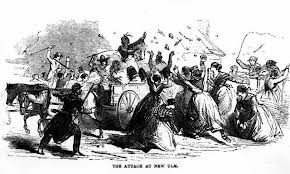
The first week in November, Thiele’s company was detailed to accompany the prisoners’ convoy to South Bend. On Sunday, November 8, 1862, Thiele was assigned to the inner ring of soldiers marching alongside the wagons of Dakota prisoners. Outside New Ulm, in Brown County, Minnesota, the convoy was attacked by enraged German citizens.

New Ulm Attack

The U.S. soldiers escorting the prisoners were armed and had been warned of impending mob violence. Yet soldiers like Thiele did not adequately protect the prisoners. Chained to one another and seated in the beds of wagons, the Dakota men were helpless to defend themselves from the stones and clubs hurled at them. Two Dakota men later died of injuries sustained in the attack.

Did the commanders in charge of the prisoners’ convoy make Co. E the inner ring of guards because they knew they would be passing through German-speaking territory? Or was it a blunder to make Germans like Thiele the Dakota prisoners’s last line of defense? New Ulm plotters put civilian women up front in the attack. Did they guess a German soldier might hesitate to bayonet a German woman?

And what of Thiele himself, who had vowed to kill any Indian who crossed his path? Did Thiele vigorously defend the prisoners in the wagon under his charge?

Seven weeks later, on December 26, 1862, two of the three warriors Thiele testified against were among the 38 men simultaneously executed at Mankato.

*****

Historians have recently pointed out that it is remarkable that the Dakotas who surrendered in 1862 did not come to more harm at the hand’s of Sibley’s soldiers, speculating that officers in charge managed to impose an impressive level of military discipline on their settler-soldier subordinates.

The problem is that the body of evidence continues to evolve. Those of us alive and working today did not inherit this emerging body of soldier-settler stories from previous historians; we’ve only been actively asking these questions for six years. Someday, most of the relevant sources will have been identified and will have given up the stories they contain. But we’re not there yet.

In the mean time, Dakota oral stories of abuse –more extensive than we have yet archivally documented –point the way.

Consider those Dakota stories, along with stories like Louis Thiele’s, this way: If today the government recruited 9/11 survivors and assigned them to guard duty at Guantanamo and subsequently, the prisoners there alleged abuse at the hands of their guards, we would not protest, “These allegations are simply political rhetoric; U.S. soldiers would never behave with such unprofessionalism.”

Rather, we would be asking, “Why in the world did they assign 9/11 survivors to guard duty at Guantanamo Bay?”

That is what we did to Dakota people who surrendered in 1862.

*****

Louis Thiele returned to Renville County in 1864, remarried, and had a reputation for having an “erratic” temper. Thiele lived at least until 1897.

Posted in Indian Hating | 1 Comment

John Moredock, Indian Hater

Grand Tower

1856 engraving of Grand Tower on the upper Mississippi River, near where John Moredock’s family was killed. Today, Grand Tower, by highway, is about two hours south of St. Louis, MO.

Early in the series on the Dakota Commemorative March, I promised to return to the story of Louis Thiele, the German Renville County farmer who knelt over the bodies of his wife and child (killed on August 18, 1862) and vowed he’d kill Indians for the rest of his life. The next chapter in Thiele’s story is coming up.

If Thiele’s promise sounds like something out of a frontier romance, it is. Fictional characters who swore revenge on Native people to avenge the death of loved ones killed by warriors are so ubiquitous that literati have given them a name: Indian Haters.

The tragedy is that the Indian Haters made famous by novelists like Herman Melville (in The Confidence Man1857) were inspired by real-life Indian Haters like Col.  John Moredock, and Abraham Lincoln’s uncle, Mordecai. For Mordecai Lincoln’s story, I refer you to Scott W. Berg’s 38 Nooses.

I want you to hear John Moredock’s story straight from the pen of the historian who made it famous. Why? Stories like Thiele’s can be misinterpreted in two directions. Over interpretation would imagine the Dakota War of 1862 birthed hundreds of Indian Haters. Under-interpretation would dismiss Thiele’s story as the experience of a single, deranged, man.

In historian James Hall’s matter-of-fact retelling, the story of John Moredock takes us inside 19th century American culture, where Indian Hating was viewed as an extreme, if understandable, reaction to personal tragedy.

Headings and paragraphing below are mine.

Hall Puts Moredock’s Story in Cultural Context

“If we attempt to reason on this subject, we must reason with a due regard to facts, and to the known principles of human nature. Is it to be wondered at, that a man should fear and detest an Indian, who has been always accustomed to hear him described only as a midnight prowler, watching to murder the mother as she bends over her helpless children, and tearing, with hellish malignity, the babe from the maternal breast? Is it strange, that he whose mother has fallen under the savage tomahawk, or whose father has died a lingering death at the stake, surrounded by yelling fiends in human shape, should indulge the passion of revenge towards the perpetrators of such atrocities?

They know the story only as it was told to them. They have only heard one side, and that with all the exaggerations of fear, sorrow, indignation and resentment. They have heard it from the tongue of a father, or from the lips of a mother, or a sister, accompanied with all the particularity which the tale could receive from the vivid impressions of an eye-witness, and with all the eloquence of deeply awakened feeling. They have heard it perhaps at a time when the war-whoop still sounded in the distance, when the rifle still was kept in preparation, and the cabin door was carefully secured with each returning night.

Such are some of the feelings, and of the facts, which operate upon the inhabitants of our frontiers. The impressions which we have described are handed down from generation to generation, and remain in full force long after all danger from the savages has ceased, and all intercourse with them been discontinued.

The Story of John Moredock, Indian Hater

Besides that general antipathy which pervades the whole community under such circumstances, there have been many instances of individuals who, in consequence of some personal wrong, have vowed eternal hatred to the whole Indian race, and have devoted nearly all of their lives to the fulfillment of a vast scheme of vengeance. A familiar instance is before us in the life of a gentleman, who was known to the writer of this article, and whose history we have often heard repeated by those who were intimately conversant with all the events.

We allude to the late Colonel John Moredock, who was a member of the territorial legislature of Illinois, a distinguished militia officer, and a men universally known and respected by the early settlers of that region. We are surprised that the writer of a sketch of the early history of Illinois, which we published some months ago, should have omitted the name of this gentleman, and some others, who were famed for deeds of hardihood, while he has dwelt upon the actions of persons who were comparatively insignificant.

John Moredock was the son of a woman who was married several times, and was as often widowed by the tomahawk of the savage. Her husbands had been pioneers, and with them she had wandered from one territory to another, living always on the frontier. She was at last left a widow, at Vincennes, with a large family of children, and was induced to join a party about to remove to Illinois, to which region a few American families had then recently removed. On the eastern side of Illinois there were no settlements of whites; on the shore of the Mississippi a few spots were occupied by the French; and it was now that our own backwoodsmen began to turn their eyes to this delightful country, and determined to settle in the vicinity of the French villages.

Mrs. Moredock and her friends embarked at Vincennes in boats, with the intention of descending the Wabash and Ohio rivers, and ascending the Mississippi. They proceeded in safety until they reached the Grand Tower on the Mississippi, where, owing to the difficulty of the navigation for ascending boats, it became necessary for the boatmen to land, and drag their vessels round a rocky point, which was swept by a violent current. Here a party of Indians, lying in wait, rushed upon them, and murdered the whole party. Mrs. Moredock was among the victims, and all her children, except John, who was proceeding with another party.

John Moredock was just entering upon the years of manhood, when he was thus left in a strange land, the sole survivor of his race. He resolved upon executing vengeance, and immediately took measures to discover the actual perpetrators of the massacre. It was ascertained that the outrage was committed by a party of twenty or thirty Indians, belonging to different tribes, who had formed themselves into a lawless predatory band. Moredock watched the motions of this band for more than a year, before an opportunity suitable for his purpose occurred. At length he learned, that they were hunting on the Missouri side of the river, nearly opposite to the recent settlements of the Americans. He raised a party of young men and pursued them; but that time they escaped.

Shortly after, he sought them at the head of another party, and had the good fortune to discover them one evening, on an island, whither they had retired to encamp the more securely for the night. Moredock and his friends, about equal in numbers to the Indians, waited until the dead of night, and then landed upon the island, turning adrift their own canoes and those of the enemy, and determined to sacrifice their own lives, or to exterminate the savage band. They were completely successful. Three only of the Indians escaped, by throwing themselves into the river; the rest were slain, while the whites lost not a man.

But Moredock was not satisfied while one of the murderers of his mother remained. He had learned to recognize the names and persons of the three that had escaped, and these he pursued with secret, but untiring diligence, until they all fell by his own hand. Nor was he yet satisfied. He had now become a hunter and a warrior. He was a square-built, muscular man, of remarkable strength and activity. In athletic sports he had few equals; few men would willingly have encountered him in single combat. He was a man of determined courage, and great coolness and steadiness of purpose. He was expert in the use of the rifle and other weapons; and was complete master of those wonderful and numberless expedients by which the woodsman subsists in the forest, pursues the footsteps of an enemy with unerring sagacity, or conceals himself and his design from the discovery of a watchful foe.

He had resolved never to spare an Indian, and though he made no boast of this determination, and seldom avowed it, it became the ruling passion of his life. He thought it praiseworthy to kill an Indian; and would roam through the forest silently and alone, for days and weeks, with this single purpose. A solitary red man, who was so unfortunate as to meet him in the woods, was sure to become his victim; if he encountered a party of the enemy, he would either secretly pursue their footsteps until an opportunity for striking a blow occurred, or, if discovered, would elude them by his superior skill. He died about four years ago, an old man, and it is supposed never in his life failed to embrace an opportunity to kill a savage.

The reader must not infer, from this description, that Colonel Moredock was unsocial, ferocious, or by nature cruel. On the contrary, he was a man of warm feelings, and excellent disposition. At home he was like other men, conducting a large farm with industry and success, and gaining the good will of all his neighbours by his popular manners and benevolent deportment. He was cheerful, convivial, and hospitable; and no man in the territory was more generally known, or more universally respected. He was an officer in the ranging service during the war of 1813-14, and acquitted himself with credit; and was afterwards elected to the command of the militia of his county, at a time when such an office was honourable, because it imposed responsibility, and required the exertion of military skill. Colonel Moredock was a member of the legislative council of the territory of Illinois, and at the formation of the state government, was spoken of as a candidate for the office of governor, but refused to permit his name to be used.

There are many cases to be found on the frontier, parallel to that just stated, in which individuals have persevered through life, in the indulgence of a resentment founded either on a personal wrong suffered by the party, or a hatred inherited through successive generations, and perhaps more frequently on a combination of these causes.”

Hall’s book, Sketches of History, Life, and Manners in the West, Vol. 2 was published in Philadelphia in 1835. The book was an American classic, about two decades old at the time Melville discovered Moredock on its pages, and about 27 years old when the Dakota War of 1862 spawned Indian Haters like Louis Thiele.

Excerpt from Hall, p. 79-82

Image Credit: Le Voyage en Papier via Google Images.

Posted in Indian Hating | 2 Comments

BECHS Concludes Meagher Lied

On November 16, 2012 the Blue Earth County (MN) Historical Society quietly rendered its verdict in a ten-month long investigation into a timber in its collection long-reputed to be a beam from the 1862 scaffold that executed 38 Dakota men simultaneously at Mankato, Blue Earth County, December 26, 1862.

Their conclusion: John F. Meagher, the beam’s donor, lied.

BECHS updated its Timber page with written findings and a 17 minute video explaining that conclusion, including using this 2012 scale model of the 1862 scaffold to illustrate its engineering:

model gallows

While BECHS has brought its internal investigation to a close, outside scholars continue to advance the story. The Winter 2013 edition of Minnesota’s Heritage magazine, available in January 2013, contains an article by Dale Blanshan, “The Surviving Piece of the Mankato Scaffold.”

The editors provide this preview:*

“Blanshan uses forensic evidence to argue that the timber can only be a piece of the 1862 scaffold. The author deciphered a confusing assortment of mortices and cut marks to support his claim. He correctly identifies corner brace mortices as used in 19th century timber framing, ties the spacing of the rope notches to the width of a military file (one man in ranks), and draws attention to old rot on only one side of the beam indicating that it had lain on damp soil for many years when reused as a warehouse flooring support. Some doubts remain based on an incomplete chain of provenance after 1862, but the chances that a conspiracy of fraud produced such a convincing artifact – and prior to 1927 – seem highly unlikely.”

My conclusion: Blue Earth County Historical Society volunteers turned up new evidence and BECHS is to be commended for adding these findings to the public record. Unfortunately, almost all the new evidence comes from newspaper sources, which are not reliable when used as BECHS does, as authoritative evidence.

Further, the video shows BECHS interpreting this weak evidence in a single direction: to disprove Meagher’s claim. BECHS has ‘proved’ its own hypothesis, which makes its conclusions questionable. The same findings would be received  differently if they were the result of an independent investigation.

For me, the questions of the legitimacy of Meagher’s claim for his scaffolding beam are still as unsettled as when I began writing about it back in February.

Click on the “Blue Earth County Beam” link in the Categories list in the right sidebar to follow the contested story of this “relic” of 1862. Like the scale model of the scaffold, the story is portrait in miniature of the ongoing contest to control the history of 1862 and its many meanings.

*****

For the record:

  • I am a member of the Blue Earth County Historical Society and agreed to be part of an independent investigation of the beam if it materialized.
  • Blanshan contacted me early in his investigation but I have not read the article.
  • *Update 2/11/13 The managing editor of Minnesota’s Heritage has asked to clarify that it is not her magazine’s policy to provide previews and that the summary I quoted reflects the opinion of the editor who answered my request to verify that the magazine was publishing the article, not the opinion of the editorial board. The Winter 2013, No. 7 edition of Minnesota’s Heritage also contains a counterpoint article to Blanshan’s written by the Blue Earth County Historical Society.
Posted in Blue Earth County Beam, Commemorating Controversy | Leave a comment