A Woman vs. the Patronage System, 1881

chester-a-arthur-patronage

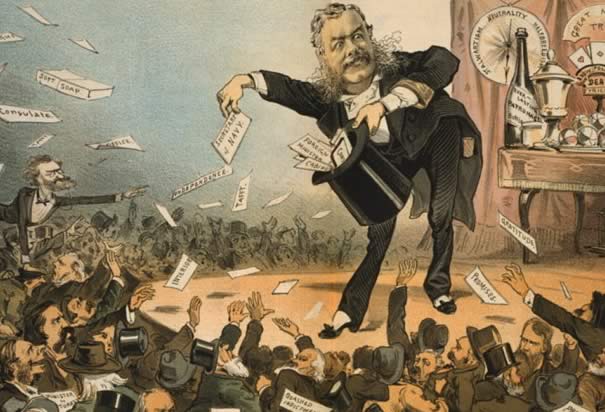
Chester A. Arthur freely dispenses the patronage favors –jobs and contracts –said to have won his appointment as Vice President. Arthur became President upon the death of  James Garfield (by assassination) six weeks after Caroline McMaster wrote the last letter below. Cartoon by Joseph Keppler.

*****

I’ve been spending my research time in the MHS Institutional Archives culling sources for my next book. As always, I encounter stray stories like this one, just too interesting to leave shut up in cool, dark storage.

I don’t know who Caroline McMaster was, but she had immaculate handwriting and the sense to number the pages in her letters –neither feature common in 19th-century correspondence. And, it seems by the time she wrote J. Fletcher Williams in August of 1881, asking about the prospects of getting a job as a clerk in state government in Minnesota, Caroline was a widow.

On February 4, 1880, Caroline wrote to Williams,  in St. Paul, Minnesota, from her home in Norwell, Michigan:

Sir,

I received this week’s Lake City papers to-day, containing the resolutions adopted by the Editorial Association on the death of my husband. Were the eulogies of Messrs. Leonard, Hall and Cartle reported, and if so, in what paper? I would be very much pleased to read them. With much sincere thanks to the association for their kind words, I am,

Caroline B. McMaster

There are no copies of correspondence outgoing from MHS in this period, so we don’t know if Williams was able to provide the memorials Caroline sought. But a year and a half later,  she wrote Williams again, this time inquiring about the prospects of a woman like herself finding a job in Minnesota.

Norwell, Michigan August 1st 1881

Dear Sir,

I would like to learn something of the number of clerks in the employment of the state government at St. Paul, which department has most, and if there are any ladies. I do not know where to look for the information I ask, but it occurred to me, that from your having been a long time engaged about the capitol, as Secretary of the Historical Society, you would undoubtedly know about it. So, although you are a stranger to me, knowing my husband counted you among his friends, I come to you with my query.

It is hardly necessary for me to explain the object of my inquiry, for you will readily guess it. I have had some thought of trying for a clerkship in one of the departments, if the nominations and elections turn out favorably this fall, but have not decided to do so, and cannot until I know more of the positions to be had, and if there are any attainable by ladies. I am encouraged to push my investigations from the fact that of about one hundred and fifty appointed officers and clerks, regularly employed by the Michigan state government at Lansing, a large number are women, and, possibly similar conditions prevail in St. Paul.

This field –office-seeking –is not an attractive one, especially for any lady, and only the strongest incentives could bring one to even think of entering it. But I can hope to meet the demands of the future for myself and child only through my own efforts, and the rebuffs and discouragements I have met in other directions, have led me to look upon the possibilities of this.

I have had considerable business experience  understand book-keeping, am a good accountant, and write rapidly. So I trust any qualifications for this work are not wholly wanting.

My letter has outgrown the proportions I intended for it when I began writing. Please excuse its length.

Trusting my request for information may find favor in your sight, I am, Yours Respectfully,

Caroline B. McMaster

It seems that Williams reported that Caroline’s prospects were dim for out-competing male office-seekers in Minnesota. She replied:

Norwell, Michigan August 8, 1881

Dear Sir,

I merely write to-day to express my thanks for your kind and prompt reply to my letter of the 2nd [sic] inst. It settles my mind most emphatically on the question involved. One sentence alone would have done it. With only six or eight places to be had I shall most assuredly not enter the lists for official employment. I had no thought of doing so in any event until after the fall elections and not then unless there was to be some decided change in the state administration.

Again thanking you for kindness, I am, Yours Respectfully,

Caroline B. McMaster

*****

Image credit: The Library of Congress via history.com

Posted in Patronage System, Women's History | Leave a comment

Legacy of Courage and Freedom: May 22

I’ve been waiting to hear a date for Lynne Jackson’s appearance hosted by the Bloomington Human Rights Commission and am happy to pass on the invitation below. Lynne is the founder of the Dred Scott Heritage Foundation and is Scott’s great-great-granddaughter. The event is free and open to the public (reservation requested). I hope to see you there!

Dred-Scott-May-22-2013-1

Dred-Scott-May-22-2013-2

Posted in abolition of slavery, Dred Scott | Leave a comment

“We do not loan books &c,” 1885

P1976.48.53

Postcard c. 1910. ” ‘The Joy Ride’ at the California Alligator Farm, Los Angeles, California.” The Carter Museum of American Art via Google Images.

*****

Before I return J. Fletcher Williams to the file cabinet, I want to share a piece of Minnesota Historical Society arcana: a memo Williams wrote to his temporary assistant in 1885, instructing him in the essentials of running the Library. Those 19th-century newspapers we use, now microfilmed, began their MHS career rolled up in a pigeon hole.

“Instructions for K. A. Guibeau, employed as assistant while I was in California, Dec. 1885” by J. Fletcher Williams, Librarian and Secretary of the Minnesota Historical Society.[1]

Memoranda

See that the daily papers come regularly, and place them in the pigeon holes. At the end of the week, take them out, and lay them in the back room.

All packages, books, &c, coming by mail, should be laid away without removing the wrappers, in some place where no one can meddle with it.

Open all letters. If there seems to be anything urgent, you had better remail it to me, directed to Los Angeles. Or, reply to it on a postal card, stating that I am absent.

Wind the clock every Monday morning.

If express packages or freight, come, take a receipt for the amounts paid the carrier, on the blanks used for that purpose.

We do not loan books &c. Any one is welcome to use them here, as long as is desired.

If any trouble occurs with the steam pipes or plumbing, or gas, report it to George Morton, engineer.

Anything unusual or unexpected, of importance, occurring, you had better report it to Mr. Upham, 1st National Bank, and ask his advice.

The annual meeting is on Jan. 11 at 7 1/2 p.m. J.B. Chaney will act as Sec.

It would be well to keep a memorandum of everything that would probably be important for me to know about, so that on my return I can attend to it, if necessary.

*****

[1] Minnesota Historical Society Institutional Archives, MHS.

Posted in J. Fletcher Williams, Minnesota Historical Society | 1 Comment

“Mister, haint you got no books about pirates, or killing Injuns?”

The Minnesota Historical Society’s Library-Museum in 1892

I’ve been reading the annual and biennial reports of the Minnesota Historical Society in the 19th century, most of them written by the Society’s stalwart Secretary/Librarian, J. Fletcher Williams.

Williams had a high opinion of the Library he carefully developed over the three decades of his tenure, between 1863 and 1893. In William’s first report, composed in 1868, the library as a subject consumed a few paragraphs of space, including a table of acquisition statistics. But toward the end of Williams’s tenure, his library essays grew to occupy a dozen pages of his report to the Legislature –a document approved by the MHS Executive Council and distributed the Society’s members and friends.

This is a story from Williams’ last report, written in 1892 for presentation to the Legislature in 1893. The story drew me in at first because it reminded me of modern-day Saturdays in the Library during History Day season, or of trying to think in the galleries on a school field trip day.

But then I got to Williams punchline.

Second-State-Capitol-1874-A

The setting of this story: ca. 1892 in the Minnesota Historical Society’s hall on the lower level of the State Capitol building in St. Paul (above, 1874), where the “museum” consisted of five glass-fronted display cases squeezed in between the floor-to-ceiling bookcases in the Library/Reading Room.

This story appears under the heading, “The Library as a School of Instruction.”

“The value of the public library, as a school of instruction, is not sufficiently recognized, except perhaps by those who, like the librarians themselves, see instances of it so often…. Young people should receive every encouragement possible and all facilities given them which are within reach. Many of our readers are young people, and the librarian gives them every possible chance to get any information which they may seem to be in search of, although their ideas of what they really want are often quite vague and unformed. But everything available is always pleasantly put at their disposal, as freely as if they were the most important persons in the realm.

Our museum, although quite limited in variety, and poorly lighted, attracts large numbers of the younger classes of our community. The noise of the ingress and egress of these juvenile visitors, their loud talk, and the fact that they invariably leave the door open, either in going or coming, and especially so in the coldest weather, does not altogether make their patronage desirable, to some of our readers [library patrons], but we bear it patiently, because our duty is to do so, for the benefit of the class mentioned, whose wants are so great, and whose advantages, so limited. The throwing open of museums and art galleries for free visitation of the street juvenile class is one of the most useful works of the education of the untutored young. It may awaken in the mind of some untutored youth, new and valuable ideas, which may be the germ of great development.

A careless boy, looking at the objects of a museum or at a painting, may have thoughts awakened in his mind, which may lead the way to his becoming one of the greatest scientists in the country…. One cannot look at the groups of children attracted by the objects in our museum, without seeing the possibility, and the duty, of trying to lead their attention into the paths of study and investigation. They are an interesting study. Every little knot of these future citizens shows their varied origin. The flaxen-haired descendants of the North-men, the dark-skinned children of Italy, the well-known types of the Teutonic, the Slavic, even the African races, are all mingled in every group which seeks the privilege of seeing the curiosities in a public museum. Still, we have not now the facilities, nor the room, to make our exhibition of historical and archaeological curiosities so free as we would wish. In the larger and better edifice, arranged for those purposes, which we hope to have in the future, that can all be provided for.

But now we can only sow the seed of our coming harvest. The street gamin who cautiously approaches the desk of the Librarian with the inquiry: “Mister, haint you got no books about pirates, or killing Injuns?” is only stepping in the first tracks towards the evolution into a reader and scholar. This feeble desire to read, to learn, must be encouraged, and supplied with the proper food. Libraries and museums here find their real work.”

The inspiration for the “gamin’s” request isn’t hard to imagine. The cases in the MNHS Library in 1892 featured sabers and guns dating from the Revolutionary War onward. A child might associate them with pirates, whether or not Williams had acquired books about them.

As to “killing Injuns,” the child had to look no further than the cabinet containing scalp and arm bones of Dakota chief Little Crow. (Little Crow’s skull was not accessioned and added to the tableau until 1896.) Yes: Mister Williams had plenty of books to offer on that subject.

*****

Source: [J. Fletcher Williams] Seventh Biennial Report of the Minnesota Historical Society, St. Paul to the Legislature of Minnesota, Session of 1893. Minneapolis: Harrison & Smith, 1892, p. 33-34.

Image: Detail from 1874 Andreas Map of St. Paul

Posted in Commemorating Controversy, J. Fletcher Williams, Little Crow, Minnesota Historical Society | Leave a comment

Great Week for Books

While I’ve been researching a set of Dakota War artifacts that disappeared 150 years ago, great book news has been unfolding.

DSCN4844

Catherine Denial gave A Thrilling Narrative a great review in the Spring 2013 edition of Minnesota History. Denial concludes, “Taken together the introductions, annotations, and foreword by Gwen Westerman transform Mary Renville’s captivity narrative from an apparently ‘simple’ statement of experience into a deeply contextualized historical document. The book will be of interest to anyone curious about the nuances and complexities of the U.S. Dakota War and particularly to scholars of that era.”

On the heels of that review, we celebrated the Twin-Cities launch of Northern Slave, Black Dakota with a party April 3 at Bachman’s Lyndale –the site of the perennial field where Walt’s grandfather first told him the story of the death of his great-great-grandfather, Ernst Deitrich, in the U.S. Dakota War of 1862.  That story sparked Walt’s quest to learn the story of Joseph Godfrey. If you missed it, Claude Peck covered the event for the StarTribune. The highlight of the evening for me was visiting with the descendants of Joseph Godfrey who drove in from the Dakotas and Iowa to join us. It was an honor to meet you!

Then, wrapping up the past week on a great note, the e-book versions of Northern Slave, Black Dakota appeared on the web. The e-book has all the features of the first edition, including the maps and illustrations, with a hyperlinked index. I love to read real books. But hyper-linked e-books are winning me over for their ease of navigation!

The Large Print edition of Northern Slave, Black Dakota also just appeared and Braille and DAISY Talking Book editions will soon be here :).

Posted in A Thrilling Narrative, accessible publishing, Pond Dakota Press | Leave a comment

“The Scourge of God” Against German “Infidels”

Pierz statue

A Native American lays down his gun at the feet of Father Francis Xavier (Franz) Pierz and literally looks up to him, while a man of European descent, kneeling, doffs his hat and bows his head. Statue unveiled in 1952, the centennial of the beginning of Pierz’s ministry in Minnesota. Artist unidentified. St. Cloud Hospital. St. Cloud, Minnesota.

*****

The stories we understand about our past have been shaped by the fierce competition between church denominations to claim the souls of people living in Minnesota –and the equal intolerance of those who felt no need for the proffered forms of salvation.

Early missionary churchmen were some of our most prolific recorders of written history. Financially supported by the faithful members of their denomination “back home” (the Eastern United States, Switzerland, Austria), missionaries regularly wrote letters and reports chronicling their successes, writing inspirationally about their struggles –in general, offering wholesome, instructive stories that reflected well on their denomination.

This was perfectly acceptable in the mid-19th century, when religion (Christian forms, at least) was tolerated, and sometimes even viewed as necessary, in the public sphere. But by the early twentieth century, publicly practiced religion fell out of vogue with historians. People were no less religious. But religion was increasingly viewed as a personal, private matter.

Historians who practiced a faith system –not all did –worked hard to personify “objectivity” by keeping their own religious worldview out of the story.  This clinical, scientific approach to history led them to discount the degree to which worldview infected  the cleric-authored documents which they increasingly interpreted as straight-forward, documentary chronicles of early Minnesota.

It was a peculiar logic:  Remain wary of politicians’ assertions. But men of God answered to a higher power; they could not lie.

Could they?

Perhaps not deliberately. But churchmen were not immune to the human condition. Just like the rest of us, they filtered everything through their own, unique rose-colored glasses.

Today, one of the more promising tasks ahead of us in history is unfiltering the a-religious, “objective” story we’ve inherited from the historians of the early 20th century. There are thousands of documents to read and reinterpret in light of the worldview the author brought to the record.

As Lois Glewwe observed in her comment on “The Prison is One Great School,” 19th century churchmen are obliging subjects. They left us lots of evidence about their worldview in their letters. Which brings me to this one.

On April 15, 1863, Father Franz Pierz sat down to write a report to his superiors at the Vienna-based Board of Directors of the Leopold Foundation for Aiding Catholic Missions in America. He opened with a long, positive, report on Catholic missions among the Ojibwe in northern Minnesota in which he credited himself with averting an August 1862 rebellion planned by an Ojibwe chief, Hole-in-the-Day. Then, in the space of one page, Pierz indicted Protestant missionaries, German Turners, and Dakota warriors alike for the 1862 Dakota War.

“Although the Sioux Indians who live in West Minnesota do not belong to my mission jurisdiction and therefore, should not be prominent in my mission report, I wish to mention in passing their barbarous cruelties in their revolutionary fury in order to further a kinder judgment of conditions.

This poor, wild Indian nation, which has been under the negligent care of Protestant missionaries, who are well payed, for 10 years, has not received any religious training at all. Therefore, the destructive rebellion, which was brought about by similar causes as the one among the Ojibways, raged with such barbarous cruelties against the white inhabitants that only one cry, namely to destroy them, was heard; for they had committed robbery and murder against the white settlers in several regions, but especially had they practiced great atrocities in the German town of New Ulm and had murdered practically all the inhabitants and burned the town.

But this seems to be the just punishment of God, in that the entire population were faithless [anti]Catholics, who wished to hear nothing about a priest; nothing about a church. They built their houses of the new town mainly on Sundays in defiance of religion and lived in great dissoluteness. These bold infidels performed an atrocious scandal on Corpus Christi last year, in that they led in procession through the town an ox festively decorated with flowers, ribbons, and wreaths, and honored the same in 4 places with music, dancing, and licentiousness, and finally burned the ox as a sacrifice. Therefore, one does not need to wonder that the wild Sioux with their unheard cruelties had to serve a deserved punishment to New Ulm just as, at one time, the heathen Romans served as the scourge of God in the destruction of Jerusalem. May this warning example open the eyes and hearts of the unbelieving to penitence, but strengthen the believing ones in the fear of God, the just judge.”

The objects of Pierz’s diatribe –Protestants, Turners, and Dakotas –were not above dissing Catholics, and each other, in the name of faith. Like Pierz, the evidence of their worldview lies pretty close to the surface if we simply go back and read the stories they recorded in context.

Does it make a difference in how we understand history? Yes. Unless you’re convinced that Hole-in-the-Day really laid down his gun at Pierz’s word and the Germans of New Ulm worshiped sacred cows.

*****

For more on Pierz, who is widely credited with attracting German Catholic settlement in central Minnesota, including bringing in the Benedictine order, see Sister Grace MacDonald’s biography, “Father Francis Pierz, Missionary” published by the Minnesota Historical Society in 1929. MacDonald quotes at length Pierz’s version of the Hole-in-the-Day story.

For more about the predjudice against “heathen” New Ulmers, see ….And So Were German Turners.

Posted in Doing Historical Research, German Turners, Religion | Leave a comment

“Sins of Omission, Changes of Heart”

Grave Injustice

I love it when a new book starts out with promise. Last night I started Kathleen Fine-Dare’s Grave Injustice: The American Indian Repatriation Movement and NAGPRA (University of Nebraska Press, 2002). When I encountered this in the Preface, I had the feeling Fine-Dare had been reading over my shoulder recently:

Sins of Omission, Changes of Heart

In the Andes of Ecuador thousands of people speak an indigenous language called Quichua or rumi shimi, the “tongue of human beings,” that has a past-tense verb ending, -shkakarka, which tells the listener that the act under discussion happened in the past but the speaker only just now realized it. The fact that this particular past-tense ending does not occur in English does not mean, however, that we are incapable of grasping its sense. Each of us is capable of understanding something that occurred before we learned of it, or having known of it, we only [now] grasp its meaning. We can revisit history and admit our inability (or our refusal) to see what might have happened that we missed, so as to better understand its effects and meaning in the present. And as it was something in the present that shook up our memory, it is only fitting that we shake up the past for different meanings.

I am a college professor and have had students become very uncomfortable and even angry when they learn about post-contact American Indian history. Their feelings are engendered less because the events provoke such strong emotions (often guilt) in and of themselves than the fact they feel they were either lied to outright or by omission regarding history they had a right to know as Americans. The reasons the “sins of omission” were made are deeply connected to the realities they cover up. Having been lied to, we can do little but lie in return, however innocently, unless we start learning what actually happened and attempt to turn our defensive guilt into -shkakarka realizations linked to education, lawmaking, reparations, and just plain old rethinking. (Kathleen Fine-Dare, Grave Injustice, xvi-xvii)

Posted in Books, NAGPRA | 1 Comment

150 Years Ago: “The Prison Is One Great School”

Slate & Pencil

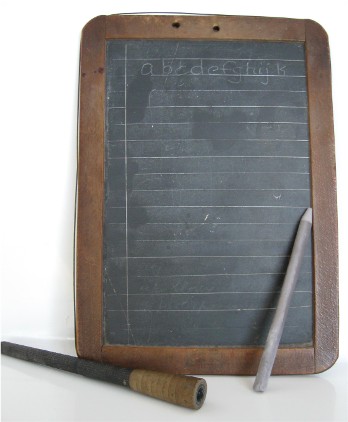
Slate, slate pencil, and holder, 19th century

Saint Anthony Min March 26, 1863

Rev. S. B. Treat

My Dear Brother

Your letter of the 12th inst. I have read since my reaching home last evening. I had a hard stage-trip down from Mankato, the roads being what people along the Valley call “awful.” At Mankato I spent ten days, including two Sabbaths, pretty much all the time in the prison. My visit there was made not quite so pleasant to myself by a severe attack of neuralgia which troubled me every day, being most severe in the forenoons, and it still holds its grip of me. It is something new to me — I only remember one attack like it before and that was more than twenty years ago.

But nothwithstanding this “thorn in the flesh” I was enabled to hold daily one or more religious services in the prison and to give some personal supervision to their educational operations.

The prison is one great school. Go in almost any time of day and you will see from ten to twenty groups or circles, reading. These circles average about ten persons and each one usually has its teacher. [Margin note: “The teachers were those who had been taught at our mission schools.”] All over the prison too you will see men engaged in writing, some with slate and pencil and others with pen and paper. There are a few old men, I should judge about twenty, who have not attempted to learn. Over all the rest Education now sits as monarch. In a separate building there are about eighteen Dakota women and a half dozen men and boys who cook and care for the prisoners. Education has entered their apartments and some women sixty years of age are learning to read. In fact it is a perfect mania. The edition of 400 of the little spelling book that I improvised and had printed at St. Paul, is nearly exhausted, and the demand is not satisfied either at Mankato or at Fort Snelling.

The Monday after I reached Mankato I distributed more than a hundred of these A.B.C. books. Many of those at Mankato are now on beyond that and want other books. Fortunately we have on hand more than 100 copies of Bunyan, which I took out of a cache on our way up to Camp Release last September. They had been buried for preservation by John B. Renville and others. They come now, in a good place, and John Bunyan will I trust experience another and more significant liberation among these Dakotas. [1]

During the last week I gave away 3/4 of a ream of writing paper, besides making various little purchases for such as had some money sent them by their friends at Fort Snelling. And I brought down with me over four hundred letters written to their friends. Major J. R. Brown, who has special charge of the prisoners, and who is required to read all the correspondence, remarked that the number of new writers increases every week wonderfully. Of course their are many who do not yet write their own letters. But the minape on de wakage, “I have written this with mine own hand,” occurs in a great many of the letters, and is the index of a feeling which an Indian possesses to as great a perfection as any other man.

On leaving this subject of education I may give expression to what is my firm belief that already as much progress has been made by the Indians at Mankato and Fort Snelling, during the present winter, in reading and writing, as was made during the twenty-six or more years preceding, by all the Dakotas.

Major Bradley of the 7th Minnesota, who by the way was one of the Military Commission, proposes as a theory, that “the best way to civilize Indians is to imprison them.” [2]

The question of polygamy was likely to give us trouble, and I was charged by a member of the Session at Fort Snelling to have the whole thing settled at Mankato. Before they were baptized at Mankato those who had two wives entered into an agreement to put one away. But the thing had not been done and so in one case at the camp we made both the wives promise to be willing to be put away. At our prayer meeting in the prison Monday night I stated the whole subject to them and told them I wanted them to have a meeting the next day and finish up what they had begun. So on Tuesday we had quite a lengthy meeting, during which nineteen men were called upon to select which of the two they would retain. They answered very promptly in all cases except two who were Mr. Hinman’s men –this is Episcopalians. A record was made of the whole proceedings which I am to make known in the camp. [3]

As Dr. [Thomas S.] Williamson had been desirous of visiting Fort Snelling he took advantage of my being at Mankato to do so. But before he thought of that we had talked of having the Lord’s supper [communion] administered in the prison. And although he could not be there the Doctor was desirous that the ordinance should be administered.

It was to me somewhat a trying duty. I look upon the whole work there as a wonderful reformation. I look upon it also as a most amazing work of God’s Spirit. But I don’t look upon those men as Dr. Williamson does –and as Mr. G.H. Pond evidently does from his several letters in the Evangelist, as but very few of them guilty of participation in the murders and outrages on the frontier. I wish I could so regard them. But I cannot. Having passed through those weeks of trials my point of observation is different from theirs, and my convictions are different also. I could not but feel that there were many bloody hands there, and how could I give into such hands the emblems of the body and blood of a dying Christ? But I remembered that they could not be more guilty than the crucifiers and murderers to whom Peter preached on the day of Pentacost, and Dakota sinners could be washing in Christ’s blood as well as Jerusalem sinners. [4]

On Sabbath morning Robert Hopkins with three others whom I had indicated the day before, seated the multitude in rows as well as they could for the convenience of making the distribution. During the whole time of two hours and a half the assembly was very quiet and orderly. We were disturbed once by the changing of the guards. There were two old men also, who when they came to take the bread, thought it proper to make a declaration of their faith. One of them expressed the hope that the Lord would loose that chain which was on his ankles. As a counter remark I said immediately that Satan’s chain was more galling than that.

That remark of the old man’s will probably give a clue to the answer of one of your questions.[5] I have no doubt that it is a mixed multitude and that they have been influenced by mixed motives. But I think that no religious man can go there and spend a week in the prison, attend their meetings morning and evening (and noon sometimes) and hear them sing and talk and pray and come away feeling that there is not a great deal of reality there. Doubtless there is much that is specious or that will not be enduring. It would be strange if it were all genuine. If those men live to get out and are again with their friends some of them will not be true to their profession of religion. But they will none of them go back to where they were before. Their own superstition is dashed to pieces like a potter’s vessel.

A paper was handed to me signed by thirty men saying that they wished their medicine bags and war spears to be handed to me if they had not been already disposed of.

But I shall weary you with this subject. I must tell you however that out of the little money sent up to them by their friends they gave me in the prison $16.40 for the New Hymn Book.

For this I have now raised about $75. A part of it I have sent on. The Tract Society (N.Y.) make us a donation of $50. The books (500) are now ready to be sent out. The cost of the edition is $173.85. A balance will remain against us of $48.85. I wish you would ask the Committee to wipe that out for us. The whole edition will be needed immediately. If Indians were not so much below par in Minnesota I could easily raise that among white people. But as it is I don’t wish to try it.

….In looking over my letter I see that I have not said one thing which I meant to have said and which perhaps you know –that Robert Hopkins is now the ruling spirit in that prison — he is the spiritual bishop there.

I don’t of course displace Dr. Williamson who has labored indefatigably this winter in season, and out of season I was going to say, but it has been in season all the time. But Hopkins has been there all the time and he stands spiritually, as he does physically, head and shoulders taller than the rest of the people.

The Sabbath I was there with Dr. Williamson, Hopkins handed us a paper which expressed their united determination to pray for three things –viz a country, a sanctuary, and religious teachers in that land. And in almost every prayer that I listened to afterwards these three things were asked for. And I don’t know that it is wrong for them to so pray.

Yours very truly

S. R. Riggs

[1] John Bunyan wrote Pilgrim’s Progress while in prison for 12 years, convicted of convening a church service outside the state-sponsored Church of England. Pilgrim’s Progress was published in English in 1678 and in a Dakota language translation by Stephen Riggs, Cante Techa: Mahpiya Ekta Oicimani Ya, published by the American Tract Society in in 1858.

[2] Bradley served on the Military Commission that tried Dakota men for participation in the Dakota War of 1862. The Commission rendered death sentences in the majority of the cases, but Abraham Lincoln authorized the execution of only 38. On March 26,1863, the day Riggs wrote this letter, the remainder of the Dakota men Bradley and his fellow commissioners had condemned to death, along with those given prison sentences and those who had been acquitted, were all in prison in Mankato awaiting news of whether Lincoln would authorize more executions.

[3] A holograph list of men and the name of the wife they “put away” dated March 17, 1863 is in box 3 of the Oahe Mission Collection at the Center for Western Studies at Augustana College, Sioux Falls, SD.

[4] Riggs alludes to a story in the Bible, the books of Acts, chapter 2, verses 14-41 in which the apostle Peter, influenced by the Holy Spirit, preached repentance and the forgiveness of sins to men who had supported Jesus’ crucifixion.

[5] In March 12, 1863 letter to Riggs, Treat observed, “The reports from Mankato, & now Fort Snelling, are certainly surprising & most gratifying. I read Mr. G.H. Pond’s letter in the Evangelist with wonder. I do not suppose that all who rec’d baptism are true converts; but that so many, with such antecedents  should be willing to make public profession of their faith in Christ, is a strange thing. Can there be any sinister design in all this? Do some hope, in this way, to escape hanging?” Northwest Missions Manuscripts, MHS.

Image Credit: historicconnections.webs.com

Posted in Literacy in the Dakota language, Mankato Prison | 1 Comment

1862 Letters From Dakota Men Condemned to be Executed

36Dakota Star Tribune

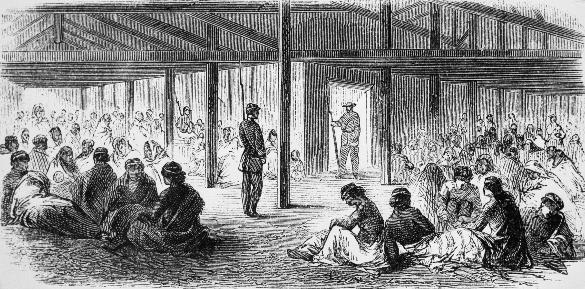
Artist’s depiction of the main Dakota prison at Mankato, MN in 1862

Today, translations of five letters written by condemned Dakota men came to hand. The letters are dated December 25, 1862, the day before the executions. The version I found is an English translation made by Dr. Thomas S. Williamson and transmitted to his superiors at the headquarters of the American Board of Commissioners for Foreign Missions on January 29, 1863.

These letters are new to me and I’ve added the text of each to that man’s e-file in the 1862 Dakota War Trials series. That file includes the page images, as well as a transcription of, his 1862 trial transcript, the execution opinion rendered by the lawyers President Lincoln ordered to re-examine the case, and his published death-row commentary on his participation in the war. That file is linked in each man’s name below.

The text in italics is an explanatory note added by Williamson. The selection of these five letters (assuming each of the condemned men had the opportunity to write or dictate a last letter to his kin) likely dictated by Williamson’s choice of audience, the mission board that employed him.  All five letters speak positively of Christianity.

A note at the bottom of the last page of this manuscript reads: “Letters of Dakotas executed at Mankato Decr 26 ’62 to their relatives dictated shortly before their execution. These men had been opposers of Christianity till the time of their imprisonment.”

The spelling of Dakota names in these letters is poor, reflecting the typist who reproduced these copies from the original holographs for the Northwest Missions Manuscripts Collection at MHS, where I found them as transcriptions.

*****

Tatemima to his wife December 25, 1862

My wife

Now you have been a member of the church for many winters. You know that I did not murder any person and so I thought I should see you again, but now I shall soon die. I wish you to think much of the Great God. My mind is now upon him and I think I shall soon go to him. I shall walk in the path of the son of the Great God. I wish you also to walk in it and so you will see me again. Command your three children who are with you to pray very much to the Great God.

My nephews and all my nieces all pray to the Great God. I think I shall now soon be happy in his house so pray much that you may see me there.

Tate Mima, Round Wind

This man was convicted of participating in the murders and sentenced to be hung on the testimony or two small German boys who doubtless mistook him for another man. I never believed him guilty because my son in law in his flight saw him and spoke to him and was completely in his power and yet was not molested by him, though at the time neither of them recognized the other, and a week after the massacre going to some of the deserted houses he found a little girl about five years old almost starved to death took her home and had her carefully nursed till she got well, and was restored with the other captives. Yet I fully expected he would be executed with the others as he did himself, but the night before the execution a dispatch was received from the President countermanding the order for his execution, which however was not made known either to himself or me till after the others were executed. T.S.W.

*****

“Gray Whirlwind to his sister, the wife of Big Eagle” [Haypeedan or Wamne omne hota] December 25, 1862

My younger sister you are very dear to me, but you will see me no more. My younger sister do not grieve because I must die. I think I shall be happy, because I trust in the son of the Great God, therefore do not grieve on my account.

Wamniomni hota

*****

Sounding Walker [Snamani] to his wife & children December 25, 1862

My wife you will see me no more. My children I greatly desire you to attend the schools taught by the missionaries.

Snamani

*****

Passing Wind [?] to His Arrow December 25, 1862

My younger brother I wish you to pray to the Great God and listen to the missionaries. My sisters I wish you to do the same.

Tatehihohe

[The name does not match any of the men executed in 1862. I am suggesting case #279 only as a hypothesis and am open to suggestions. CRZ.]

*****

Coming Voice to Half Metal Woman December 25, 1862

Now I am about to die trusting in the Great God. I wish you also to regard and trust him. I love you and you are very dear to me.

Hotaninku

Image Credit: “36Dakota” http://www.startribune.com

Posted in 1862 Dakota War trials | Leave a comment

The Gardner Art Heist: Solved?

Gardner Art Heist Cover

I first encountered the story of the 1990 theft of masterworks from Boston’s Isabella Stewart Gardener Museum two decades after the paintings disappeared, in the “Carrie” stack of my personal bibliophile-shopper (my mom), who flagged Ulrich Boser’s The Gardner Heist: The True Story of the World’s Largest Art Theft (Harper, 2009) as a book that might drag me out of the 19th century.

According to a March 19, 2013 article in the Boston Globe, “In a stunning twist in a case that had frustrated investigators for decades, federal law enforcement officials said today that they had identified the people who stole $500 million worth of masterworks in a daring heist from the Isabella Stewart Gardner Museum in 1990.” (full story)

I don’t remember enough of the details of Boser’s investigation to recall if his deductions matched those announced yesterday by the FBI. But I enjoyed Boser’s biographical sketch of Isabella Stewart Gardner and his reconstruction of the theft.

A 23 years-long investigation that finally yields answers is my kind of story :).

Posted in Uncategorized | Leave a comment