Walt Bachman Interview

In 2011, Walt Bachman approached the Pond Dakota Heritage Society about the gift of the manuscript that became Northern Slave, Black Dakota: The Life and Times of Joseph Godfrey.

Publishing has been part of the Pond Dakota charter since the Society’s inception and several of us on the board had watched the manuscript develop over a decade. So for objectivity, we sought external reviews from two well-known historians: Rhoda Gilman, author of Henry Hastings Sibley: Divided Heart and Stand Up! The Story of Minnesota’s Protest Tradition
and Mary Lethert Wingerd, author Claiming the City: Politics, Faith and the Power of Place in St. Paul, co-author of American City: A Rank and File History of Minneapolis, and most recently, author of the award-winning North Country: The Making of Minnesota.
With enthusiastic recommendations from both Gilman and Wingerd, the Pond Dakota board moved ahead.

Two Legacy Grants later, Northern Slave, Black Dakota will be officially released March 1, 2013. Thanks to Legacy funding and Bachman’s outright gift of the manuscript, the Pond Dakota Heritage Society will retain all the profits to further its public history mission.

After three years on the Pond Dakota Heritage Society board I am stepping down at the end of 2012 to help manage Pond Dakota Press for the Society. So with my publishing cap on, I am pleased to introduce you to Walt Bachman, the author of Northern Slave, Black Dakota: The Life and Times of Joseph Godfrey.

Zeman: Walt, how did you, a retired lawyer living in New York City, become interested in the Dakota War?

Bachman: I was born in Minnesota and practiced law there for 22 years.  I trace my obsession with researching and writing history to two events: a family story my grandfather told to me when I was a teenager, and a visit to the Brown County Historical Society 16 years ago. Grandpa told the tale of the killing of his grandfather during the Dakota War, and he suggested that I go to New Ulm to learn more about him. I didn’t get around to heeding his suggestion for almost 30 years, and then my plan was simply to write a booklet for my family about the circumstances of our ancestor’s death in 1862.

Zeman: What did you find in New Ulm?

Bachman: On my initial visit, I learned that my great-great-grandfather, Ernst Dietrich, was one of the first settlers of New Ulm, and that he had been killed under unique circumstances. On August 18, 1862, Dietrich was a leader of a civilian recruiting party that was trying to enlist local farm boys to join the Union army. His flag-waving group, traveling in wagons, happened to be visiting Milford, a hamlet six miles west of New Ulm, on the very day the war started. The recruiters were all men, and their brass instruments glinting in the sun and their flag led Dakota warriors to believe they were white soldiers. In fact, they were unarmed. The warriors ambushed them on the outskirts of Milford. Dietrich and three other men were killed. Today, a roadside monument marks the site.

But it was an emergency dispatch I found in the files of the Brown County Historical Society that really captivated me.  It was written to Governor Ramsey the night of August 18 and told of the killings at Milford, claiming that the Dakota attackers who killed Dietrich were led by “a Negro man.” Neither my Grandpa nor anyone else in my family had ever told me that part of the story, and I immediately wondered how this black man came to be daubed in war paint and fighting with the Dakotas.

Zeman: So you’ve written the biography of a man who was alleged to have killed your great-great grandfather? Isn’t that a bit unusual?

Bachman:   Yes, it is unusual, but any bias would have shown itself as hostility towards Godfrey, and any reader of my book will see that is not my interpretation of his life. I soon concluded that Godfrey neither led the Dakotas who killed Dietrich nor pulled the trigger that led to his death.   I don’t know of any other sympathetic biography –which this is –written by a descendant of the subject’s alleged victim.

Zeman: I remember when Alan Woolworth first told you to call me. I said something like, “Good luck. But Godfrey is so obscure I doubt you’ll find enough material to write a book.” Obviously my prediction was wrong! How did you uncover this story?

Bachman: I did a lot of painstaking research using original records at The National Archives, the Minnesota Historical Society, and other libraries in the U.S. and Canada. The research phase for the book took me about 10 years. But I also benefited from the help of many other Dakota War scholars, including you. I spread the word that I was interested in anything related to Godfrey and early African-American history in the region, and quite a few scholars passed along invaluable tips and sources that contributed enormously to the book.

Zeman: The feeling is mutual. You’ve made yourself part of local research community despite living in New York by sharing sources. You have easier access to the National Archives than we do and you’ve come up with some great stuff that I, for one, hadn’t found yet.

Tell me more about the Joseph Godfrey you discovered. I don’t think anyone is inclined to view him with sympathy.

Bachman: You know, that’s interesting because Godfrey was the only participant in the war who has come to be reviled by both whites and Dakotas. The fact that he was, and to some extent still is, everybody’s favorite scapegoat tells us a lot about racial prejudice and the less-than-candid ways the war has been represented.  By both sides. I hope that his story intrigues people to go back to the Dakota War histories and ask what those authors were trying to conceal by turning Godfrey into a scapegoat. His biography also helps debunk some of the more misleading claims still being made the war, for example, about the nature of the military tribunal trials of Dakotas after the war.

Zeman: None of the Dakota War histories says that Godfrey was a slave. Was that part of the story difficult to research?

Bachman: Yes, it was especially hard to reconstruct Godfrey’s life before 1862. But, using a wide variety of sources, I discovered that he was born into slavery in Minnesota after his mother was brought there as the slave of an army officer. Late in adolescence, Godfrey fled from an abusive Minnesota master and sought sanctuary among the Dakotas. The presence of a home-grown fugitive slave in Minnesota is something no other history even hints at. Godfrey’s full story reveals a lot we’ve never known about African-American and slavery history in Free states.

Zeman: I have the answers to this question sitting on my shelf. But people reading might not know this is not your first book.

Bachman: My first book, Law v. Life, came out in 1995. It was a series of personal essays about the realities of life as an American trial lawyer.  It was well-reviewed and went through a second edition.  I’ve also published a couple of book chapters and a few articles relating to the Dakota War, but the Godfrey biography will be my first history book.

Zeman: What’s next on your research and writing schedule?

Bachman: I’m working on a book about the story behind Godfrey’s story: how the U.S. army’s policies and practices spread slavery across America. I’ve gathered tens of thousands of records documenting the use of enslaved servants by army officers, and they reveal the army’s crucial role in bringing slavery to places like Minnesota. Slavery was illegal there under federal law, but that did not stop many officers from importing slaves to Fort Snelling and elsewhere in Minnesota. Officers did the same thing in Free states and territories across the U.S.   And a surprising number of northern officers, many of whom became Union generals during the Civil War, were once slaveholders.

Zeman: What do you do when you’re not working on history?

Bachman: My wife and I love to travel both in the U.S. and abroad. And we lead a full cultural life in New York, attending many plays, concerts, and lectures. I also love spending time with our five children and six grandchildren, who are scattered around the country in New York, Wisconsin, Minnesota, and New Mexico.

Zeman: Tell us when Northern Slave, Black Dakota will be available?

Bachman: The official release date is March 1, 2013. The book will be available in e-book form, hardcover, and alternate print formats like large print and Braille.

Zeman: One last thing. Your publisher told me you’re coming to Minnesota for Black History Month in February 2013? (laughs)

Bachman: You would know! Yes. The Bloomington Human Rights Commission is co-sponsoring a presentation on Sunday, February 24, 2013 from 2-4 PM at the Creekside Community Center in Bloomington.  My subject is, “Northern Slaves: How the U.S. Army Brought Slavery to Minnesota.” I know you’re optimistic we’ll have advance copies for sale and signing.

Zeman: We’re working on it!

Posted in 1862 Dakota War trials, Books, Joseph Godfrey, Pond Dakota Press, Slavery in Free states, Walt Bachman | Tagged , | 6 Comments

The Dakota Prisoners’ Caregivers

Real life is never as cut and dried as histories make it seem. The stories of the Dakota Women’s March to Fort Snelling, and of the Prisoners’ March to South Bend in November 1862 are great examples.

Although the majority of the Dakota women who surrendered in 1862 were taken to Fort Snelling, some Dakota women were sent with the prisoners to South Bend, then to Mankato, and finally on to Davenport in 1863.

This means some Dakota families today carry stories from grandmothers who shared many of the prisoners’ experiences, while others carry stories from grandmothers who were interned at Fort Snelling. Both groups were subject to the overt race hatred that prevailed in Minnesota in 1862-63.

It is not surprising that Dakota oral history sometimes conflates the two groups, reporting that the women and children were marched through New Ulm along with the prisoners, then, were marched on to Fort Snelling.  Other Dakota stories hold that the condemned men were marched to Fort Snelling along with their families, where every fourth man was arbitrarily selected out for execution. These stories say the selected men with their families were marched to Mankato  –again, placing women and children in Mankato as witnesses to the executions.

Further confusing matters is the fact that General Pope first ordered that very scenario: all the Dakota captives were to be delivered to Fort Snelling where the condemned men would be executed. Then Pope changed his order, directing the men condemned by the military commission be separated out and sent to Mankato, while the remaining captives be sent to Fort Snelling.

But practical concerns dictated an in-the-field modification of Pope’s order. The prisoners were kept in chains. Chained, they could not cook for themselves or tend to the sick and injured in their midst. Further, the prisoners were not allowed knives, awls, sewing needles or anything else that could be used as a weapon against their captors.

The prisoners needed others to take care of them. So twenty Dakota men and women –and a small, but unknown number of their young children –who would have been sent to Fort Snelling were not. Instead, they were detailed as caregivers to the prisoners: water-haulers, nurses, cooks, laundresses, and sent with the prisoners to Mankato.

These prison caregivers were caught in the attack on the prisoners outside New Ulm. They were subject to the attempts to lynch the prisoners in South Bend and Mankato. Most of the caregivers were and Dakota women at Mankato complained to Sibley that the white soldiers guarding the prisoners troubled them in their tipis at night. They would have watched the 38 march to their deaths.

We know the names of these Dakota caregivers:

6. Thomas Renville

7. “Hoak-in-yan”

 8. Akipa Renville

9. Red Iron     

10. Winuna Renville  

11. “Wasu-na-win”

12. “Maza-yo-hom-ni-win”

13. “Cecile Tami-ye”  

14. “Taga-maga”

 15. “Pe-ya-at-ke-win”           

16. “An-e-ki-ya-win” 

17. “Eci-ti-win”

18. “Wakan-hde-ze-win”

19. “Wa-kan-ka”        

20. “I-ye-ton-ka-win”

21.  “Ta-maza-waste-te”

22. “Wan-du-ka-tok-ca-win”

23. “Wan-kan-moni-win”

24. “An-apu-pte-win”

25. “Ta-wi-ya-ku”

 26. “Maza-mde-ca-win”

The numbers preceding each name are as given in “Report of Maj. J. R. Brown and Capt. G.D. Redfield List of Persons Employed and of Prisoners.” This PDF transcription reproduces the first two pages of the document dated December 31, 1862, including the job each person was assigned.

The first 5 names on the list are white (and French) men. I did not transcribe the last section of the report referred to in the title, “…and of Prisoners” because the prisoners are listed only by number, not name.

Walt Bachman found this document in the National Archives and shared it with Lois Glewwe, who used it in her 2008 essay on the attack on the prisoners outside New Ulm in Trails of Tears. Walt also shared it with me, and with his permission, I am posting my transcription to make the names more widely available.

Posted in Dakota Commemorative March, Primary Sources | 18 Comments

Universal Access to History

Having my first book appear in print has definitely been a highlight of my year. But today I’m even more proud of having a hand in bringing another book into print in universally accessible forms: Walt Bachman’s Northern Slave, Black Dakota: The Life and Times of Joseph Godfrey (forthcoming from Pond Dakota Press March 1, 2013)

It has been an asset to have recently gone through the traditional book production process with the University of Nebraska Press for A Thrilling Narrative. Thanks to two Legacy Grants from the State of Minnesota, Pond Dakota Press has hired several of the same professionals to produce Northern Slave, Black Dakota.

Northern Slave, Black Dakota promises to be a beautiful book, and an important contribution to the history of slavery in the U.S. in Free states and territories, as well as on the U.S. Dakota war trials of 1862. Bachman himself will tell you more about the book in an interview I will post later this week.

Thanks to Legacy Grant funding, Pond Dakota Press has been able to aim from the beginning to publish books like Northern Slave, Black Dakota in non-traditional formats that will be accessible for readers who have visual impairment or reading disabilities like dyslexia. As the parent of a child with visual impairment, I can’t help but be an advocate for universal access to history.

Books are more accessible now than they used to be. In October 2012, a court rendered a decision in a major lawsuit that will allow the Hathi Trust, via Google Books, to continue digitizing books held by University libraries. Digitization makes books searchable electronically, and in limited circumstances, grants electronic access to people who cannot access traditionally printed text. But unless a copyright is in the public domain, publishers opt in to Hathi digitization and although much better than nothing, the Hathi process does not yield a universally accessible book.

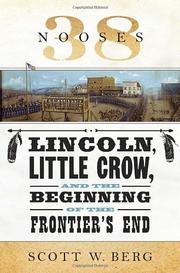
The trend toward simultaneously releasing an e-book alongside a physical book, as Pantheon is doing with Scott W. Berg’s 38 Nooses is also a step in the right direction. Producing ebooks is not simply about catering to market demand. It is also about equity for people who live with visual impairment. The 38 Nooses ebook will be accessible to a wider range of readers than the print version, like those who will choose to read at a larger font size or change the background-foreground contrast using an e-reader.

But universally accessible ebooks –books that can be effortlessly  navigated by the visually impaired –are not yet the norm. As a friend who is blind told me when I shared that Pond Dakota is simultaneously releasing Northern Slave, Black Dakota in EPUB 3, “Wow! I’ll be able to read a new book? Books are old by the time they appear in a form I can read.”

EPUB 3

Producing a book in the EPUB 3 format (a leading-edge platform for e-reading devices) makes books universally accessible. In an April 28, 2012 review of a free ebook, Accessible EPUB 3: Best Practices for Creating Universally Usable Content by Matt Garrish (O’Reily Media, 2012), Thad McIlroy writes:

“One of the triumphs of EPUB 3 is that it now makes it realistically practical for every publisher to make their ebooks accessible to readers with disabilities as part of a regular ebook creation workflow.

Matt Garrish hints at something I’d like to make explicit: ebooks that are built for accessibility are well-made ebooks: more likely to delight ALL of your customers because of their thoughtful and careful construction.” 

My access point for information on advances in accessible publishing technology is the Daisy Consortium, which publishes a monthly digest-style newsletter, The Daisy Planet, and hosts a Marketplace to connect authors and publishers with vendors who use EPUB 3.

Read How You Want

Thanks to our Legacy Grants, Pond Dakota Press has awarded the ebook conversion and distribution contracts for Northern Slave, Black Dakota to a Daisy Consortium vendor, Read How You Want. Besides using EPUB 3 & MOBI, Read How You Want makes books available on-demand in other accessible formats including Braille, Large Print and phonetic print.

For a glimpse at the future of accessible publishing, watch this interview with Read How You Want founder, Chris Stephen.

Even better, the Read How You Want conversion bid was significantly less than the bids of vendors who use the older forms of EPUB, despite the formatting complexity of Northern Slave, Black Dakota (the end notes).

In the big picture, technological advancements make the 21st century a great time to be living with a visual impairment. I feel privileged that Pond Dakota Press is part of the change toward universal access to books for readers of all abilities.

*****

The Minnesota Historical and Cultural Grants Program, or Legacy Grants, has been made possible by the Arts and Cultural Heritage Fund through the vote of Minnesotans on November 4, 2008.
Posted in accessible publishing, Pond Dakota Press, Walt Bachman | Tagged | Leave a comment

Big Blue Friday: Two MHS Exhibits with Kids

Black Friday at MHS

If you know me IRL, you know I’d rather do almost anything than mall-shop –ever, much less on Black Friday. Thursday night, my husband was the hero who took our twelve-year-old daughter shopping at 9:30 PM. They came home and crashed at 12:30 AM, happy.

Hope, my eight-year-old, woke me up at 5:11 AM for a date with her sister, Mercy, age nine.

When it was light enough to see this (it was dark when we arrived), the girls dubbed our adventure, “Big Blue Friday.”

What is Big Blue Friday?  As I took this picture at 5:45 AM at the Minnesota History Center in St. Paul, a stranger behind me observed, “What does this tell you about Minnesota? How cool is this? All these people got up before dawn to bring their kids to do history!”

Incentives made it fun: knit caps for the first 200 children (they were gone by 6:00 AM) and the prospect of a free MHS Memberships for the first 50 families. (Word is that the memberships went to people the staff found waiting outside when they arrived at 5:00 AM!)

Other inducements: Free breakfast. Free parking. Shopping bags with coupons (some with cool prizes). A 25% off shopping voucher Both gift shops open at 6:00 AM.

AND the opening of the new Then, Now, Wow exhibit.

So after breakfast, my girls and I headed up to the third floor. We didn’t know all the exhibits would be open until we got upstairs. When we saw the crowd headed for Then, Now, Wow we veered off to the Dakota War of 1862 gallery.

U.S. Dakota War of 1862

My twelve-year-old daughter and I have been through the 1862 exhibit twice. But I have not made a point of taking my eight- and nine-year-old daughters. When I saw everyone headed the other way, I thought: The gallery will be almost empty; we’ll have space to talk about it.

The exhibit was not designed for children and the mood in the 1862 gallery every time I’ve been it has been thoughtful, somber.

But Friday morning there was space for the girls to touch the words, to sit down on the floor by Mary Schwandt’s bullet-riddled skirt for a conversation. A woman I did not know, a mom with children, joined us. Unlike me, the other mom was not tongue-tied at 6:15 AM, when my eight-year-old asked:

“Mom, what do you mean Mary was a ‘captive’? What’s that? Did Dakotas steal her? Why didn’t her mom and dad stop them?”

While I was trying to frame up an answer, the other mom spoke up.

“Yes. She was stolen. Being  ‘captive’ is when somebody takes you. You don’t want to be taken but they don’t give you any choice. Her mom and dad couldn’t help her because they were dead.”

Well, I thought. You did not mention Dakota people at all or how or when Mary’s parents died. That was fast thinking. But I can’t let it go at that; losing parents is pretty real-life for some kids.

I pointed to this picture of Maggie Brass on the wall. “In Dakota, her name was Snana. Snana adopted Mary as her daughter.  Snana loved Mary and kept her safe until the war was over.” I could almost see the relief in a child’s eyes.

How crazy is this? I observed in my head. When we were editing the text I brought up the convention of using the name each person used for herself. So they nixed Holcombe’s ‘Snana’ and restored Maggie’s ‘Maggie Brass.’ But here I am telling her story to children and I’m using her Dakota name because without it she could be a white woman in braids. Children need to know she’s Dakota, too; “Dakotas” are not just the warriors who shot at Mary Schwandt.

The shooting came next. Gwen Westerman is right. The weapons in the exhibit are at child eye-level. My girls were confused by the time their tally reached one pistol and two rifles.

“So this was one of those wars where the white people killed the Indian people?” my daughter asked. “Did white people shoot the bullet holes in Mary’s skirt?”

In the exhibit, all the weapons belonged to white people.

How do you explain ‘war is hell’?? How do you explain how soldiers of every race compensate with hagiography?

“Yes. These are all weapons white men used to fight. Dakota men used weapons, too; the holes in Mary’s petticoat were made by bullets from a Dakota gun.   But Dakota people asked not to have anything that belonged to them on display. There are no Dakota weapons in this room.”

“So the white people kept these guns because they are special?” asked my little one who sleeps next to a curio cabinet of special things ranging from tiny purple teacups to sparkly rocks. “It was just an ordinary gun before?” she pressed. “But if you shoot it in a war it gets to be in a museum?”

“Pretty much,” I answered.

What else could I say? ‘We don’t curate objects; we curate stories.’ ??

By the time we reached the tombstones at the end of the 1862 exhibit, they were ready to camp out again and we finally got down to discussing the ‘Why‘s of the war.

Again, I was struck how different children are. The 1862 exhibit was developed for adults. So the ‘Why‘s of the story –the provocations and grievances –are presented up-front. But my girls cruised past the ‘Why‘s and didn’t pause until they got to the ‘What‘s of the war. They experienced the ‘What‘s via the 3-D objects, even processing 2-D words with their fingers. Only after my girls found out what happened did they begin pondering why.

We sat on the floor under Ellen McConnell’s tombstone and talked about making and breaking promises. About hunger. About anger and ways people express it.

Mercy summed up, “So Dakota people tried using their words. But nobody listened?” She was puzzled. “Why didn’t anybody listen? We’re supposed to listen. We’re supposed to help. We’re supposed to keep our promises.”

Hope couldn’t reduce her thoughts to the requested one word, but confined her words to one Post It: “War is interesting but something is hard to understand. But…hmm…too much killing.”

The bottom line really is pretty simple, isn’t it?

Then, Now, Wow

Then we headed across the hall. “Yeah!” Hope enthused. “I want to see George Washington’s teeth again!” Same gallery, different exhibit :).

Then, Now, Wow is the Children’s Museum meets MHS. This exhibit is a no-brainer: if you have children or grandchildren, GO! MHS under-billed it by not putting an exclamation point on “Wow!”

If you turn right inside the door, first-up is a fur-trade post exhibit. Go soon to touch new pelts.  I’ve chaperoned many a history field trip and I’ve ever handled beaver and otter that hasn’t been petted by thousands of children before of me. Wrap one around your hand, skin-side out and imagine the softness and warmth of a Dakota mitten.

Next up: an iron ore mine. If your child is sensitive to sound, you may want to skip the mine. A hard-surfaced room filled with children simultaneously operating drilling machines was a little much for Hope. But Then, Now, Wow is arranged so you can easily bypass the mine. Kids who read and follow instructions will enjoy the mine simulation.

As we emerged from the mine, we were drawn to this tipi in the center of the exhibit. Eighteen months ago I talked with the artist, Bobby Dues, while this tipi was still on the drawing board. It was fun to see how it turned out! I won’t show you what’s inside so you can enjoy it yourself. But don’t miss the sign above the door as you exit :).

Hope hesitated at the sight of boys hovering over what appeared to be a freshly killed bison. Then. Next, she watched the boys reach inside and pull out a pastel liver bearing a QR code. Now. Wow.

Hope tentatively tugged one of the bison’s hooves. It came off in her hand. She carried it to the QR scanner which announced that Dakota people used a bison hoof as a musical instrument like a tambourine.

Opposite the bison body is a display case holding models of objects made from parts of a real bison.

I could imagine a Dakota interpreter here talking about how then bison ranged into now‘s Minnesota and sacrificed themselves to keep the Oyate (people) fed, clothed, and sheltered; how Dakota people thanked the bison for his sacrifice and honored it by not wasting any parts; how the Dakota man who killed a bison did not keep it all but shared the bounty like the children were sharing. Bison is still the favorite meat of many Dakota people. But now they get it at the butcher or the grocery store.

In my imagination, the QR scanner spoke the word for the body part in Dakota, Dakota language day camp in the exhibit… My brain perseverated on language until the girls scanned the last of the bison’s parts and we moved on.

We next encountered a plow without oxen (kids power the plow and the ox yokes –without cooperation, none of the treadmills turn) and a sod house, perhaps the home of the plow’s owner.

On the other side of the sod house was the Soo Line train car, which might be more Now! with a special contribution from Bobby 🙂 .

To the left of the Soo Line car, the not-to-be-missed (we couldn’t find it at first) refurbished Grain Elevator/climber extravaganza.

To the right of the Soo Line car was a huge puzzle map of Minnesota. Kids arranged and rearranged the laminated cubes to complete the map. It was, to my surprise, a very popular activity. A dozen kids, most of whom did not know each other, cooperated to complete a task which, like plowing, was too big to do alone.

Next, we found an amazing street car where every window opened for a peek at what went on inside the building glimpsed from that window. Like the women in this photo might have taken the street car to work at this candy factory.

By the time we found this car to crank to life, our brains were numb from rising early and two exhibits worth of information-overload. The donut energy had worn off about the time we reached the QRed-bison.

In my twenty years of frequenting the History Center, it was the first time I ever saw the sunrise through the windows of the rotunda, much less watched it with my daughters.

We hope MHS repeats Big Blue Friday next year!

Even if they give it a more conventional name :).

Posted in Exhibits | Leave a comment

38 Nooses

Last summer, I had the pleasure of visiting with Scott W. Berg when he was in town to visit family. I was also happy to snare him for an appearance at the Pond House on August 12, 2012, where Scott, who teaches in the MFA program at George Mason University and writes for the Washington Post, gave us an insider’s look at writing history for a popular audience.

Scott agreed to an interview with me about his new book, 38 Nooses: Lincoln, Little Crow and the beginning of the Frontier’s End, being released by Random House/Pantheon in hardcover and e-editions December 4, 2012.

An excerpt of 38 Nooses is now available on the web, along with an advance review from Kirkus. It concludes:

“Throughout the sweeping narrative, Berg skillfully weaves in various perspectives, including that of Sarah Wakefield, a woman held captive by the Dakotas, and Bishop Henry Whipple, a paternalistic advocate for the Native people. Yet Berg’s greater accomplishment is his ability to overlap the little-known Dakota War with its far better known counterpart, the American Civil War. The author’s juxtaposition offers readers a contextual framework that provides unique insight into the era. For instance, just days after the mass execution, Lincoln issued the text for the Emancipation Proclamation, prompting curious readers to wonder: How does a country see fit to condemn one group of people to death and then, less than a week later, set another group free?”

It is about time we had a well-researched, highly readable book like Berg’s to put the Dakota War of 1862 in its national context and onto the national stage. I’m looking forward to reading 38 Nooses in it’s finished form!

Posted in Books, Scott W. Berg | Leave a comment

Hot Water, Part 2

“They were coming to the end of the town and they thought they were out of trouble. Then there was a big building at the end of the street. Someone threw hot, scalding water on them. The children were all burned and the old people, too.” –Maza Okiye Win. 

*****

 In Part 1 of this post, Dakota stories told us that children in at least three Dakota families, as adults, bore burn scars attributed to being doused with scalding water on the march from the Lower Sioux Agency to Fort Snelling in November, 1862.

Retribution, Not Defense 

Before moving on to the question of where the scalding happened, note that an important detail agrees in four of the five sources I quoted in Part I.

Sarah Purnell is the outlier. She recalled the women of South Bend boiled hot water “as a means of defense” on August 19 or 20, 1862 —during the opening days of the war, when hundreds settlers like Purnell’s family, in communities west of South Bend, were being killed by Dakota warriors.

No matter your opinion on whether the war’s opening attacks on unarmed civilians constituted “just” warfare, most of us would agree that given warning, people of any race would try to defend their families. For example, a few days after the citizens of South Bend stayed up all night to keep the kettles boiling, 100 miles west, at Hazlewood on the Upper Reservation, the Dakota Peace Coalition formed an armed Soldiers’ Lodge to defend their families from threatened attacks by Little Crow’s soldiers.

But don’t miss context of the other four stories. The Dakota stories likely date to Monday, November 10, 1862, and the soldiers’ stories date to Sunday, November 9, 1862. The military phase of the 1862 segment of the U.S. Dakota War had ended six weeks earlier when the Peace Coalition turned the settler captives over to Sibley at Camp Release on September 26, 1862.

So in the majority of extant stories, the water boiled to be poured on Dakota people was not prepared as a weapon of defense, but as a weapon of retribution.

“Historcal Truth” and a Hypothesis

Where were the Dakota women and children scalded with water hurled from upper story windows? This is not simply one of those “little details” popular historians like to jibe scholarly historians for caring to get right.

If we don’t hypothesize a location, then scour the documentary sources written by people in that place at that specific time, we will not be able to prove or disprove the hypothesis. In many cases, including this story, the information uncovered disproving a hypothesis can be as historically fruitful as proving it.

The activities of history are acts of discovery. Historians who submit their story-telling agendas to the rigors of the scholarly discovery process often find they were wrong. But every hypothesis shown to be wrong leads closer to historical truth of what actually may have happened.

“Historical truth” is a fairly narrow construct that answers factual questions like: Who? How Many? Where? When? And, sometimes, How? Other forms of truth can be more helpful in approaching questions like: Why? What did this mean then? What does this mean now?

So, with the intent of furthering historical inquiries into the “Where?” of this story, here’s the Henderson hypothesis: In November 1862, the Dakota women and children on the march to Fort Snelling were scalded with hot water as they passed through Henderson, Sibley County, Minnesota.

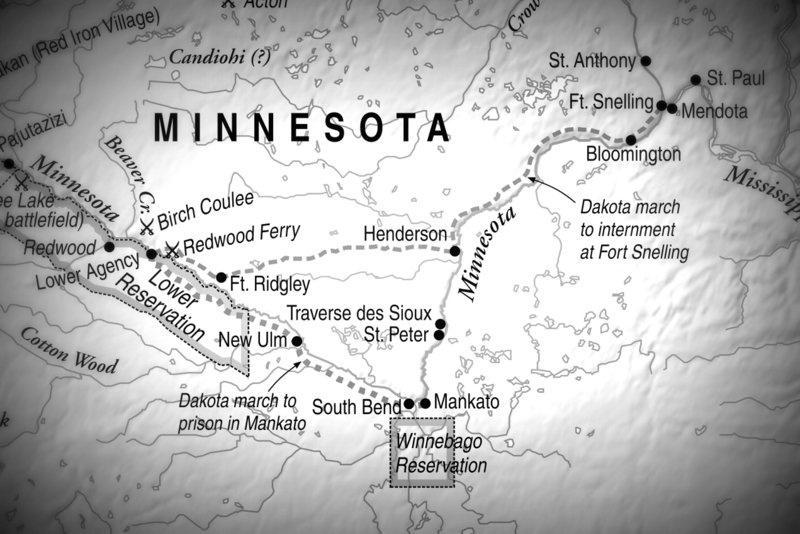
Digitally enhanced detail of the Dakota women’s and the Dakota prisoners’ November 1862 march routes from Map 3 in A Thrilling Narrative of Indian Captivity: Dispatches from the Dakota War (University of Nebraska Press, 2012).

 The Historic Women’s March

The Dakota women’s march group left the Lower Sioux Agency on the morning of November 7, 1862, crossed to the north bank of the Minnesota River at the Lower Sioux Agency, and spent the night in camp near Fort Ridgely.

The Dakota women and children for whom the “Women’s March” is named were not alone. They were accompanied by some Dakota men: those too elderly to have fought in the war; and by leaders of the Dakota Peace Coalition –mature men (generally over the age of 30, but not elderly) who had worked to bring the war to an end.

The whole group, numbering about 1,700 people, was guarded and escorted by about 200 Federal soldiers commanded by William R. Marshall. The convoy spent the next two days, November 8-9, 1862 walking east and camping at night, along an east-west wagon road, the Henderson-Fort Ridgely Trail. [1] Today, Minnesota State Route 19 approximates the Fort Ridgely to Henderson leg of the historic march route.

This historic route over which the women’s group were taken to Fort Snelling is confirmed by period primary sources including a claim dated November 10, 1862 for the purchase of ten bushels of corn and ten bushels of oats, “delivered to Wm. R. Marshall, Lieut. Col. 7th R. while transporting Indians and Soldiers from Fort Ridgely to Fort Snelling.” The claim was filed by Fred Greenhagen, whose farm was adjacent to the Henderson-Fort Ridgely trail, west of Henderson in Sibley County. [2]

On September 8, 1862, the second day of the march, an appeal appeared on the first page of the St. Paul Daily Press:

“We have been shown a private letter from Lieut. Col. Marshall, in which, after referring to the fact that Gen. Sibley has entrusted him with the removal  to Fort Snelling of those Indians who have been declared by court martial to be either friendly, or guiltless of the late massacre, with a considerable body of women and children. He earnestly deprecates any molestation, by the inhabitants of the Minnesota Valley. Reports of threats to this effect have reached him, and we urge his appeal that no attempt will be made to execute them.”[3]

Why Henderson?

The burn patterns reported in Dakota history –heads, backs, shoulders, arms –matches the oral history reports that scalding water was poured down upon them from a “big building.”[4]

Which locations on the historic women’s march route had “big” (possibly two-story) buildings? The Lower Sioux Agency is not an option. Before Dakota warriors set the Lower Agency on fire on August 18, 1862, there were a few two-story buildings in the town, like the boarding house and the Federal warehouse. But by November 1862, they were in ruins and the Lower Agency town was not inhabited.

The “big” buildings at Fort Ridgely like the barracks also do not fit the oral history descriptions of a town where citizens hurled cans, potatoes, sticks, and hot water. Further, there is no indication the women’s route passed through the Fort’s parade grounds, in range of its two-story buildings.

So the first two documented locations along the historic women’s march route, the Lower Sioux Agency and Fort Ridgely, don’t fit the stories told about the attack with boiling water.

In 1990, Elsie Cavender specifically identified New Ulm as the town where her grandmother, Maza Okiye Win, was assaulted. However, in a longer, earlier telling of Maza Okiye Win’s story, Elsie Cavender detailed the process by which she (Cavender) concluded the attack had occurred at New Ulm. Maza Okiye Win herself, Cavender reported, did not know the name of the town where she had been attacked.

This is not the only case where oral history has grafted in bits of information originating in written sources, in this case, incorporating a historical error.[5] So while New Ulm would have been the first town with “big” buildings from which hot water might have been hurled if the Dakota women’s convoy was on the south side of the Minnesota River, they were not. They were on the north side, perhaps 20 miles away on the Henderson-Fort Ridgely Road.

(An important exception are the small number of Dakota women and their young children who accompanied the prisoners to South Bend. These women and children might have been scalded at any place hot water is known to have been prepared for use against the Dakota prisoners, like at New Ulm. Their story will appear in a future post.)

So Henderson, not New Ulm, is the first Minnesota River valley town of any size the women’s convoy encountered. Marshall had heard threats of attempts to “execute” Dakotas in the women’s convoy once it left the depopulated prairie and reached the still-settled Minnesota River valley (where the larger towns east of New Ulm had not been evacuated).

Despite his public appeal for mercy on these innocent Dakota people, Marshall’s fears came true. The Dakota women’s convoy was attacked at Henderson. Sam Brown reported:

“I went along with Colonel Marshall’s detachment, the train measuring about four miles in length. At Henderson…we found the streets crowded with an angry and excited population, –cursing, shouting, crying. Men, women, and children, armed with guns, knives, clubs, and stones, rushed upon the Indians as the train was passing by and, before the soldiers could interfere and stop them, succeeded in pulling many of the old men and women, and even children from the wagons by the hair of the head and beating them,and otherwise inflicting injury upon the helpless and miserable creatures.

As Bad As Savages

I saw and enraged white woman rush up to one of the wagons and snatch a nursing babe from its mother’s breast and dash it violently on the ground. The soldiers instantly seized her and led, or rather dragged, the woman away and restored the papoose to its mother, limp and almost dead. Although the child was not killed outright, it died a few hours later. The body was quietly laid away in the crotch of a tree a few miles below Henderson and not far from Faxon. Here, soldiers did what they could to protect the people.”[6]

This attack at Henderson was also recounted by Gabriel Renville,  one of the principal men in the Peace Coalition’s Soldier’s Lodge, in a narrative dating to about 1863.[7] While neither Brown nor Renville mention scalding water in their stories, they were only two among more than 2,000 eyewitnesses and likely could not see what was happening blocks away at the other end of the convoy.

So we know from stories of the documented attack on the women’s convoy at Henderson that Marshall’s soldiers were taken by surprise. The outstanding question is whether hot water was among the weapons used by the citizens of Henderson against Dakota people on November 10, 1862.

Regardless of the location of the attack with boiling water, these stories of scalding significant enough to leave permanent scars leave us with a new factor to consider regarding the mortality rate among Dakota people during the following months of their internment at Fort Snelling. Some of them were recovering from burns significant enough to slough skin and thus were susceptible to infection.

Some Dakota children survived their burns and lived to tell their stories. How many others did not?

*****

[1] For chronologies of the women’s march, see Mary H. Bakeman and Alan R. Woolworth, “The Family Caravan,” in Trails of Tears: Minnesota’s Dakota Indian Exile Begins (Prairie Echoes, 2008), and p. 35 in Becky Weinberg’s May 2007 Cura grant report, The Dakota Women’s March, commissioned by Dakota historians.

[2] For details, see the sources cited in Note 1 above. Bakeman discovered the Greenhagen claim. A digital reproduction appears on p. 66 of Trails of Tears. Greenhagen’s farm is shown on the fold-out map of the historic woman’s march route in the same volume. Lisa Elbert, a participant in the Dakota Commemorative March, was the first to hypothesize the Henderson-Fort Ridgely Trail march route for the women’s group in her MA Thesis, “Tracing Their Footsteps: The Dakota Marches of 1862” (University of Minnesota, December 2005). Copy available at the Minnesota Historical Society.

[3] St. Paul Daily Press November 8, 1862 quoted in Bakeman and Woolworth essay in Trails of Tears, 61-62.

[4] For Dakota stories from the 1862 march and modern Dakota perspective on the Commemorative March including photos, see Waziyatawin Angela Wilson, editor, In the Footsteps of Our Ancestors: The Dakota Commemorative Marches of the 21st Century. St.Paul, MN: Living Justice Press 2006.

[5] I trace the process by which this mistake probably entered the oral history stream and why that belief is more resonant than the factual truth in, Carrie R. Zeman, “Through the Heart of New Ulm: The Persistence of Place in Stories of the 1862 Dakota Exile,” in Trails of Tears: Minnesota’s Dakota Indian Exile Begins (Prairie Echoes, 2008), 123-147.

[6] Brown, Samuel J.  In Captivity: the Experience, Privations and Dangers of Samuel J. Brown and Others While Prisoners of the Hostile Sioux during the Massacre and War of 1862. Washington D.C.: Government Printing Office, 1900. Edited reprint available in, Anderson, Gary Clayton and Alan R. Woolworth, eds. Through Dakota Eyes: narrative accounts of the Minnesota Indian War of 1862. St. Paul: Minnesota Historical Society Press, 1988.

[7] Renville, Gabriel. “Narrative Account of the Sioux massacre in Minnesota in 1862.” In The South Dakotan. 11 (November 1903): 4-17. Edited reprint available in Anderson and Woolworth, eds. Through Dakota Eyes.

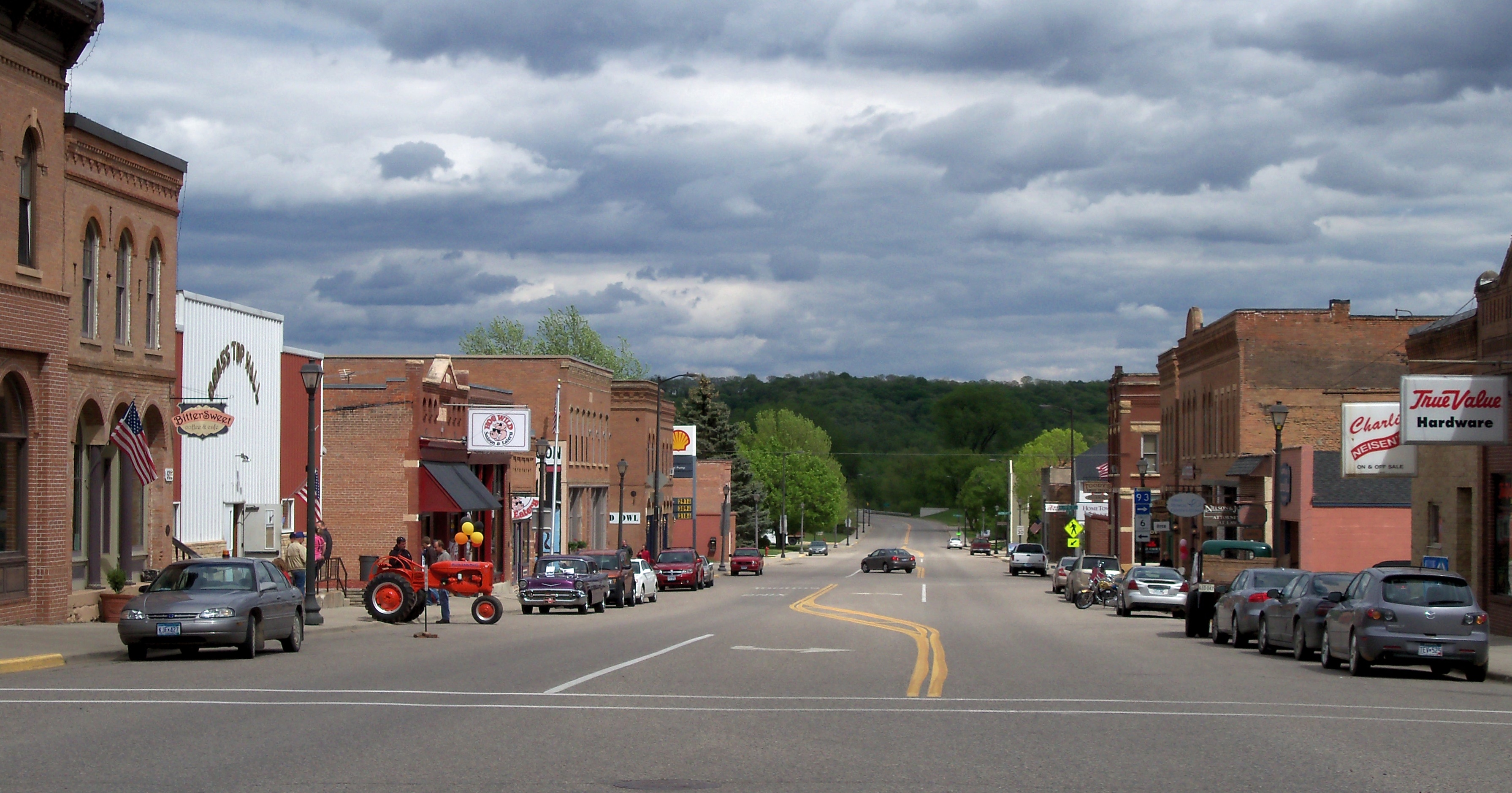
Image credits: BitterSweet Coffee and Gifts, Henderson, Minnesota, Google Images. Base Map 3 produced under a Legacy Grant, copyrighted 2012 by the Pond Dakota Heritage Society.

Posted in Dakota Commemorative March, Doing Historical Research, Indian Hating, Primary Sources, truth-telling | Tagged | Leave a comment

Hot Water

Henderson, Minnesota

Few stories tell us as much about the mindset of Minnesotans in the wake of the 1862 war. Or how little we know today about who we were then.

Dakota people told us first. It took years of listening to begin to hear parallel stories in white-authored sources.

In 1990, Elsie Cavender reported that her Grandmother, Maza Okiye Win, had told her: “When they came through New Ulm they threw cans, potatoes, and sticks. They went on through the town anyway. The old people were in the cart. They were coming to the end of the town and they thought they were out of trouble. Then there was a big building at the end of the street. Someone threw hot, scalding water on them. The children were all burned and the old people, too. As soon as they started to rub their arms the skin just peeled off. Their faces were like that, too. The children were all crying, even the old ladies started to cry, too. It was so hard it really hurt them but they went on.”[1]

In 2002 Kathryn Akipa reported: “Our great grandmother, Emma Ortley, Wasicu caze (English name), she was a little girl during that time. She was one of those children who had hot boiling water thrown down on her when she was walking. Her mother had been killed in the uprising. Her mother’s little sister was like a teenager, and she saved her little niece, Kunsi Emma. When they were force walked like that, she had hot water thrown on her. She remembered all of that. She healed from her wounds, but she still carried that scar.”[2]

These two stories sat in my file penciled “Hot Water” until 2006. That year, I added a Post-It reminding me of a new story a Dakota friend told me about a great-grandmother, a child on the 1862 march, who rarely talked about the burn scars on her shoulder and arm she kept hidden under dresses.

It wasn’t just that it was a third source. (Historians like to see a least three sources  supporting a story.) It was shared so-matter-of-factly: she had children, sang in choir, kept burn scars up her sleeves.

Those scars suggest that, as a little girl in 1862, she was walking on the right side of the convoy as they came down the hill into Henderson. Henderson is the city that best fits the historic route of the women’s march in 1862. And it best fits the descriptions passed down in Dakota families.

But where did the scalding water come from? In 2006 I dimly recalled reading that  hot water was used as a thermal weapon in distant places like ancient Greece.  But on Main Street in Minnesota in 1862?

Once the question registered, I began finding references to hot water in primary sources. None of them are linked to Henderson. But they support the claim at the heart of the Dakota stories: Minnesotans were prepared to douse Dakota people with boiling water, and some are said to have attempted it.

Sarah Purnell Montgomery wrote of the defense of South Bend (opposite Mankato on the south bank of the Minnesota River) on about August 19-20: “As a means of defense we filed every available tub and vessel with water drawn from a nearby well and laboriously carried up an outside stairway. Fires were kept burning during the night to keep the water boiling, and had the Indians attacked us, as they intended to do that night, they would have received from our windows showers of boiling water.”[3]

Two primary sources specifically associate boiling water with the attack on the prisoners’ wagon train as it passed outside New Ulm in 1862. On November 14, 1862 Charles “Herb” Watson, one of the soldiers on the prisoners’ march, wrote in a letter home, “…we did not come through town [New Ulm] because we heard that they were going to kill the Indians they had barrels of hot water to throw down on them to scauld [sic] them.”[4]

Thomas Watts, another soldier on the prisoner’s march recalled much later, in 1923: “Probably New Ulm harbored the greatest prejudice against the Indians of any town in Minnesota…. Instead of going through town, he veered off to the right about half a mile. When the people discovered this fact they came rushing out in great numbers to meet us, both men and women, armed with all conceivable weapons. The men carried guns, revolvers, pitchforks and scythes. The women were armed with brooms and mops, as well as the proverbial kettle of hot water. As soon as they found the caravan would not stop for them to pour hot water down the backs of those children of nature, they deposited their teakettles on the ground and commenced gathering stones in their aprons and bringing them to their male companions to throw at the fiends.”[5]

In part 2 of this post, I’ll explore why the town of Henderson, not New Ulm, is currently the leading candidate for the city where white people scalded Dakota women and children with water in 1862.

*****

[1] Cavender, Elsie “Eye Witness Report from Maza Okiya Win (Isabel Roberts) in 1862 as told to and carried by Elsie Cavender passed to Angela Cavender Wilson by Elsie Cavender in 1990” unpublished typescript. Brown County [Minnesota] Historical Society.

[2] Kathryn Akipa quoted in In the Footsteps of Our Ancestors, Living Justice Press, 2006.

[3] Montgomery, Sarah Purnell “Sioux Uprising —Interesting Personal Experiences. Reminiscences of Mrs. Thomas Montgomery” [Minneapolis Sunday Tribune?] March 17, 1940. Clipping. Brown County Historical Society. In the Footsteps (above) misattributes Purnell’s story to New Ulm.

[4] Charles H. Watson, Camp Lincoln, to Father November 14 1862. C.H. Watson letters, the Minnesota Historical Society.

[5] Thomas Watts “Campaigner Mourns Measles That Kept Him From Indian Hanging Bee” in The Minneapolis Tribune August 5, 1923.

Photo credit: Henderson, Minnesota, Wikimedia Commons.

Posted in Dakota Commemorative March, Indian Hating, Primary Sources, truth-telling | 1 Comment

The Deer That Got Me A Better Car When I Turn Sixteen

This is a post in my series honoring the 2012 Dakota Commemorative March. I’m just going to tell you a different story. It’s true.

Last night we had a dinner party at our house. Just before dessert, my husband left for a few minutes to pick up our oldest daughter from riding lessons.

The rest of us were still at the table visiting when the phone rang. It was my husband on a bad connection. On a dark country road, his car had collided with a deer. The car was so smashed it would not run. He was walking to the riding stable just up the hill to get our daughter.

He assured me he was fine, unhurt. But hearing his heart rate in his voice, my brain issued a worst-case analysis: He could be in shock. He’s hiking in the dark on a hilly back country road  where drivers do 70, to a stable at the end of a dirt road where no one is watching for him to arrive on foot.

One of our guests drove me out to the riding stable, stopping as we passed the smashed car to reassure the Community Service Officer scanning the ditch with his flashlight that the driver had walked away. We couldn’t reach him by phone, but hoped to find him up the hill and bring him back.

We drove on to the stable where we found my husband on his cell phone calmly filing an insurance report.

Our daughter, smelling like she had just stepped out of a barn, was horse-high and chatty when we returned to the crash scene and began filing the police report. She hadn’t heard her daddy’s voice in the minutes following the accident. His adrenaline rush had passed by the time she finished putting up Dyna and stepped out of the barn into our story.

The novelty of the police lights strobing in the dark, the smashed car, struck her brain (bathed in horse-induced happy-hormones) as an Instagram moment. She began snapping photos and lamented she didn’t have Wi-Fi. The only trauma she experienced was realizing the car she had imagined driving in four years might not be around.

It is a truism about trauma: each person involved in a traumatic event experiences it from a unique perspective. Therefore each person remembers it differently.

150 years from now, a historian might find the fragments of this story I’ve told here, my husband’s report as recorded by the insurance adjuster, and the story my daughter writes for English class next week.

This future historian considers herself fortunate to unearth three primary sources on the same obscure incident and sets about triangulating the stories to find out what really happened.

But the stories don’t agree in tone or on details. The historian carefully considers this. She concludes the husband and the wife were traumatized; they are not impartial eyewitnesses. But the daughter arrived on the scene immediately afterward; her account  is the most objective.

The historian privileges the daughter’s account and, 150 years from now, publishes the story of what happened last night. It is a triumphal, all’s-well-that-ends-well tale: “The Deer That Got Me A Better Car When I Turn Sixteen.”

Ignorant of our personal history, the historian’s story misses the accident’s real impact on my husband and me –the reasons why our narratives of the same story are so different from our daughter’s.

The historian hears from some of our descendants that she reported some details correctly but failed to capture the bigger-picture story passed down in our family.

The historian pouts a little. She worked so hard to dig out those old reports; she was trying so hard to tell a true story! She remembers what it was like to be sixteen and want a red transporter; she felt genuine empathy for the daughter and wanted to help her readers identify with a teen who lived in the days people drove cars.

Our descendants shrug. They tried. It’s not their job to make the historian feel good about her research. It’s their job to carry the story my husband and I told them to remember. Even if that means they continue to transport the long way, detouring around the stretch of road where my husband collided with the deer.

Posted in Commemorating Controversy, Dakota Commemorative March, Doing Historical Research | Tagged | 1 Comment

A Scheme for Revenge

The Union forever! Hurrah, boys, hurrah!
Kill every Indian, papoose and squaw;
The Indians must be slain or driven to the plain
And silence the war whoop forever.”
— rendition of “The Battle Cry of Freedom” attributed to soldiers in Minnesota, 1862

*****

In this series honoring the 2012 Dakota Commemorative March, so far we’ve seen written evidence supporting the contention that soldiers charged with guarding Dakota prisoners of war in October and November of 1862 war were, at the very least, deeply conflicted people.

All of them wrestled with the social roles they were assigned as men in Euro-American culture. Chief among these was their duty to protect and defend their own women and children.

Men like Abraham J. Van Vorhes were expected to hold Fort Ridgely to protect the hundreds of settler women and children who sought refuge there. Van Vorhes arrived armed with a gun, and defending a Federal military installation placed powerful weapons like howitzers on his side of the fight. So some men, like Van Vorhes, could emerge from the war a Hero the common way: by fighting.

Settler-survivor soldiers like Louis Thiele were anti-heroes because they survived. In the ethos of the day, it was more noble to die in the line of duty than to survive by shirking it. In a 19th century novel, a heroic husband would step into the line of fire and intercept a bullet intended for his wife or child.

But in Renville County, the men were mostly unarmed farmers and were taken by surprise. Confronted by armed Dakota warriors, some men, like Thiele, ran away and from hiding watched as their wife and children were attacked and killed or were carried away into captivity. Only “cowards” survived to give witness. Hunting and exacting revenge upon imagined perpetrators –Dakota people –offered settler-survivors like Thiele social redemption.

But even those soldiers, like Hubert Eggleston, who had not suffered personal trauma, must have been traumatized by everything they witnesses between the day they enlisted and the day they finally arrived at Camp Release. These soldiers relieved the civilian survivors of the siege of Fort Ridgely. They were assigned to burial parties to search for and inter dead settlers. They had been party to surprise battles at Birch Coulie and Wood Lake. And, as one of those soldiers graphically described below, they were present when the captives were turned over at Camp Release.

I offer none of these observations as excuses for how soldiers behaved toward the Dakota people they were guarding in 1862. Rather, understanding these settler-soldiers’ trauma and need to defend their masculinity, I wonder: How can we non-Dakotas be so quick to dismiss Dakota oral history about abuse at the hands of soldiers?

I am not surprised that stories like the one Thomas Watts tells below continue to surface, backing up what Dakota people have been saying for 150 years.

That point of view is my own.

But  want to give credit where credit is due. Military historian Stephen Osman shared Thomas Watts’s campaign stories with my working group for Trails of Tears: Minnesota’s Dakota Exile Begins in 2008. Stephen was the first to cite it in print in his Trails essay, “Sibley’s Army in November 1862.”

The editor’s introduction the Watts’s story, which appeared in the Minneapolis Tribune July 15, 1923, reads: “Thomas Watts of Minneapolis was a boy of 18 when he enlisted in 1862 and was sent to fight the Indians in the outbreak of that year. Last Sunday he described how he and his companions rescued the survivors of the luckless battle of Birch Coulie. Today the narrator describes the horror he felt when they got to the Indian camp from which they were able to rescue the women and children who had been held prisoner by the savages. It was with difficulty their officers kept them from lynching. These personal reminiscences will be continued in next Sunday’s Tribune.”

“About one half of the regiment formed two lines at the exit of the [Dakota] village [at Camp Release] and white prisoners were brought out between those lines. They were sobbing hysterically and clinging to their rescuers with a deathlike grip, as if they were not quite sure of their emancipation. The occasion was so momentous and full of feeling that I might have cried myself had I not been a soldier. I scanned the faces of my nearby comrades and instead of tears was a set jaw and a determined look on each face that boded no good for those responsible for all this suffering.

The released prisoners, numbering 250 in all were made as comfortable in a camp hurriedly established with our lines. Immediately after the prisoners were released, a strong detachment entered the village and disarmed every Indian. The guns were brought in wagons to our camp and corded up in a pile and left free to any who wished one, but the most of us thought one gun enough to carry so only very few availed themselves of the opportunity to become doubly armed.

After the Indians had been disarmed we were allowed to visit their camp in small squads. There were many cattle they had stolen, and the tepees were well supplied with carpets and other household goods taken from those they had murdered.

Scheme for Revenge

That afternoon a scheme was incubated among our men that if carried out would have left a great stain on our escutcheon that time would not erase. It was intended to kill every living soul in that Indian village. Of course the horrible tales told by the released prisoners added fuel to the flames.

Our two gun battery was planted on a knoll commanding the Indian Camp, and we still had a few horsemen with us. The plan was that at a given signal the guard surrounding the camp was to retire, then the battery was to shell the camp and the infantry was to do its work, and what was left, if any, the cavalry was to finish.

Before the plan was complete, the news of which reached General Sibley’s ears, he caused a wagon to be placed in the middle of our camp, mounted it and made a speech which was rather in the nature of a threat. The men retired to their camp fires to talk it over. The general response was, “To Hell with Sibley.” Our older men almost invariably opposed the diabolical plot. Such men as Daniel B. Turner and Z.L. sergeant, of our company, each about 50 years of age, said and did everything possible against it. When reminded there were some good Indians in the lot, the reply came that there are no good Indians but dead ones; and when pleadings were made in [several words on this line illegible] children, the answer to that was, “Nits make lice.”

After supper, speeches were made against the plot. Among the speakers were Lieut. Col. William R. Marshall and Lieutenant Colonel Averill, both very popular men in the command. Marshall was subsequently made governor of our state, and Averill a member of Congress. They caused many to be ashamed of themselves.

It was promised that the Indians should be court marshaled immediately and that we should have the privilege of hanging the guilty ones. Finally the men, feeling a little sheepish, crawled into their tents to sleep over it. As time wore one more mature minds overcame the radical.

The next day a heavy guard entered the Indian camp and arrested every adult male and brought them to our camp, where they were placed under a strong guard. Logs were cut in the nearby timber on the Minnesota river and a log pen about ten feet high was constructed and they were placed there for safe keeping. A military court martial, with Colonel Crooks as president, was appointed to try them, and men were sent to the timber to cut logs to make a gallows to hang them on. This somewhat appeased the wrath of the radicals.”

Posted in Commemorating Controversy, Dakota Commemorative March, Indian Hating, Primary Sources, truth-telling | Tagged | 1 Comment

Soldiers “Trysting” in the Dakota Camp

“…I did not drill to day was sick –feel better to night –nothing of importance –another bans read on dress parade that there should be  no more Trysting with the Squaws it made the boys a little mad as there was a good deal of it done in Camp.”

–Hubert N. Eggleston, November 5, 1862

After reading those words, I managed to dodge Corporal Eggleston’s diary for a whole month.

Hubert N. Eggleston (Co. F), like Louis Thiele (Co. E) was member of the Sixth Minnesota. I wanted to find out more about Thiele’s military service in the wake of the 1862 war. But Thiele did not leave personal papers. So I shadowed him. Thanks to enduring interest in the Civil War, shadowing an enlisted man is not hard. For example, Alfred J. Hill wrote a  history of Thiele’s unit, History of Company E of the Sixth Minnesota Regiment of Volunteer Infantry.

Even better, Stephen Osman, retired Senior Historian for the Minnesota Historical Society, has cataloged the Historical Society’s entire collection of Civil War personal accounts and other primary sources like diaries written by Minnesota soldiers. Osman organized the material by regiment and unit. So I simply had to look up the Sixth Minnesota and begin calling potentially relevant primary sources: the unpublished diaries and reminiscences of other men in Thiele’s regiment in 1862-63.

Historically, this approach is a little risky. Eggleston, for example, was not in Thiele’s company, but in Company F. It isn’t simply that their tents were not adjacent. Thiele’s mess-mates were first-generation German immigrants and Eggleston’s  were Yankees –a considerable cultural gap that will gain significance as this series unfolds.

So last year, when I sat down with a series of palm-sized diaries written by men like Hubert Eggleston, I was not expecting to find Louis Thiele. Rather, I hoped to absorb some of the ethos of the day: Sibley’s army in action on the frontier in October and November of 1862.

Closed and clasped, Eggleston’s diary is the size of a 3 x 5 index card. It didn’t take up much room in his knapsack, or leave much room for writing. Eggleston wasn’t deterred by lack of space. He simply wrote narration in miniature, with a pencil he probably sharpened with his pocket knife. 

I flagged the November 5 page for copying and made a note in my electronic file. But I managed to avoid going back to MHS to pick up the copies for four weeks. It’s the research equivalent of putting down Dillard’s The Living when I know that on the next page, someone’s going to die.

A month after I first held Eggleston’s diary, I climbed back down into the research trenches at the Minnesota Historical Society. The 13-volume Oxford English Dictionary told me that the usage of “tryst” in verb form hasn’t changed in 150 years.

Sibley’s campaign Order Book dryly promulgated, “non intercourse with the Indian camp.” Letters Sibley and Riggs wrote to their wives at the time were more explicit.

Sibley set the scene on October 17, 1862, writing of the families of the Dakota men imprisoned at Camp Release awaiting trial: “The poor women and children in the lodges were the very picture of distress  when they learned that they were to proceed to join their kindred at Yellow Medicine without their natural protectors. Poor wretches, they are objects of pity, notwithstanding the enormities perpetrated by their fathers, husbands, and brothers.”

Stephen Riggs, at the time was acting as Sibley’s chaplain, told his wife on October 15: “Another charge [against Captain John Kennedy] is that he and some other men were away last night at the Indian camp and did not return until midnight. He and some others are placed under arrest and await trial by court martial. It seems to be impossible to keep soldiers out of the Indian Camp. No one is permitted to go out there unless he has a pass from the commanding officer –and yet Saturday a night after we brought the Indian men away, some three or four soldiers were out troubling the women. This they told the General and myself on Sabbath when we went out to their camp. Sabbath night a guard of ten men were sent out to protect them. There was no complaint after that.”

But complaints from Dakota women continued. On October 25, 1862, Sibley informed his wife: “The big crowd of sixteen or seventeen hundred consisting of the old men, and the women and children, will reach here [the Lower Sioux Agency] tomorrow. I find the greatest difficulty in keeping the men from the Indian women when the camps are close together. I have a strong line of sentinels entirely around my camp to keep every officer and soldier from going out without my permission; but someway or other, a few of the soldiers manage to get among the gals –and the latter, I notice, take care not to give any alarm.”

On October 31, Riggs wrote: “Some men of the 3rd were caught the night before in the Indian camp, and were accordingly put into the guard house. One of them, as I passed by, spoke to me and told me… he had only been over to the teepees to buy moccasins.”

Eggleston’s diary entry was dated November 5: “…I did not drill to day was sick –feel better to night –nothing of importance –another bans read on dress parade that there should be  no more Trysting with the Squaws it made the boys a little mad as there was a good deal of it done in Camp.”

November 11, with the Dakota prisoners’ camp relocated to Camp Lincoln, Riggs wrote home from South Bend: “Saturday night the Indian women who are with us to cook for the prisoners came up and reported that the soldiers were troubling them. Gen. Sibley sent for the officer of the guard and ordered him to arrest any man they might find in the lodges. So about midnight we were awakened by the officer of the guard calling to the General. He reported that they had taken a man in the Indian teepees and wanted to know what he should do with him. The general asked who it was. The reply was that it was an officer whose name was Brown. The general was dumbfounded. He finally told the officer of the guard that Mr. Brown was his assistant adjutant general and to send him up to report himself to headquarters….[Brown] explained that he was sleeping in his father-in-law’s tent to protect the women. But nevertheless the scandal went all over the camp.”

The documentary evidence backs up the November 5 entry in Eggleston’s diary. His words placed me –as a woman, not a historian –in the camp of Dakota tipis at Camp Release, then at Yellow Medicine, then at the Lower Sioux Agency and then, Mankato.

Camps guarded by men who were hundreds of miles and months away from their wives and sweethearts.

Even church-goers like Eggleston didn’t think of me as the girl next door, but as a different species whose females (like “mares” or “ewes” or “bitches”) are “Squaws.”  Yet they feign to use the verb “trysting” with its connotations of mutuality when they are armed guards and my sisters and I are their captives.

Would I trade beads and pipes and moccasins for bread (as the soldiers also  wrote in their diaries) if there was not someone in my family more hungry than I am?

Would we women complain to General Sibley about the white soldiers who insult us at night in our own tents if it was a mutually agreed upon assignation? (Our few remaining men can do little to defend us because Sibley has disarmed those he did not arrest.)

Would Sibley write orders forbidding his men from procuring our buffalo robes, our moccasins, our ponies, our food or anything else we will need to survive the coming winter if he thought we would not suffer without those things?

Even if Sibley wants to shield us from abuse, is he capable of adequately protecting us given the circumstances? Can his soldiers respect a leader who forbids them doing the very things he had done with Dakota women when he was their age?

Posted in Dakota Commemorative March, Doing Historical Research, Indian Hating, Primary Sources, truth-telling | Tagged | 2 Comments