Indian Hating

Wilhelmina Buce Carrigan (1855-1912)

 Minnie Buce Carrigan was seven years old in August 1862, when she witnessed the deaths of her mother, her father, and four younger siblings at the hands of Dakota warriors at her home on Middle Creek in Renville County, Minnesota. Carrigan and her ten year old brother, Charlie,  were held captive for six weeks.

In 1884,when she was twenty-nine, Carrigan began writing and speaking about her 1862 experiences. Her best known story is Captured by the Indians.

Carrigan’s story about a soldier named Louis Thiele was square one in my inquiry into Indian hating in Minnesota in the wake of the U.S.-Dakota War. More about “Indian Hating” in a moment. First, the story Carrigan recorded, dating to late September or early October 1862:

“One day while she was staying at Camp Release, Mr. Thiele came into our tent. He told Mrs. Krus how the Indians had killed his wife and child. He assured her that her husband was alive and that she would soon see him again. Then he went on talking about how he and a half-breed named Moore, buried the dead. They had buried quite a number before he had courage enough to bury his wife and child. When he came upon their bodies the dogs had eaten most of them and there was nothing but a few pieces of their clothes. He said he knelt down beside them and cried, prayed, and cursed the Indians, all in one breath. He swore that he would shoot Indians all the rest of his life. At last the half-breed could stand it no longer and asked Thiele if he was going to kill him, too. Mr. Thiele did not answer at which Moore threw down his spade and went away, leaving him to bury his dead alone.

After burying what dead he could that day, [Thiele] started for the Fort, not caring where he went. With nothing to eat but corn and wild plumbs [sic], he wandered until he met Sibley’s men. He asked the General to let him have some soldiers to bury the dead. General Sibley could not send a force until two weeks later and there was nothing left of the bodies but bones and clothes. They simply dug a hole beside the skeletons, rolled the bones in and covered them up.”

The story caught my attention for two reasons. First, I thought I had already encountered “Mr. Thiele” –Louis Thiele, who first showed up on my historical radar in 1999 as a farmer from Flora Township, Renville County, listed as a refugee at Fort Ridgely during the war, where he reported that his wife and child had been killed.

Second, researching a very early Dakota War novel, I had read Louise K. Barnett’s classic book The Ignoble Savage: American Literary Racism 1790-1890. In it, Barnett identified a stock character in popular mid-19th century American frontier fiction called an “Indian Hater.”

In 1851, American historian Francis Parkman explained the phenomena of Indian Hating: “It is not easy for those living in the tranquility of polished life fully to conceive the depth and force of that unquenchable, indiscriminate hate, which Indian outrages can awaken in those who have suffered them. The chronicles of the American borders are filled with the deeds of men, who, having lost all by the merciless tomahawk, have lived for vengeance alone; and such men will never cease to exist so long as a hostile tribe remains within striking distance of an American settlement.” (quoted in Barnett, 129)

Louis Thiele was one of the citizen soldiers besieged at Fort Ridgely when Van Vorhes penned the “ANNIHILATION” manifesto on August 22.

But is there proof that Thiele ever did more than threaten to kill Indians in revenge?

Later, I re-read the accounts of the discovery of Justina Kriegher by members of the Birch Coulie burial party. Kriegher, a German settler wounded on the first day of the war and left for dead, survived for weeks on the prairie, too weak to do more than crawl. When two of Sibley’s soldiers saw a figure creeping toward them through the grass, one soldier raised his rifle and took aim at the head of flowing dark hair. The other stopped him. The soldier who almost shot Kriegher, supposing she was an Indian, was Louis Thiele.

Thiele also showed up again as a witness in three of the 1862 Military tribunal  trials of Dakota warriors accused of murdering civilians in Flora Township, Renville County. When President Lincoln had the nearly 400 death conviction sifted for evidence of murder of rape, only 39 of the convictions were allowed to stand–including all three against whom Thiele testified. Two of the three were executed on December 26, 1862.

Later in this series, we’ll meet Louis Thiele again in the story of the attack outside New Ulm on the wagons of chained prisoners being transported to Mankato.

150 years and too many wars later, we are more aware of the deep and lingering effects of trauma people sustain when they are victimized or witness the victimization of people they love. I can’t imagine what Louis Thiele experienced in 1862.

But historians currently argue that “moral restraint” was the factor that kept ethnic cleansing in Minnesota from crossing the technical line into genocide in the wake of the war.  Isn’t it esoteric to insist that body counts are the sole measure “moral restraint” when we  know the camps of soldiers guarding the Dakotas were populated with avowed Indian Haters like Louis Thiele?

Minnie Carrigan’s brother, Charlie (August) Buce, only ten years old when their parents were killed, also grew up to be a soldier, and, it seems, an Indian Hater. Carrigan wrote:

“My brother left for Montana at the age of 19. When we were at Camp Release he came one day and told me that he saw all the Indians that were to be hung but the one who killed our parents was not among them. He cried and said, “Yes, he is a good Indian now. Just wait until I get big I will hunt Indians the rest of my life and will kill them, too, if I can find them.” For two years after we parted he would write to me regularly  but then we heard no more of him. I am inclined to think that he was killed at the time Gen. Custer made his last stand, for that spring I received his last letter.”

Posted in Commemorating Controversy, Dakota Commemorative March, Indian Hating, truth-telling | Tagged | 6 Comments

“Let the Sioux Race be Annihilated”

Unexpectedly, on August 18, 1862, Abraham J. Van Vorhes, editor of the Stillwater Messenger and member of the Stillwater (Washington County, Minnesota) militia home guard, became a Dakota War correspondent.

Deputized by Superintendent of Indian Affairs Clark W. Thompson to deliver the long-delayed 1862 annuity gold to the Sioux Agency, Van Vorhes was among the escort who drove the stage off the direct road to Fort Ridgely to spend the night at a tavern. In an August 20 letter reprinted in the Goodhue County Republican August 29, Van Vorhes reported:

“The party attending Mr. Wykoff, acting Superintendent, who was on his way to the Upper Sioux Agency to make the annual annuity payment, met a messenger about six miles from this place, on Monday morning [August 18, 1862], announcing an outbreak at the Lower Sioux Agency, and the murder of all the whites in the vicinity, except the few who made their escape….”

Van Vorhes and company were trapped inside Fort Ridgely for the duration of the siege. Not certain the messenger carrying his August 20 letter would get through the Dakota lines, Van Vorhes wrote a back-up letter on August 21 recapping the story of the siege.

The next day,  August 22, Van Vorhes wrote that he and his fellow citizen soldiers made a solemn vow, printed in the September 2,1862 edition of the Stillwater Messenger:

“On Friday the 22d ult., surrounded by a horde of six or eight hundred savages beleaguering a little band of brave men and three hundred wounded and half-starved refugee women and children –men exhausted by continuous days and nights of battle and labor –with ammunition almost exhausted and the heart sick and faint with hope of reinforcements dying out –seemingly deserted by friends, and being pressed into closer quarters by blood-thirsty enemies –with no light to cheer the gloom except a faith in God and a solemn resolve to die at the post of duty, if die we must —a little band of us –the “Old Guard” of Fort Ridgley—mutually pledged ourselves upon the altar of the Eternal God that if either or all of us escaped from our then perilous situation, we would prosecute a war of utter extermination of the entire Sioux race; —that wherever a member of the race might be found, irrespective of age, sex, or condition, his blood should atone the untold outrages of the past fifteen days on our western frontier. We believe this should be the spirit which should actuate every white man. The race must be annihilated –every vestige of it blotted from the face of God’s green earth. Otherwise our State will be ruined and white men slaughtered or driven from our young State. ANNIHILATION; –that is the word.”

I wrote in my historical introduction to A Thrilling Narrative, we can’t simply dismiss stories like this a racist hyperbole because some soldiers told us they attempted to act out these vows. And Dakota oral history reports that some succeeded.

You’ll meet one of these men in the next post, a citizen soldier named Louis Thiele.

Posted in Commemorating Controversy, Dakota Commemorative March, Primary Sources | Tagged | 3 Comments

Stories that Measure the Human Heart

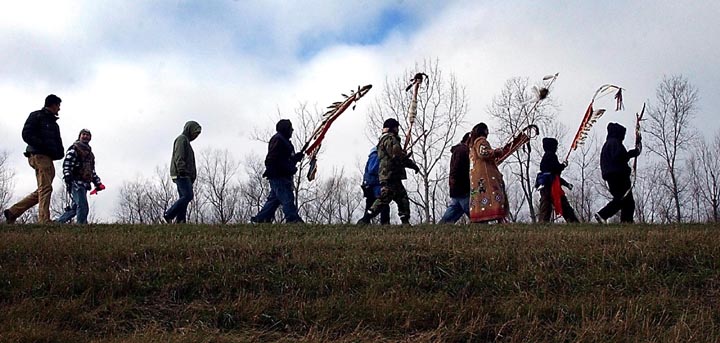
Minnesota stands of the verge of one of the most poignant commemorations of 1862. Over six days, from November 7-13, 2012, Dakota people and their allies will march roughly 150 miles from the Lower Sioux Agency near Morton, Minnesota, to an internment camp site at Fort Snelling, near St. Paul.

Those who march, and those who remember, honor the 1600 Dakota prisoners of war –innocent men, women, and children –forced to march on a similar trek 150 years ago known as “Minnesota’s Trail of Tears.”

Establishment historians call it “remarkable” that more Dakota people did not die during the 1862 march, referring to the relatively few Dakota deaths recorded in white-authored sources.

But for 150 years Dakota people have orally documented stories about deaths, persecution, and torture along the march route: stories that didn’t make the history books until the 21st century.

In 2002, the year of the inaugural Commemorative March, I had never heard this part of the story of U.S. Dakota War of 1862. But once I began paying attention, I discovered there were many primary-source references, so many that I wondered how we white folk had collectively managed to forget November, 1862.

Except for the obvious reason: Who would want to remember?

By 2008 I was persuaded that the relative absence of Dakota deaths documented in period sources is misleading. Measured by numbers, the story is disquieting, self-congratulatory: “See? It could have been so much worse. Military discipline averted disaster.”

Maybe it did.

Instead, as the 2012 Commemorative March unfolds, I suggest we read the documentary record the other way: for what these stories tell us about the human heart.

I won’t pretend to be objective. My historian persona will supply primary evidence. But I am keenly aware it is my other self –my mother-self –that feels the weight of these stories. What would it have been like for me and my daughters, bereft of my husband, to be subject to the race hatred, the sexual objectification, the terror of being guarded by soldiers whose hearts harbored the things they later confessed?

I will focus on stories told by soldiers who guarded Dakota prisoners 150 years ago. The documentary record clearly shows that soldiers were not the only ones who felt this way. Calls for “exterminating” Dakota people blanketed Minnesota newspapers by August 22, 1862.

But the Minnesota frontier, as the story of the Dakota marches open, was eerily empty, depopulated by the death and terror and weeks of war. The Minnesotans who lived permanently in the eastern part of the state, and the thousands of others who had fled there, could do little more than rage at the Dakota from afar.

Ironically, this means that even with winter approaching, the  Dakota people who had surrendered at Camp Release were comparatively safe, geographically isolated on a vacant frontier.

But it was not an empty frontier. There were about 2000 soldiers accompanying Sibley’s expedition tasked with guarding the Dakota. So while this series will widen to embrace the attitudes and actions of settlers as the march moves east, it starts near the war’s Ground Zero inside the mind of settler soldiers.

*****

Photo credit: Tipi smoke hole, the author

Posted in Commemorating Controversy, Dakota Commemorative March | Tagged | Leave a comment

Many Hands, Many Voices: Writing, Editing, and Publishing Indian Captivity Narratives, Part 3

by Zabelle Stodola, University of Arkansas at Little Rock

The opening parts of Zabelle’s article are found here: Part I, and Part II

Carrie has done such a great job providing specific information about the dime novels based on Josephine Huggins’ captivity that I thought I’d try to place those comments in a wider context. In 2004, I co-authored an essay on dime novels with Colin T. Ramsey, who teaches at Appalachian State University.[i] For part 3 of my blog entry, the last in this series, I’m going to extract some general information from that article.

Literary forerunners: The first real dime novel, Malaeska: The Indian Wife of the White Hunter by Ann Sophia Stephens,did not appear until 1860, only a couple of years before the US-Dakota War broke out.[ii] But this dime novel as well as the countless dimes that followed were influenced by two earlier literary forms: pamphlet novels, which flourished in the 1830s and 1840s, and “story papers,” which appeared in the 1840s and early 1850s. Like the story papers in particular, dimes were cheaply produced and sold, were enormously popular, were marketed to the working classes (though many social strata read them), and were known for including sensational and sometimes violent content as well as stereotyped, two-dimensional characters.[iii]

Marketing: The term “dime novels” originally came from a new series the publisher Beadle and Adams called Beadle’s Dime Novels.[iv]  As a marketing ploy, Beadle and Adams prominently highlighted the low price of these books in its title. If a publisher today launched a series named Harper’s Dollar Novels, for example, it would probably sell well too and undercut competition! The early dime novels were pocket-sized—four by six inches—and formulaically ran to about 100 pages each.  Cheaply bound in paper with an instantly recognizable single-colored cover, they cost a dime, of course (later on Beadle began publishing a series called Beadle’s Half Dime Library). The original series was an overnight success with a new title coming out about every fortnight for the next fourteen years, until a new series, Beadle’s New Dime Novels, replaced it.  There were succeeding spin-off series too. As you can see from the cover of Malaeska, the early dimes used only black lettering. But soon full color covers became the norm with increasingly graphic and garish illustrations.  Eventually “dime novels” stopped being a brand name and became a generic term for any cheap, paper-covered fiction.[v] By then, many other publishers had jumped onto the dime novel bandwagon.

Content, production, and authorship: Another of Beadle’s dime novel innovations was the concept of the recurring character. The writer Edward Wheeler created the first recurring character, Deadwood Dick, who was an appealing outlaw (or sometimes detective) and an anti-hero of sorts.[vi]  In this way readers could not only expect a recognizable book on the outside but predictable material and characters on the inside.

The use of regular characters also encouraged standardized narrative situations.  Although the earliest dime novels usually displayed a variety of settings, somewhat developed characterization, and an extended conflict, as the genre evolved, dime novel  plots increasingly relied on scene after scene of violent confrontation.[vii] Dime novels were so formulaic that publishers tended to market trademark characters like Deadwood Dick rather than publicize the work of individual authors. In fact, dimes often appeared anonymously or pseudonymously and might be written by a stable of hack authors.[viii] Sometimes the same individual published under several pen names. Only a handful of writers—including Edward S. Ellis, about whom Carrie has written in previous posts—became well-known as authors of dime novels. And even they sometimes published under various pen names to increase their output. I’ve read that romance writers today also may also publish under different names. It’s easier to churn out a lot of formula fiction than other, more individualized, kinds of work, and of course both dimes and romance novels (Harlequin novels for example) are examples of formula fiction.[ix] Dime novel publishers might encourage writers to use modest amounts of innovation to keep a reader’s interest, but they basically wanted writers to conform to pre-determined guidelines.

Colin Ramsey and I end the introductory segment of our article with this paragraph, “Ultimately, then, we should see the dime novels as a significantly mass-produced form of reading matter which depended upon a set of nearly interchangeable character types and easily reproducible marketing, and which employed quasi-industrial production methods that de-emphasized individual authorship.  However, despite these facts, we should not dismiss the form as being uninteresting or assume its readers were unsophisticated.”[x]

Following our general introduction in the article is a detailed examination of two dime novels using Indian captivity as a plot: Malaeska and Indian Jim. Colin wrote the section on Malaeska, but I wrote the section on Indian Jim, which is one of many dimes based on the US-Dakota War. I returned to an even more detailed analysis of this dime novel in a separate chapter devoted to it in my 2009 book The War in Words: Reading the Dakota Conflict through the Captivity Literature.[xi]

Dime novels have attracted a lot of scholarly attention in recent years especially with the availability of online resources, though piecing together accurate information is still very complicated (e.g. trying to track a title’s many reprints or identifying the real identity of pseudonymous authors).

For more information, I recommend the following references:

“Beadle and Adams Dime Novel Digitization Project” at http://www.ulib.niu.edu/badndp/ (accessed 3 November 2012).

Bill Brown, ed. Reading the West: An Anthology of Dime Westerns. Boston: Bedford, 1997.

J. Randolph Cox. The Dime Novel Companion and Source Book. Westport, Connecticut: Greenwood, 2000.

Michael Denning. Mechanic Accents: Dime Novels and Working Class Cultures in America. New York: Verso, 1998.

“Dime Novels” at www.newberry.org/dime-novels (accessed 3 November 2012).

“Dime Novels and Penny Dreadfuls” at

http://www-sul.stanford.edu/depts/dp/pennies/home.html (accessed 3 November 2012).

Albert Johanssen. The House of Beadle and Adams and Its Dime and Nickel Novels: The

Story of a Vanished Literature. Vol. 2. Norman: University of Oklahoma Press. Also

available online at http://www.ulib.niu.edu/badndp/bibindex.html (accessed 3

November 2012).

Edward LeBlanc. “A Brief History of Dime Novels: Formats and Contents.” In Pioneers,

Passionate Ladies, and Private Eyes: Dime Novels and Series Books, and Paper Backs, ed.

Larry  E. Sullivan and Lydia C. Schuman. Binghamton, New York: Haworth Press, 1996.


[i] “Dime Novels.” Co-authored with Colin T. Ramsey. In A Companion to American Fiction 1780-1865, ed. Shirley Samuels. (Oxford: Blackwell, 2004), 262-73. Since we published this article, a lot more information has appeared on dime novel literature.

[ii] Cover image of the first edition of Malaeska courtesy of Google Images.

[iii] Ramsey and Derounian-Stodola, 263-64.

[iv] J. Randolph Cox. The Dime Novel Companion: A Source Book (Westport, Connecticut: Greenwood, 2000),  xiii.

[v] Cox, Dime Novel, xiv.

[vi] Edward LeBlanc, “A Brief History of Dime Novels: Formats and Contents.” In Pioneers, Passionate

Ladies, and Private Eyes: Dime Novels and Series Books, and Paper Backs, ed.E. Sullivan (Binghamton, New York: Haworth Press, 1996), 16.

[vii] Bill Brown, ed. Reading the West: An Anthology of Dime Westerns (Boston: Bedford, 1997).

[viii] Michael Denning, Mechanic Accents: Dime Novels and Working Class Culture in America (New York: Verso, 1998), 20.

[ix] Harlequin has an extensive website at www.harlequin.com

[x] Ramsey and Derounian-Stodola, 266.

[xi] The image of Indian Jim is taken from the Newberry Library’s page on “Dime Novels” at www.newberry.org/dime-novels. The Newberry Library, an independent research library in Chicago where I have conducted a good deal of research over the years, possesses an especially large collection of early dime novels and Indian captivity narratives.

Posted in Dime Books, Edward Sylvester Ellis, pop culture, Zabelle Stodola | Leave a comment

The 2012 Dakota Commemorative March Series

I imagined 2012 Dakota Commemorative March, at least part of it, might be my first. A short answer from my doctor this week,”No way,” ended that hope. But I will be there in spirit, supporting those who will be marching by doing what I do: public history.

My aim is not to convince you that history happened in a certain way, at a certain place or time between November 8 and 13, 1862. That was the frigid week when the members of the Dakota Peace Party and their families, accompanied by the women, children and elderly among the families of the Dakota men imprisoned at Mankato in the wake of the war, were marched by the military from the Lower Sioux Agency to a internment camp at Fort Snelling.

Rather, I will honor the stories told by people who were there: Dakota and settlers alike in 1862. I also want to share the historiographical stories from survivors that propel the 150 year old tragedy of “Minnesota’s Trail of Tears” into the present.

The “war” part of the 1862 story, roughly August 17-September 26, 1862, has all the stock characters of a Dime novel: heroes, villains, suspense, tragedy, resolution –even though the historiography of the war will be forever snarled over which elements deserve which labels.

But the wake of the war, especially the months of November and December 1862, is very different. To me, it reads like Annie Dillard’s novel The Living, where “living” struck me as waiting to die, the only questions being, when and by what means. It’s one of the few books I’ve had to put down and walk away from because I could not bear to read what I knew I’d find on the next page. Yet I absolutely had to finish the story.

I began researching the Dakota Women’s March (as it was then known) in 2002, published on that subject in 2008, and have continued to research since. In my estimation, it is the defining story of the Dakota War of 1862. Much harder to read than Dillard, and more critical, because it real life history.

There are no, “But it was only a dime novel-exaggeration!” dodges possible here. These stories come from the dark underbelly of documentary history in Mni Sota Mkoce.  Painful as they will be to hear, this is who we were. And to the extent we fail to reckon with them and repudiate them, it remains who we are.

Writing of the Commemorative March, Stephanie Hope Smith, who, like me, is not Dakota, wrote this in an October 10, 2012 post on her blog The Hopeful Peacemaker.

“What I have observed is that for those who believe that history happened a certain way — it does matter how their stories are told.   History DOES matter.  Details DO matter.  And because it matters to someone, if I’m their neighbor, it should matter to me.  That begs the 2000+ year old question…who is my neighbor.

 Strong emotional reactions are tied to the personal belief that the story unfolded a certain way, and that it is the way they were told.  Regardless of the documents you  would view later, photos or the personal stories shared, any “proof to the contrary” that brings a detail into question, some stories passed down to us are ingrained as deeply as our DNA.  And I’ve come to the conclusion that it’s ok to have competing “histories” and that we don’t have a neat little package of what exactly happened.  We won’t get history right.  But we need to acknowledge the person who has the competing historical details.  Give honor to the person even if we disagree.  Stop planning your rebuttal and listen.”

*****

A note about the structure of this series. I have learned that I have two dedicated groups of readers. Some of you use this site like a blog and others use it like an on-line research library.

Daily readers won’t be disappointed because there will be a lot of new primary sources in this series. But to streamline the process for those who use this website for research, I may make more than one post on the same day to give discrete primary sources a discrete URL. So scroll down when you arrive. The post on the top may not be the only new  one.

Photo credit: The Hopeful Peacemaker.

Posted in Commemorating Controversy, Dakota Commemorative March, Dakota Peace Party, truth-telling | Tagged | Leave a comment

The Cultural Work of Pop-Fiction

The four volume Twilight Saga by Stephanie Miller

Today, young people love serial fiction about vampires and the dystopian future.  In the 19th century, young Americans consumed dime novels about the frontiers of that day: the American West; “exotic” locales (like Sumatra, Burma, the Antarctic, and Pacific atolls); the cutting edge of technology (like “motion pictures,” “airships” and submarines); and the mysterious (“unexplored” regions, detectives).

These disparate genres were united by more than cheap reproduction and mass distribution. Like all best-sellers, they played into and amplified the social concerns of the people buying and reading the books. In the 19th century, that was the burgeoning working-class: young men and women entering factory work in unprecedented numbers.

One of the most resonant social themes in that era was the work ethic: that upward social mobility was within the grasp of anyone willing to  diligently apply himself to acquiring a basic education and to performing physical labor. The best-selling heroes of the day were “pull themselves up by their own boot-straps”-type fellows (and later, gals) who managed great feats due to sheer dint of pluck and character against unforgiving odds.

Odds like those came with the unpredictability of frontiers. Consider the real-life Federal programs aimed at “civilizing” Native American people. Education and manual labor were seen as “civilizing” forces for socially degraded people of all stripes: the indigent, and the alcoholic (the “poor farm” movement); the parent-less (orphan trains which shipped them to farms and rural schools); immigrants (settlement programs); African-Americans (Freedman’s Bureau); Catholics (conversion to the Protestant work-ethic via Christianity).

“40 acres and a mule” (a reconstruction-era slogan) were viewed as good for everybody.

In this cultural milieu, the generic Indian of 19th century fiction was a handy stereotype, embodying everything anti-American. Native men were characterized as warlike (warfare was viewed as recreation, not work) and lazy, creating that second stereotype, the Native female “drudge,” doomed to carry the slacker-men’s work burden.

Is it any wonder that “Indians” were a staple protagonist in the popular fiction of the 18th and 19th centuries?

A major problem is that the “bad guys” of the frontier, Native Americans, were real people. My oldest daughter’s peers are not likely to run into a vampire –except, perhaps, tonight at a Halloween costume party.

The Hunger Games saga, by Suzanne Collins

But what if she and her friends were unexpectedly thrust  onto a post-apocalyptic world and confronted with what they interpreted as a  Hunger Games scenario? Would their first response be to reach out, shake hands and assume the best? Or would their preexisting mindset about dystopia –that frontier of modern pop fiction– make them approach every unknown person as a potential adversary?

How can we posit that it worked much differently in early America when wave after wave of eastern “civilization” washed up against the receding coastline of the western frontier? It must have taken unusually discerning readers of dime books to suspend stereotypes when they arrived on the frontier and routinely encountered the protagonists of pop-culture imagination.

One of the strangest characteristics of Indian captivity narratives –fictional and not –including those of the Dakota War, is that the captive-author usually offers her readers helpful hints for Indian Captivity: which clothing and footwear are best-suited; which frying pan, washing pan, and knife to grab when fleeing the house; the most valuable cooking ingredients to pack; how to placate one’s captors. Mary Butler Renville even recommended taking a box stove and a rocking chair!

Why? Native Americans were real people and the literature of their day warned frontier residents to be prepared for Native encounters of the most extreme kind. The Boogeyman, they said, was real. He was Native American and everyone better watch out.

If you don’t believe it, read some 19th century dime fiction.

*****

Photo credit: “We Want Our 40 Acres and a Mule” RGB Street Scholars via Google Images; the Twilight and Hunger Games sagas, Google Images.

Posted in Captivity, Dime Books, pop culture, truth-telling | Leave a comment

Many Hands, Many Voices: Writing, Editing, and Publishing Indian Captivity Narratives Part II

by Zabelle Stodola, University of Arkansas at Little Rock

In part one, I discussed several letters having to do with the writing of Josephine Huggins’ captivity narrative, and I also considered the fact that the holograph manuscript is missing. In this second posting, I will look  more closely at the published versions that appeared first in newspapers and then within a book-length history of the Dakota War. I’ll also touch on Josephine and Eliza Huggins’ reactions to these publications in several letters that they wrote to missionary Stephen Riggs.

For Josephine’s story to go through a number of transformations was not unusual among nineteenth-century Indian captivity narratives. In fact moving from a handwritten document to a series of newspaper articles and then to a book or pamphlet was pretty standard in a captivity narrative’s publication history.  The book or pamphlet might focus on the ex-captive’s story alone or it might be a larger work authored by someone else that simply included an ex-captive’s story among other material.

St. Paul Press 12 February 1863, page 3, the Alexander G. Huggins Papers at the Minnesota Historical Society.

The first published version of Josephine Huggins’ experiences was serialized in the local daily newspaper, the St. Paul Press, from 3 to 5 February 1863. A week later, the story was reprinted in that same newspaper’s weekend edition dated 12 February 1863.

Eliza Huggins then wrote to Stephen Riggs on 18 February 1863 (Letter “C”) to thank him and his daughter Isabella, “for the trouble you have had with Josephine’s narrative. If we had been trying to write her story for the public eye, we would have written differently but perhaps it would not have been really any better.”

In using “we” presumably Eliza meant that both she and Josephine had worked on a draft and then sent it to Riggs in somewhat rough form without realizing that it was destined for “the public eye.”  Hence their thanks for “the trouble” that Stephen and Isabella Riggs took converting a private document into something suitable for public consumption.  Eliza does not mention specific changes that the Riggses might have made.

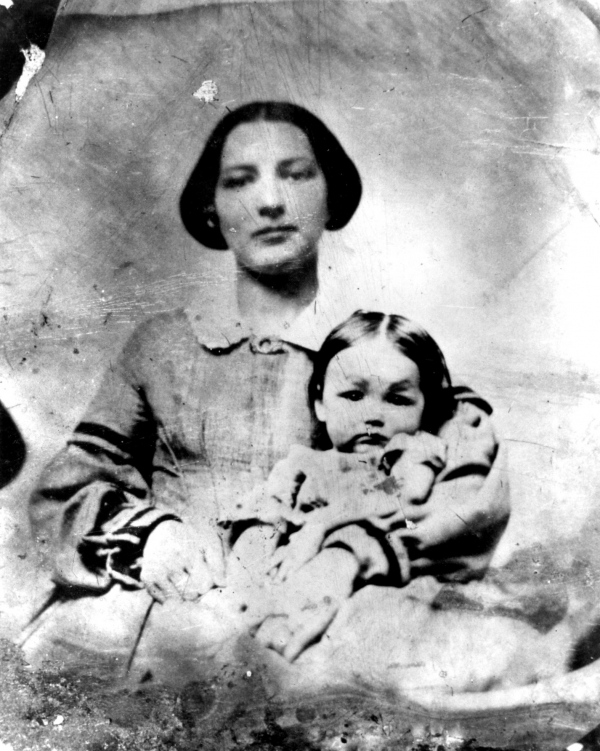
Sophia Josephine Huggins and her daughter, Letta

Like many Indian captives, Josephine was an ordinary person to whom something extraordinary happened. Indian captives in general often needed editors, amanuenses, or ghostwriters to convert their experiences into readable and saleable form. But in the absence of handwritten edited drafts where the changes are clear, it’s often impossible to know what a captive originally wrote or dictated and what an editor changed.

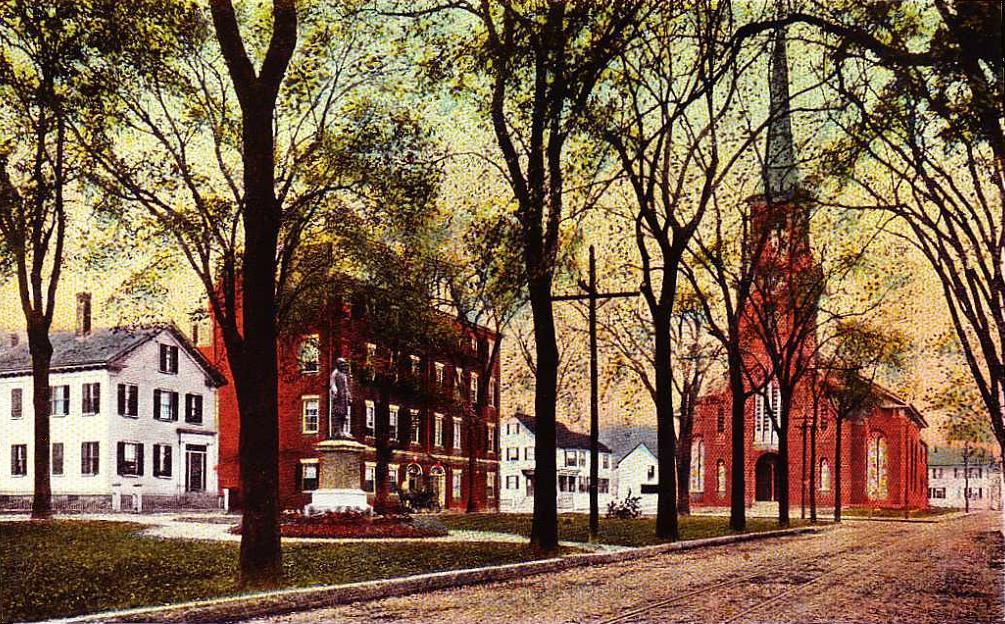
Brown’s Square, Newburyport, MA in the 19th century

On 13-14 March 1863, somehow the Newburyport, Massachusetts, Daily Herald picked up the story. Neither Carrie nor I has examined this version so we don’t know whether the Herald printed the St. Paul Press story verbatim. It’s also not clear whether the Huggins family had any connections in this town to  explain why the Herald was interested in the story in the first place.

But newspapers were more ephemeral than books, and occasional authors weren’t paid—or weren’t paid much—for their journalistic work. Since there seemed to be an insatiable demand for Indian captivity narratives, a story might next appear in book form as a permanent record and as a way for authors to earn some money.  Ex-captives had sometimes lost their home, possessions, and livelihood, so they looked for ways to make money as soon as possible. Even when they had to pay the up-front costs of private book publication, authors hoped that the story of their misfortunes might turn a profit. Sometimes the newspaper and book versions were identical, but sometimes authors and editors spent extra time revising the earlier text for its appearance as a book or in a book.

Berlin City [WI] Courant, page 1, December 25, 186

This year Carrie and I edited another Dakota War narrative that originally came out in installments, though in a Wisconsin, not a Minnesota, newspaper. It was the story of John and Mary Renville which first appeared as a 13-part weekly serial beginning 25 December 1862 in the Berlin City Courant, the newspaper of the Wisconsin town where the Renvilles had resettled after the war. The newspaper account came out under the title “The Indian Captives: Leaves from a Journal.” When Mary Renville returned to Minnesota in 1863, she copyrighted the serial in booklet form, and it appeared in 1863 with the more sensational title A Thrilling Narrative of Indian Captivity. Of course, that’s the book from which this website gets its name!

Josephine’s letter to Stephen Riggs dated 14 December 1863 (Letter “D”) indicates that she knew of  Isaac Heard’s book, History of the Sioux War (dated 1863 but copyrighted 1864). It’s still considered the best of the histories that came out immediately after the war. “If Mr. Heard’s book that you mentioned gives correct account [sic] of the massacres and is worth its price I will be please[d] if you could get one for me without putting yourself to too much trouble. I should like to see a book of the kind,” she wrote.

Curiously, she didn’t seem to realize that Heard had included her story within his book, though he  wouldn’t have needed to contact her, anyway, as he took much of his information straight from the St. Paul Press. As this detail indicates, somewhere along the publication line, ex-captives might lose control of their stories and of how those stories might be retold or manipulated by others.  And of course it was Heard and his publishers who made money from his book, not people like Josephine whose experiences were included in it.

Finally, on 9 February 1864, Josephine sent Stephen Riggs another letter (Letter “E”) filled with news and with apologies for her delay in writing. Early on she says, “I also received the book that you sent me, for which I thank you very much.” Her request for Heard’s book in her December letter, and her apologies for procrastinating, suggest that the book she thanked him for two months later was indeed Heard’s History of the Sioux War. But she does not name it, so the reference could be to a different book.  Was Josephine sick to death of going over or reading about the details of her captivity? Perhaps.

In my next posting, I will build on the information Carrie has provided in her recent posts about the dime novel adaptations of Josephine Huggins’ story. My contribution will be to give you some general information about “dimes” to contextualize the specific publications purporting to tell of Josephine’s experiences.

*****

Photo credits: “Adventures Among the Indians,” The Minnesota Historical Society; Josephine and Letta Huggins, Patricia Huggins; Newburyport, MA, Wikimedia Commons; Berlin City Courant, Zabelle Stodola.

Posted in history of printing, Josephine Huggins, Zabelle Stodola | 1 Comment

In Which Real Indians Are Captive to Dime Hero Wanna-bes

Oecetiduta commented on my post, Yellow-back Gold: “Too bad the stories of  ‘Indians’ being held captive are not shared, too.”

That is precisely why historians of the western Indian wars need to pay attention to the pop-culture of the 19th century. We have written and spoken and hypothesized about the past as if the stories of eye-witnesses were written in splendid isolation, as if the narrators were not products of the culture in which they lived.

“Dime novels were the main source of entertainment for the common man,” Vicki Anderson explains, “giving some excitement, romance and escape, both for the city people and the rural population –the city because of the boring jobs most of them had and the rural people because they were cut off from the activities of the city. These popular books brought to attention the popular ideals of the times. Their colorful and exotic fictional characters told of the typical American values of  patriotism, individualism, frontier virtues and the belief in hard work as the road to betterment in their lives.” The Dime Novel in Children’s Literature, p. 80. (McFarland, 2005)

From the modern vantage point, it is easy for a person of non-Native heritage like me to judge dime novel characters as “colorful,” “exotic,”  and “fictional.” In fact, I’d say I find them biggoted cartoons. But I was born in 1966.

Take a moment to read a true story written by a man born in the early 1870s, who loved to read dime novels. Notice how the fiction he consumed influenced what he did in real life:

“There was a sharp crack of a rifle and another redskin bit the dust!” This is typical of the way some of the authors of our old “blood and thunders” used to start their stories.

 Remember the days when we would live through the daring feats of Deadwood Dick and Buffalo Bill and the triumphs of Frank Merriwell, Frank Reade and Yankee Doodle? It wasn’t necessary to read pages of tiresome description before coming to the action. They usually started with a “bang” and interest never lagged until the end.

 Many a time we have hidden one of these old thrillers in our pistol pocket, then sneaked out in the barn or some other secluded spot to become absorbed in the adventures of Diamond Dick or the outlawry of the James Boys. Some youngster would take his reading too seriously and decide to go west and kill Indians. The writer admits that he got the idea when about 14 years of age, saved up his earnings until he managed to accumulate 50c, give an older boy 35c for an old 22-cal. revolver whose trigger did not work and would fire only by working the hammer with the thumb, and invested the other 15c in a box of .22 cartridges. Then go down by the creek to practice the “quick draw.” After many attempts to get the gun out of his hip pocket without getting the hammer tangled up in his clothes and shooting at the mark until his ammunition was exhausted he decided to wait until such time as he was able to get more dependable equipment. The Indians and Bandits were saved for the time being.

 This is probably one reason why our parents were so opposed to our reading these novels….”

His name was Floyd L. Beagle and that’s his auto-biographical introduction to a pamphlet called, Blood and Thunders or Dime Novels of the 80s and 90s, published around 1920.

Some will protest that nothing came of Beagle’s teen-aged role-playing. The gun was broken. He didn’t actually shoot anybody.

Not when he was 14. But consider who Beagle’s contemporaries were. Dime-novel readers his age grew up to join the army and indiscriminately massacre Lakota men, women, and children at Wounded Knee December 29, 1890.

For all we know, some of Chivington’s soldiers traded copies of Edward Sylvester Ellis dimes on the long march west to their massacre of Cheyenne and Arapaho people at Sand Creek November 29, 1864.

I transcribed some of Edward Sylvester Ellis‘s racist stereotypes of Dakota people in “The Minnesota Captive” here. Yet listen to how William Everett praised Ellis in a July 1864 article in the North American Review. While Everett dismissed most of the dime literature he read as wretched, of Ellis, he said:

“Mr. E. S. Ellis’s ‘Seth Jones’ and ‘Trail Hunters’ are good, very good. Mr. Ellis’s novels are favorites and deserve to be. He shows variety and originality in his characters; and his Indians are human beings, not fancy pieces.” (p. 308)

In the same article, Everett observed that by April 1, 1864, there were five million copies of dime books in circulation, half of them novels. He concluded his review:

“Why these works are popular is a problem quite as much for the moralist and the student of national character as for the critic. It is a satisfaction that, being so, they are without exception, so far as we can judge, unobjectionable morally, whatever fault might be found with their literary style and composition. They do not even obscurely pander to vice, or excite the passions.

And it is a striking fact to be learned from Messr.s Beadle & Co.’s account of sales, that the best books on their list are those for which there is the greatest demand….If a novel as good as those by Mr. Ellis sell twice as fast as one by an inferior author, it is for their interest to obtain the services of other writers of not less merit than he.

With such established popularity as they have obtained for their publications, a serious responsibility rests upon them. They are wielding an instrument of immense power in education and civilization. They are bound to use it, not alone with reference to their own profit, but with constant regard on its effect upon the public.” (p. 308, paragraphing added)

You’d think Ellis would have a review that prestigious framed, hanging over his desk to remind him of his moral responsibility every time he and his pen,“deliberately, in cold blood, tomahawked them all–cleft open the head of each,while the others stupefied with horror, powerless with fright, as they heard the heavy, dull, blows crash and tear through flesh and bone, awaited their turn.” (“Mrs. Huggins, The Minnesota Captive” 1864, p. 16)

Ellis’s “…Indians are human beings, not fancy [imagined] pieces.” Right.

This is race hatred sanctioned by one of the leading magazines in the United States in the 19th century. It’s exactly what made boys like Floyd Beagle want to grow up and hunt Indians.

Posted in Dime Books, Edward Sylvester Ellis, Josephine Huggins | Leave a comment

Innocence and Evil

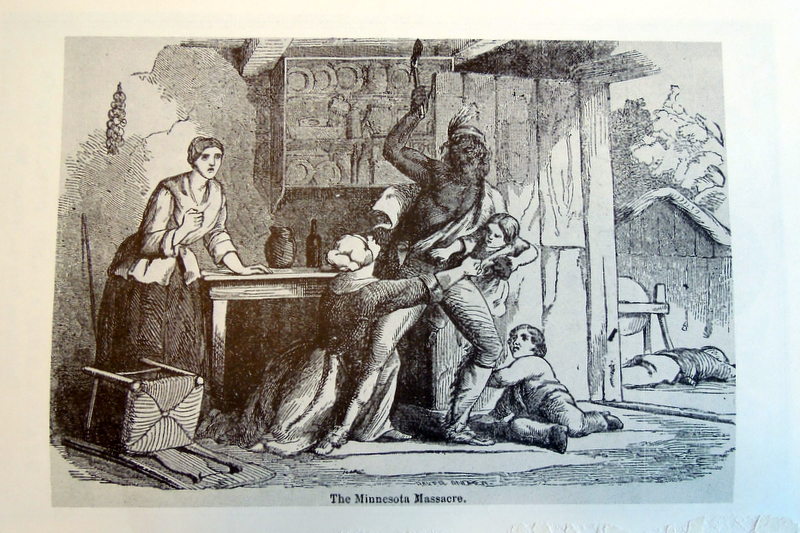
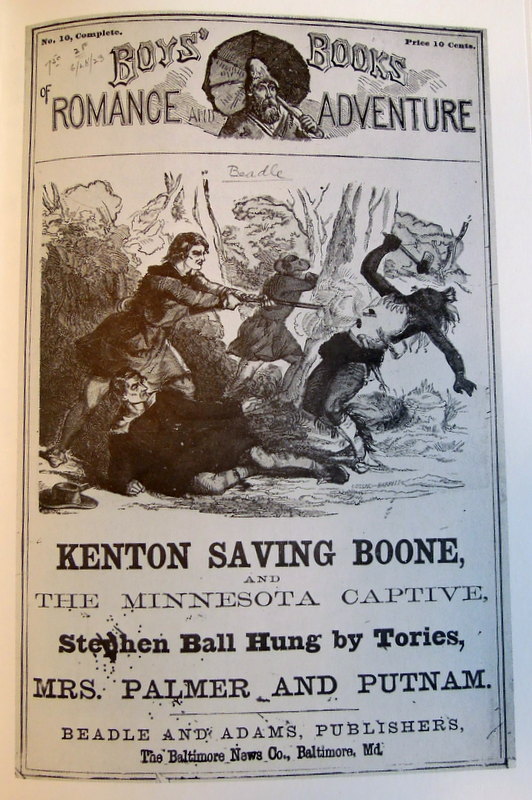
This engraving, titled “The Minnesota Massacre,” faces the title page for Josephine Huggins’s story in Beadle’s Boys’ Book of Romance and Adventure No. 10. Dime publishers had extensive collections of stock artwork they recycled in multiple titles. While the expressions on the faces of the women and children are clearly defined, the muscular Native American man’s features are inscrutable beneath a mask of blind fury. 

Nancy L. Chu writes, “Viewed as reflections of the times in which they were written, dime novels provide insight into a code of behavior and set of attitudes significant to the lives of people long gone. Perhaps the most intriguing part of this reading experience is the identification of the attitudes which bridged fiction and reality in the nineteenth century and whose remnants, fortunately or unfortunately, remain with us today. Female dime-novel characters and their living counterparts were both subject to these attitudes, and successful authors made their heroines and anti-heroines conform to the expected social and spiritual requirements or pay a heavy price for failure.”

Chu was commenting on the role assigned to women in dime fiction. The same thing could be said for the stereotyped characterizations of Native Americans. While the dime genre has long been dismissed as simple entertainment, these old books embody some of the dominant cultural values of their day.

In this post, I will explore what Ellis’s treatment of Josephine Huggins’s story reveals about how virtuous women were viewed in the 19th century. That is directly tied to the next post, where we’ll see the real-life consequences of similarly stereotyping Native Americans.

Isaac Heard was the first to subtly dial-up the moral value of Josephine’s story by making Josephine the wife of a missionary. Ellis not only repeated that idea, he took other subtle liberties to polish the real-life Josephine into a stereotypical dime-novel heroine.

These are some characteristics Ellis found worthy of comment:

  • Josephine was unprepared for violence and captivity: “The massacre… did not reach the station until the next day, and then it came with the most startling suddenness.”
  • In her trust and innocent goodwill, Josephine was deceived by Native men, who entered her home under pretext: “They evinced much friendship…”
  • Native people recognized Josephine’s cultural superiority and were properly awed: “They appeared particularly pleased with the sewing-machine that was used. They minutely examined it, and seemed anxious to understand how it was that it wrought with such astonishing rapidity.”
  • She witnessed the death of her husband: “She heard the rapid report of two guns in succession.” A few moments later, Josephine saw his body outside the house. (p. 6)
  • Josephine behaved nobly, rising above her trauma: “Although her heart was ready to burst with grief, she was compelled to force it down, and attended to the safety of her loved ones and herself.” Before fleeing, “the faithful wife, at imminent risk of her own life, ran into the house and procured a lounge cover, which she spread over the corpse of her beloved husband.”

Next, Ellis spends pages developing Josephine as a beacon of civility in the Dakota homes in which she sought refuge, where she was honored and shielded by “good Indians” who treated her as, “the royal guest of the lodge.”

Exerting her birthright to the Protestant work ethic, Josephine was an exemplary captive: “With tact and judgment, Mrs. Huggins endeavored to conform to the tastes and opinions of those around her. By this means she endeared herself to them…. She assisted the chief’s wife in sewing,cooking, bringing water, or any other chore to which she could turn her hand.”

Throughout, Josephine remained an idealized Christian. “Six long, weary weeks passed slowly away. How sad, and lonely,indeed, none but that stricken young widow can tell. But the same consolation that had been the comfort and delight of her husband was hers. The blessed Bible that had once been his, was her constant companion, and from its pages she drew those great truths so sustaining to the human heart inits hour of affliction.”

So Ellis took mild fictional liberties with Josephine’s story. At the same time, her real-life narrative would have appealed to him as an author because the main job of a dime novel heroine was to stand in stark relief to the dark “heathenism” of the Native world into which she was thrust.

But Ellis corrupted the spirit of Josephine’s narrative by transforming it into anti-Indian propaganda. As Lois Glewwe remarked in the post which started this series, “Josephine’s story is remarkable in many ways. Unlike so many captivity narratives of the 1862 war, this document does not demonize the Dakota, nor are the events or dangers exaggerated or enhanced with violent and dramatic details.”

Authors like Ellis could not resist making the Indian captivity scenario a fictional proving ground for True White Womanhood. Too conveniently, the formula required demonizing Native Americans to justify the eradication of their “threat” to moral paragons like Josephine Huggins. Tragically, not just at the end of the story, but as we will see, in real life.


Posted in Dime Books, Edward Sylvester Ellis, Josephine Huggins | 1 Comment

Meet “Mrs. Huggins, the Minnesota Captive”

Cover (facsimile) of Beadle and Adams Boys Books of Romance and Adventure, No. 10 containing “The Minnesota Captive,” 1864, as reproduced in the Garland Library of Narratives of North American Indian Captivities, vol. 86, 1978.

*****

“When the reader takes up these volumes, it is with the expectation of perusing incidents that occurred at least half a century ago –incidents of which, perhaps, he entertains a shadowy remembrance of hearing his grandparent speak, long years since, when he was but a boy at his knee. But we are now about to record an occurrence that took place within the memory of most the boys whose eyes may chance to fall upon these pages.

In the burning month of August, 1862, a whirlwind of fire and death swept over the mountains and plains of Minnesota. The great rebellion, then as now, absorbed the principal attention of the people, so that this attracted much less notice abroad than it would have done in ordinary times. But the thrill of horror that ran along the border when they realized what a fearful massacre had burst upon them, will never be forgotten by survivors. At such times there always occur scenes of terrible moment, acts of daring, hair-breadth escapes, and innumerable conflicts, which never become known except to the participators. There are a few, however, that are chronicled by the pen of the historian, and among these we present the narrative of Mrs. Sophia Josephine Huggins, wife of the beloved missionary who was slain at his station, near Lake Iyedan, or Lac qui Parle.”

Ellis’s 1864 paraphrase of Sophia Josephine Huggins’s story follows. It seems to be a straight-forward retelling of her story which had appeared in the St. Paul Press in February 1863, sixteen months previously. But Ellis’s introduction contains clues that he actually cribbed from Isaac Heard’s A History of the Sioux War and Massacre, published just months before. He refers to stories, “chronicled by the pen of the historian, and among these…the story of Mrs. Sophia Josephine Huggins” and repeats Heard’s mistake of characterizing Josephine’s husband, Amos Huggins, as a missionary.

Remarkably, Ellis took few liberties with Heard’s gloss on Josephine’s story. He had good reasons for keeping Josephine’s story on the moral high-ground and I will explore those in the next post.

But upon my first reading, imagining myself as a teen-aged boy of the 1860s who had just surrendered a hard-earned dime for this book, I mentally challenging Ellis: “This woman’s story is so tame! What about those thrilling horrors, awful massacres, scenes of terrible moment, acts of daring, and hair-breadth escapes you promised?”

In the end (literally), Ellis didn’t disappoint his legion of fans. Concluding Josephine’s story, he abruptly changed gears to supply a fictionalized context for her captivity: sensational stories that unfolded outside the realm of Josephine’s sheltered experience. Ellis wrote:

“Mrs. Huggins remained at Camp Release for about two weeks. She is quite a young woman, and her vigorous constitution by that time made her herself again, and shortly after she and her children took their departure, and joined their friends below.

An officer who served in the expedition sent out to quell the Indians, in an article published in Harper’s Monthly, gives some incidents of the massacre which fill the mind of the reader with horror not soon to be forgotten. He says:

‘But who can tell the story of that hour? Of the massacres of helpless women and children, imploring mercy from those their own hands had fed, but whose blood-dripping hatchets the next moment crashed pitilessly through their flesh and bone –of the abominations too hellish to rehearse—of the cruelties, the tortures, the shrieks of agony, the death groans of that single hour?’”

Perhaps eager to make up for what lacked in the first nine pages of the story (Josephine’s experience), without breaking the quotes attributing it to the Harper’s correspondent, Ellis offered up three additional pages of straight-up atrocity stories like these:

“The ferryman himself, tomahawked before his own door, was disemboweled, his head, hands, and feet chopped off, and inserted in the cavity. They overtook a boy trying to escape. Tearing off every thread of clothing, they pricked and  pierced him with their blunt-headed javelins, laughing at and mimicking his agony until death came to his relief….Passing a stick through the ankles of a woman, they dragged her over the prairie, till, from that alone, torn and mangled, she died.”

A page later, Ellis concludes a lengthy scene starring Cut Nose with this gristly description:

“Taking an infant from its mother’s arms, before her eyes, with a bolt from one of the wagons, they riveted it, through its body, to the fence, and left it there to die, writhing in agony. After holding for a while the mother before this agonizing spectacle, they chopped off her arms and legs, and left her to bleed to death.”

These examples are gruesome and hard to read today. In fact, in tone and detail they are the antithesis of Josephine Huggins’s real-life experience.  But in the 19th century, stories like these served to advance a leading ‘moral’ agenda: colonialism. To Edward Sylvester Ellis and his readers, these choices made perfect sense.

More about why next time.

*****

I can’t let vicious stereotypes of Native American people like Ellis made go without comment. It is critical that historians recognize and call out the standard barbarity tropes of Indian Captivity Narratives and dime novels when we find them imprinted on our collective memory as history.

Until quite recently, historians of the Dakota War have not been interested in the influences of popular culture on recorded history. So they have indiscriminately accepted eye-witness accounts of atrocities said to have been committed by Dakota warriors in 1862.

Modern historians must take excruciating care to investigate 1862 atrocity stories before repeating them. If there is no precedent for an alleged act (the crucifixion of infants, infliction of torture, gang rape, etc.) in the ethnography of Dakota warfare, these alleged atrocities are not solid evidence of anything beyond the prevailing 19th century stereotypes about Native Americans.

*****

With thanks to the University of St. Louis Library for the loan of Garland vol. 86 containing the selection made by Wilcombe E. Washburn of “The Minnesota Captive” from Boy’s Book of Romance and Adventure No. 10 in the Beinecke Library at Yale University.

Posted in Dime Books, Edward Sylvester Ellis, Josephine Huggins | 1 Comment