John P. Williamson on Writing the English-Dakota Dictionary

Once upon a time,

Someone found a suitcase of old, old letters in an old, old house. They were charmed letters. We know because Someone did not throw the letters away.

Instead, Someone took the suitcase to the Dakotah Prairie Museum in Aberdeen, South Dakota to be appraised. Someone never returned to claim the letters.

This happened so long ago that Someone may no longer be living. But a decade ago, Jeff Williamson, a descendant of this man,

John Poage Williamson, 1835-1917

went looking for information about his great-grandfather, John P. Williamson. Jeff talked to Alan Woolworth who told him the Dakotah Prairie Museum had letters written between some Williamsons and some Riggs. Jeff told his research friends about the letters at the Dakotah Prairie Museum.

Jeff’s friends were so excited that some of them drove to Aberdeen to read the letters. You see, the suitcase contained new old, old letters. The Dakota Prairie Museum is a museum, not a library. Historians never thought to look there for letters.

This story is about one of those charmed letters.

The first page of this letter is missing. Maybe the day Somebody’s Ancestor placed the old, old letters in the suitcase at the old, old house, the window was open. Maybe the breeze puffed the first page to the floor, where a tabby cat, dozing in the sun, took a lazy swipe at the page, batting it under the settee where it was forgotten.

Or maybe Somebody’s Ancestor needed to wrap a sandwich and grabbed the nearest piece of paper, which happened to be the first page of this letter. History is like that.

We’ll never know.

In any case, John P. Williamson’s letter about writing the English-Dakota Dictionary, probably written to his friend Alfred Riggs in Santee, Nebraska, maybe around the year 1888, abruptly opens on page three.

You may think this strange. But some grown-ups pick up old, old letters and read them to themselves as bedtime stories. Really. So suitcases full of new old, old letters make them very, very happy.

The End

*****

Manuscript L74.14.540.1 No date. Found with 1888 letters. The Dakotah Prairie Museum, Aberdeen, SD. Transcription by Carrie Reber Zeman 2012.

“off without reading Websters definition or consulting an other dictionary. However I doubt whether I so wrote ten per cent. Sometimes on difficult words I have read all Webster said and compared other Desk Dic’s and studied a good deal and sometimes consulted Indians. This in the other extreme and over done in a few cases. The great majority of the words I glance at Websters main definitions & divisions, determine upon divisions I think suitable –then consult other works. I preferred to frame my Sioux words first before looking at former works, because it makes the work more original and gives a wider range.

As to dialects I think I followed a little different course at different times. If I had the whole to do over, I shd follow the plan I have, I think, the Santee, then add the Ihanktanwan and the Titonwan, marked I and T (or otherwise). For example, Knife, n. Isan; (I & [T?]) mina. And Across the River Aksanpa; (T.) Koakata [?]. In the latter case leaving it to be understood that Yankton follows the Santee. I did not pay as much attention to dialects as I shd like to have done. The Titonwan especially is almost wanting where as it really varies from the Santee more widely than the Yankton. I understand the Tit. now better than when I made the compilation & yet would feel quite lame in writing it without a good assistant. And I do not know that it is best to try much in that line.

I formerly took a good many notes and you furnished me a good many. These were however mostly made from the School Dictionary and I think have nearly all been used in that and you will get the advantage of them by referring to it. At least I have no notes of that character in shape that I can furnish you [ ] without the trouble of reviewing the whole field and writing them off. And I would most as so compile the whole thing as to go into that.

The easiest way I can help you any will be for me to look over your copy as you suggested. It will not be very hard work to read it and make the outside corrections which I can do from memory. If I feel right smart I may dip into it more or less deeply.

So much for the Dictionary. Good luck to ye.

I will send down the old copy by Express to your name at Springfield.

Yours Tly,

John P. Williamson

*****

Williamson’s English-Dakota Dictionary did not appear in print until 1902.

Why are letters like this one important? The Dakota language in its written forms has filtered down to us through layers of outside mediation: non-Dakota people like John Poage Williamson. John P., the youngest son of Presbyterian missionary to the Dakota, Thomas S. Williamson and his wife Margaret Poage Williamson, was born at Lac qui Parle in 1835, the same year his father began teaching Dakota people to write in a form of the Dakota language the missionaries had reduced to fit the Roman alphabet.

As an adult, John P. Williamson, who grew up from infancy in a Dakota-speaking community, was widely acknowledged to be the best non-Dakota speaker of that language in his generation. He went on to spend his life in Dakota-speaking communities as a missionary pastor.

Yet, today, Gwen Westerman tells a great joke about the English-Dakota Dictionary being only half as thick as the Dakota-English version. What happened to the Dakota language via writing and  translation? Dakota scholars  are asking those questions.

Letters like this are windows into the process which yielded John P. Williamson’s Dictionary, the most widely owned English-Santee Dakota Dictionary in circulation today.

*****

Edited 10/2/12 with the help of Jeff Williamson. Thanks Jeff!

Posted in Dakota Language, John P. Williamson, Primary Sources | Leave a comment

“A Teton Version of the Santee Massacre”

Year 77, 1862:  “Boy/ a/beside camp/ they come and scalp him/ it being so.” In the Fire Thunder Winter Count, Oglala 1786-1906, Franz Boas Papers, American Philosophical Society. Translation by Ella Deloria.

One of the more fascinating presenters I heard in Fargo at the Northern Great Plains History Conference was Dakota Goodhouse of Standing Rock, a Program Officer for the North Dakota Humanities Council. Goodhouse compared several Plains winter counts to put the U.S. Dakota War of 1862 into perspective. Only one of the winter counts Goodhouse collected commemorated 1862-63 as the year the Santees did anything.

Considering the war from a Lakota point of view reminded me of “A Teton Version of the Sioux Massacre,” a story Ella Deloria recorded, now in the Franz Boas Papers at the American Philosophical Society in Philadelphia.

Deloria introduces the piece simply, “The Teton who related this for me to record obtained this from the Santees; I do not check the historical accuracy as to the dates of treaties etc., I merely record his language for the sake of the text.”

Even if Deloria collected the story as an exercise in comparative linguistics, it is a fascinating glimpse into the Dakota War of 1862 as seen from a relatively unmediated Native perspective. For that reason, I’m not supplying any annotations, simply Deloria’s free translation, reproducing the numbers that correspond to the same lines in her literal translation, and in the Teton original.

A Teton Version of the Sioux Massacre as translated by Ella Deloria. Franz Boas Papers, American Philosophical Society, Philadelphia. Transcription by Carrie Reber Zeman, 2009.

“1. In the Treaty of 1851 it was stipulated that every man, woman, and child should receive twenty dollars in gold every year.

2. And then in the Treaty of 1858, there was added the requirement that all the men should cut their hair short, adopt “citizen’s dress,” farm, and live in houses like those of white men and in every particular to learn the ways of white men.

3. Among the Santee chiefs there were two who objected strenuously to these several requirements. One was Little Crow, and the other was the well-known Sakpe (Six.)

4. It is said that these two declared as follows: “Whoever it is who first cuts his hair shall be soldier-killed by the camp police.” But at least that threat was not carried out.

5. The gold was distributed regularly always the first day of July. And for nine years this was well carried out, without fail that by now the people were sure of it, and expected it.

6. Once again the time came around for the payment, so the tribe which had been out hunting came back into the agency and camped; but the agent told them, in a meeting he called with the people:

7. “The gold has not yet come; so go out again on a hunting trip, and after two weeks come back here.”

8. They obeyed him and returned some time in the middle of July, but again he told them to go out; so once more they went, returning around August first.

9. He told them to go a third time. But by now they were displeased. They stayed in camp and had meetings nightly.

10. Meantime some people at Yellow Medicine Agency, (thirty miles away) had broken into the store-house and helped themselves to food. When this news reached people at Redwood Agency, the displeasure grew greater as to their plight.

11. They grew more and more enraged, and in their deliberations, public utterances to the effect that they fight the whites began to be heard.

12. During these days, two young men went off into “The Big Wood” to hunt deer. Having only meager luck, they finally grew hungry.

13. Only here and there, and far apart there were now beginning to be white men’s farms, so they went to one to ask for food.

14. Only the woman was in the house, so they asked her, but she angrily answered them, and ordered them out of the house; whereupon one of the young men derided his companion, saying, “There, after all of the manhood of which you boasted in the past, you have just been pushed out of the house ignominiously, by a woman!”

15. “Certainly I have so boasted!” and he turned his gun upon her and shot her dead. Her husband who was in the stable now came running, having heard the report.

16. When the young men saw him coming, the other now said to him who had caused him to shoot, “There, now, it is your turn, if you too are a man!” so the man now shot down the husband.

17. Then when it was too late they realized the enormity of their act, and agreed they must go home and report it correctly and in detail.

18. They  traveled night and day and got in about midnight, but the people were still in meeting, so they stopped and told all.

19. “We have done a horrible thing, so it is all right to turn us over to the agent for punishment ” they said.

20. But instead Little Crow and Six both sprang to their feet exclaiming, “It is foreordained; these two young men have blazed the trail for us already. Tomorrow we shall kill the store-keepers and help ourselves to the contents of the stores.”

21. Some mature men among them disagreed with the plan, and showed it by their utterances, but no heed was paid by them, and so the assembly disbanded.

22. Very early the next morning they raided three stores and killed such whites as they found there, and took the wares of their stores, and divided it among themselves, by grabbing each for himself. Meanwhile some hurried the the agency which was nearby and also killed the whites there.

23. Others crossed the Minnesota River and went from farm-house to farm-house, killing the men, and taking the women captive, and also they killed many children.

24. This is so, for when they finally got together and were traveling westward, there was no white child with them.

25. Next day, from the fort thirty soldiers and an officer, and an interpreter, making thirty-two men in all were coming to investigate the affair, but before they landed, they were all killed midstream, including the interpreter.

26. Also the Indians went to Fort Ridgely and to New Ulm to fight some more, but that is another story. Also to the Yellow-medicine Agency.

27. Several days after these events, they were now traveling, camping on the way, westward. They would camp and then three or four days they would move on.

28. At a place named Hazel Creek (?) they were camped when it was reported to them that the soldiers were coming to bury their dead, so the men went back to fight them, but nothing came of that.

29. Again when the soldiers caught up with them at Wood-lake they went to fight them, but were badly beaten, so they retreated and returned to camp, and those who were hostile to the whites folded their tents before morning, and continued their westward flight.

30. Before this those who were friendly to the whites remained behind, camping in the form of a circle; and they took the captives from the hostiles and kept them there.

31. On the other side of the ridge were the hostiles in camp, the ones who went to Wood-lake to fight, and had decamped in the night and gone away.

32. Next day as the sun was low in the sky General Sibley and his soldiers arrived. This place was therefore called Camp Release.”

Posted in Primary Sources | Leave a comment

Finding Mabel Hawley

Saturday morning I got up a few hours before dawn to drive to through the first snowflakes of the season. My destination: eastern Wisconsin to meet Vicki. Our agenda for the day: to find Mabel Hawley.

“Some things are just meant to be,” Vicki keeps saying. And after the string of crazy coincidences that landed Vicki in my inbox last week, I had to agree.

A few years ago, when Vicki purchased Mabel Hawley’s autograph book, Ella Renville wasn’t on the Internet. When Vicki sat down a few weeks ago and began Googling the names in Mabel’s album, Ella’s story had been on the Internet for three weeks. That’s how Vicki found me.

“Where did you buy the album?” I emailed in response to Vicki’s comment here. “At a rummage sale,” she replied, attaching a photo of Ella’s page in the album.

A few days later Vicki shared that the rummage sale was in Berlin, Wisconsin.

Berlin is the town where John, Mary, Ella and Belle Renville settled as refugees after the U.S Dakota War of 1862, 15 years before Ella met Mabel, and 150 years before Vicki found Mabel’s album there.

The house in the foreground was 15 years old when the Renvilles were in Berlin.

Mary’s brother, Russell Butler, was living somewhere in Berlin in 1862 and opened his home. But he and his wife had four children and John and Mary had two. When the house proved too small, John rented a house nearby.

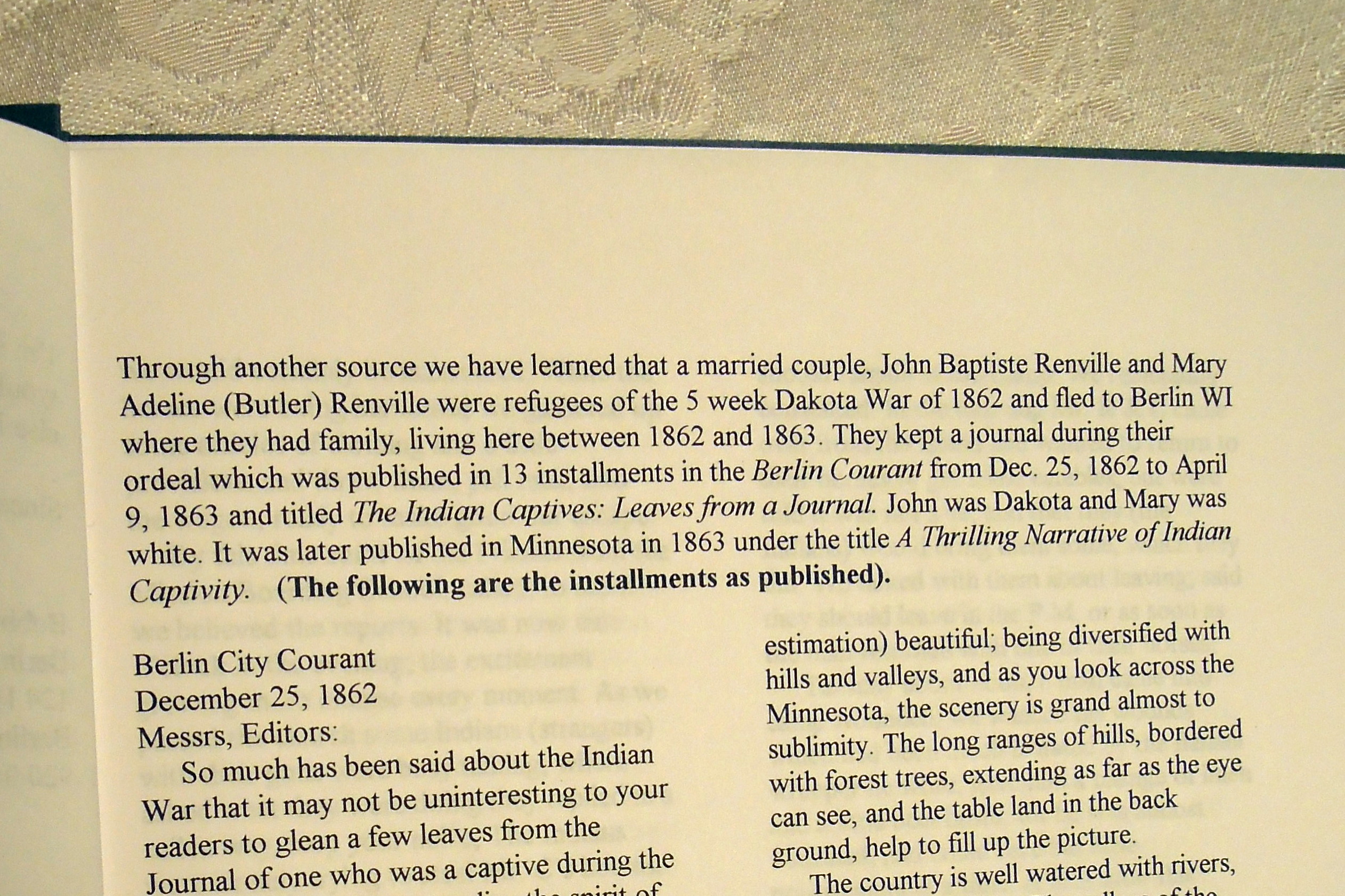
There Mary sat down at a table and, with Ella and Belle playing at her feet, opened a journal she had kept during the war and began writing the newspaper serial for the Berlin City Courant, that became, in 1863, A Thrilling Narrative of Indian Captivity.

The offices of Berlin Courant editor T. L. Terry were on the second floor of the yellow brick building in the foreground.

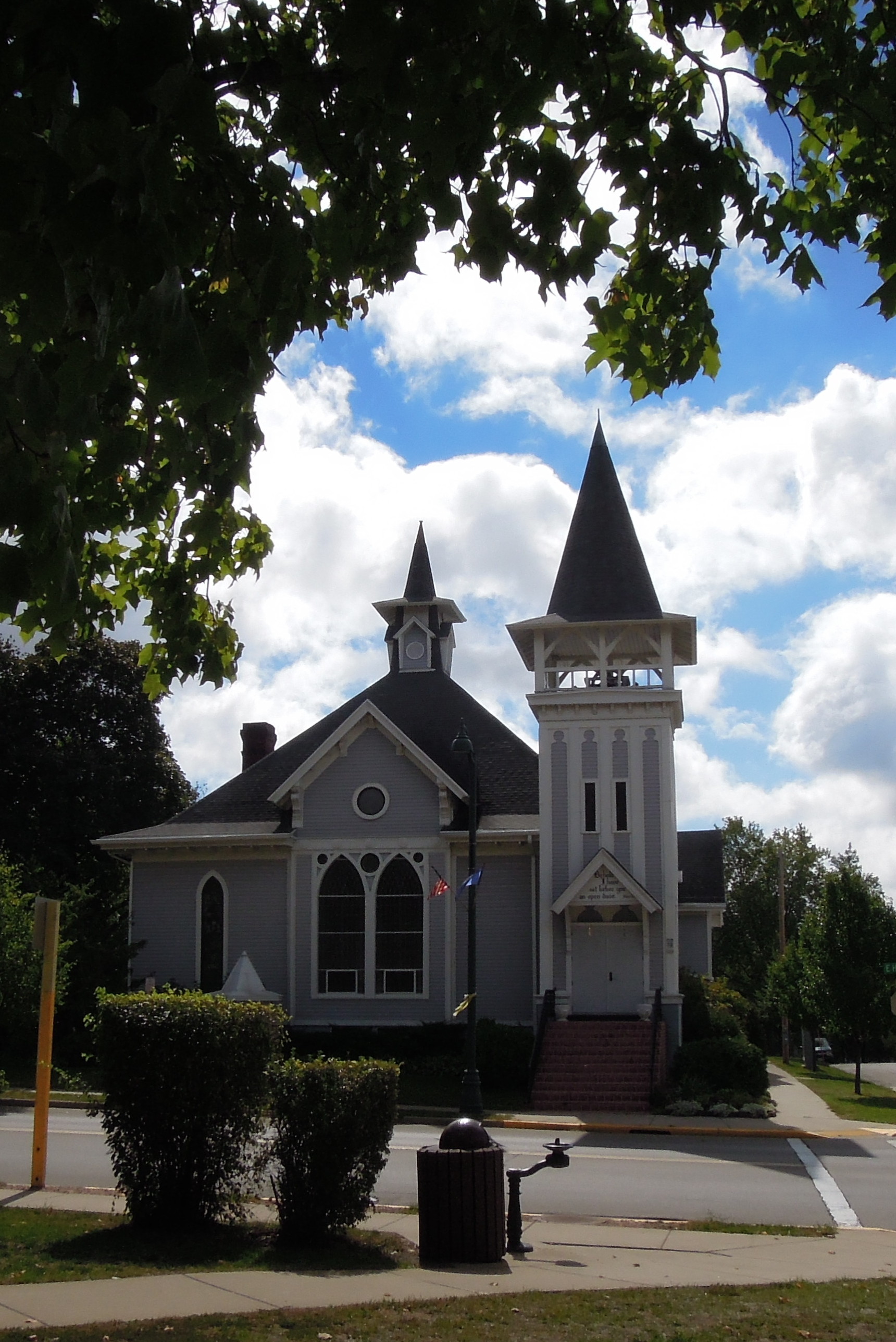
Vicki purchased Mabel’s album here: at a little house across the green from the church (below, today) where Mary and John worshiped before they moved back to Minnesota.

*****

This trip, for me was also about finding Mary, Ella, and John during the months they spent as refugees in Berlin.

I only “found” Mary –discovered her family of origin –on March 17, 2010: three months before the manuscript was due. I was thrilled to find her after years of fruitless searching. But I was also appalled that I had only 12 weeks to incorporate Mary’s family into the story.

While I hunkered down in a bunker of sources on the Underground Railroad, Zabelle rode to the rescue and corresponded with Bobbie Erdmann, former Mayor of Berlin, author, historian, and as I discovered in person on Saturday, a living encyclopedia of Berlin history.

Bobbie confirmed, via email, the little we knew about the Renvilles’s stay in Berlin. But they were only there through the winter of 1862-63, not long enough to leave much of a trace–beyond the serial, “The Indian Captives: Leaves from a Journal” on the front page of thirteen issues of Terry’s newspaper.

Her 2010 correspondence with Zabelle intrigued Bobbie, who looked further into the Courant story. When I met Bobbie on Saturday, she handed me a new Berlin Historical Society transcription of “The Indian Captives” as appeared in the Berlin newspaper in 1862-63.

*****

This is Mabel Hawley as a little girl, the beloved daughter of the up-and-coming George Hawley and his third wife, Isabella. Vicki, who is a born historian, found a Mabel picture in a book on a Poysippi, WI, family related to the Hawleys.

Mabel Hawley Tresler’s grave in Lot 95 of Riverside Cemetery, Oshkosh, WI.

Vicki and I found Mabel’s grave at the end of a long, wonderful day exploring Poysippi, Berlin, and Ripon, the places Mabel Hawley and Ella Renville called home in Wisconsin. Then we found a handy ledge on a nearby mausoleum and opened Mabel’s autograph album again.

Unfortunately, and perhaps tellingly, at school in Ripon, Ella used inexpensive ink. Her inscription in Mabel’s book is fading off the page. But Ella’s story, like Mabel’s, is just beginning to see sunlight after a century of obscurity. Some traces, like Mabel’s album, are ephemeral. Other answers, like the spelling of Mabel’s names and the existence of Ella’s baby sister, Mary, are carved in stone.

Posted in Ella Renville, Primary Sources | 1 Comment

Early Reviews

Please excuse this first-time author’s grin :). While scholarly reviews of books often don’t appear until a year or more after publication, popular reviews of A Thrilling Narrative are beginning to appear!

On 9/18/12, Sandy Amzeen summarized her Monsters and Critics review of A Thrilling Narrative, “Anyone looking to further their understanding of the culture and trials of this turbulent time in America’s history can’t do better than this excellent book.” Full review here.

Walt Bachman, in the first Amazon review, gives it five stars, calling it,“[a]must-read book on the Dakota War of 1862, the largest Indian war in the American West…. a well-written and brilliantly researched gem.”

For the record: I know Walt, but I don’t know Sandy. Thank you both!

Other popular and scholarly reviews are quoted and/or linked on the Reviews page on the About the Book tab on the navigation bar at the top of this page.

If you’ve read the book, thank you for considering adding your review to Amazon or B & N or Goodreads or your favorite book review site!

Why? The 2012 edition of A Thrilling Narrative is a beautifully bound hardcover priced for the scholarly market and for collectors who love to own first editions. But my co-editor and I edited and annotated Mary Butler Renville’s Dakota War story with a general audience in mind. The sooner we sell down the first edition, the closer we will be to a second edition in paperback  for a popular audience and for use as a classroom text.

That’s where your opinion makes a BIG difference. Public Library book buyers consult popular reviews to determine if there is enough interest to purchase copies to lend to their patrons. So posting a review online is even better than simply requesting A Thrilling Narrative from your library; on-line reviews influence many public libraries.

To see what the reviewers are talking about, check out this excerpt of A Thrilling Narrative. Many days, the University of Nebraska Press’s 20% discount on direct orders beats the price from on-line sellers –worth comparing. The coupon code for A Thrilling Narrative is on the book’s Flyer.

End of infomercial :). Thank you for reading!

Posted in A Thrilling Narrative | 2 Comments

Who was Mabel Hawley?

What did people do before search engines? I was alive then, but am too young to remember.

Last week, a search for Ella Renville of Sisseton, South Dakota hit on a post I made several weeks ago, “Cincapi” Means “Children.”

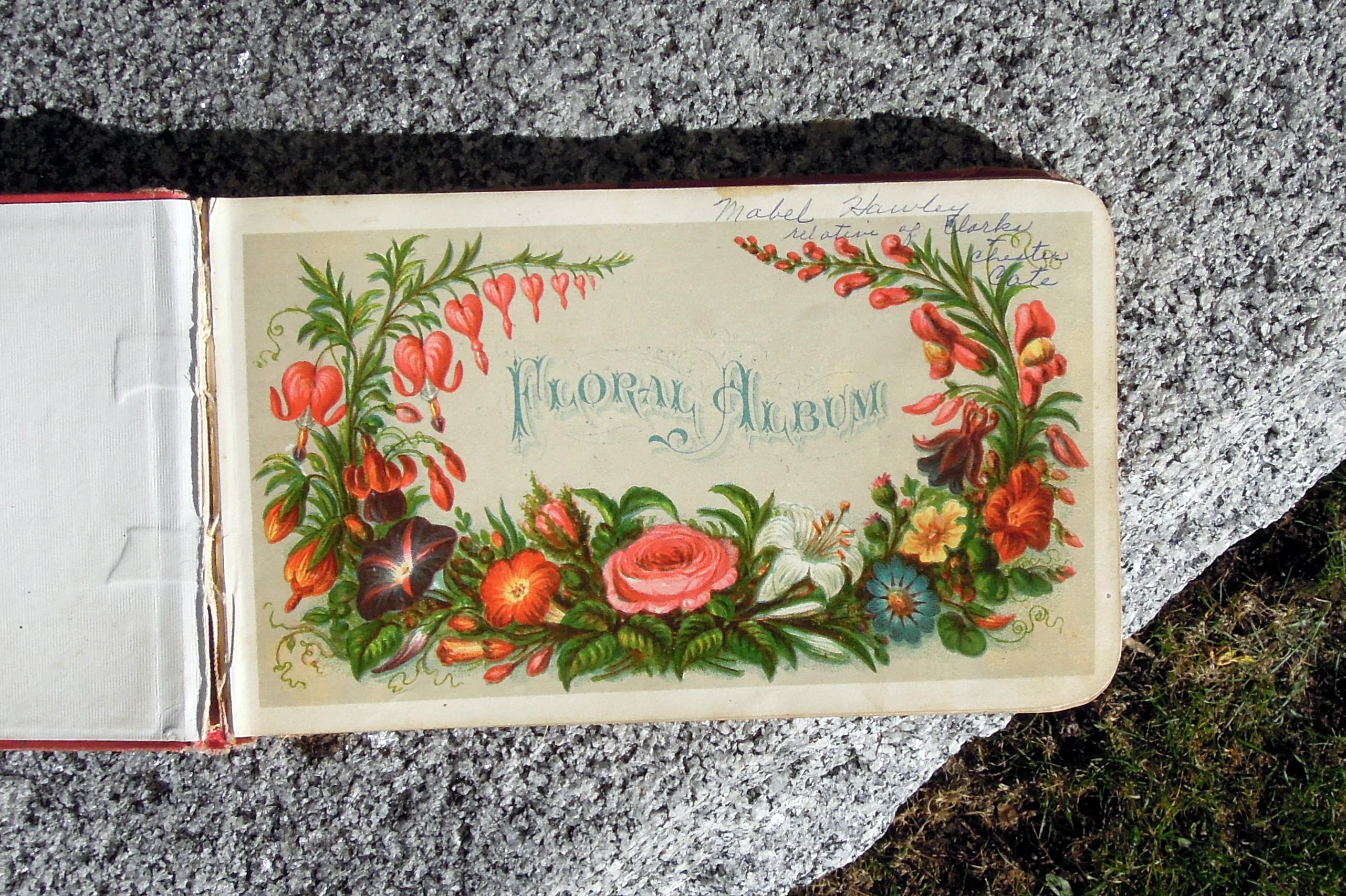
Several years ago, Vicki (who typed the Ella Renville search) had picked up an autograph album at a rummage sale just because she found the little book beautiful. This Floral Album belonged to Mabel (or May, or May Belle) Hawley of Poysippi, Wisconsin, who was born around 1864. As a Junior at the Preparatory Academy at Ripon College in Ripon, Wisconsin, 27 miles south of Poysippi, Mabel asked Ella Renville to sign her album.

“Miss Hawley, That you may have a truly happy life is the wish of your friend, Ella Renville, Sisseton Agency, Dakota January 31, 1880.”

When she wrote these words, Ella likely was already battling tuberculosis. Ella’s death on Valentines Day, 1882, prompted her parents, John and Mary Butler Renville, to erect a headstone in the cemetery at Sisseton remembering their cincapi, their children: Ella and her baby sister, Mary, who died at birth.

The gift of a photo of Ella’s tombstone revealed another gift: first-time knowledge of her baby sister. That post paved the way for a gift from Vicki: Ella’s holograph (the first I’ve seen) in Mabel Hawley’s album.

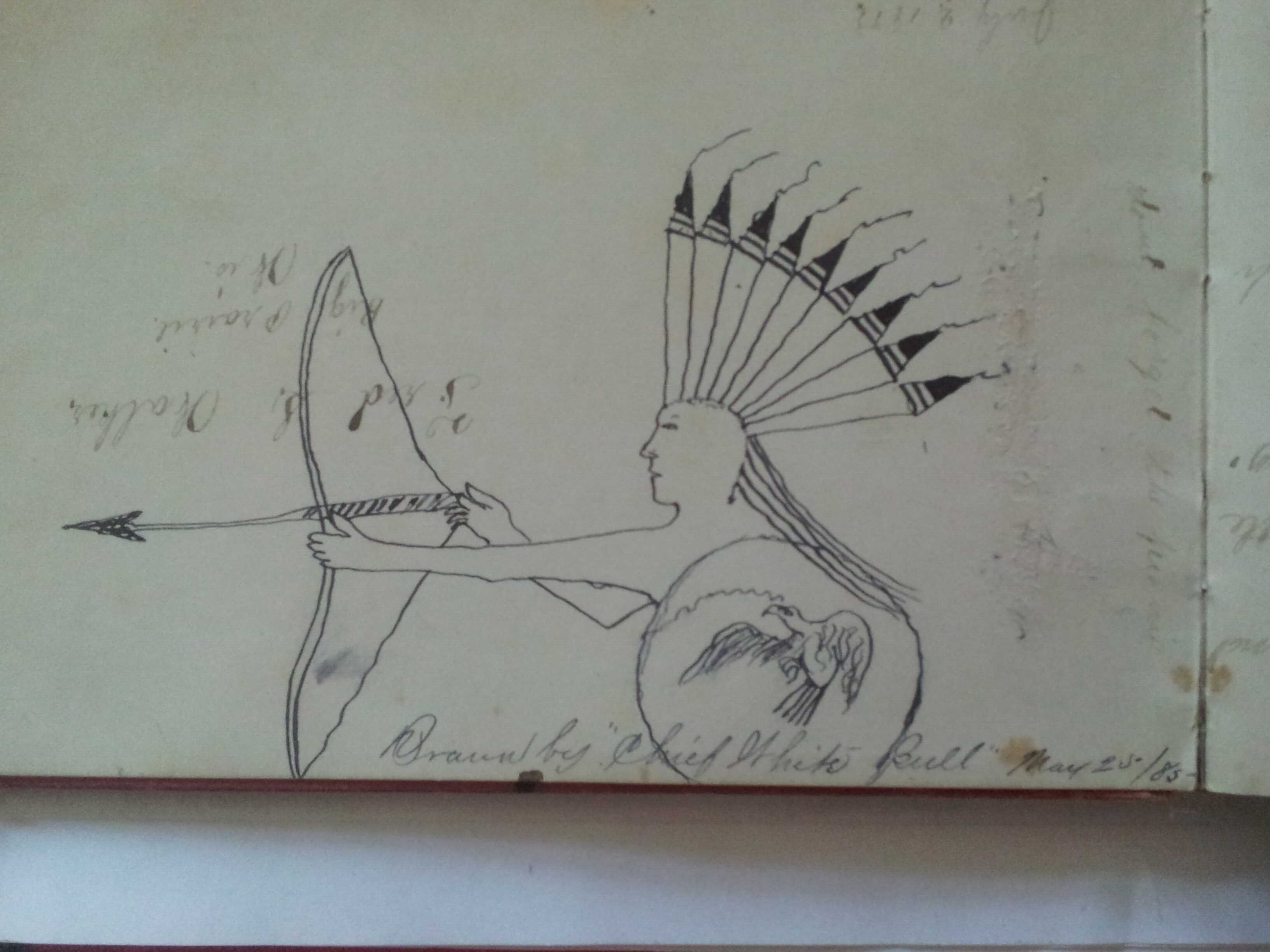
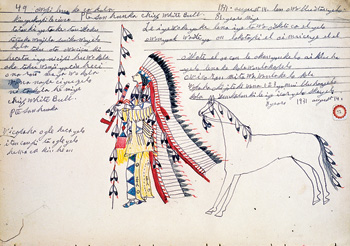
But Mabel Hawley herself is still a mystery. Who was she? Vicki is working on that question. You see, Mabel’s album contains more than inscriptions from her school chums. A few pages beyond Ella’s wish for a truly happy life is this ledger-style pictograph:

Captioned in a feminine hand: “Drawn by Chief White Bull May 25/85.” 

Sitting Bull’s nephew, Tatanka Ska, or White Bull, is the Lakota warrior some say killed George Armstrong Custer at the Battle of the Little Bighorn in 1876. A name coincidence? Maybe. Or maybe not. Sitting Bull’s nephew is also renown for his ledger art, including this image from the White Bull Manuscript in the archives of the University of North Dakota:

Mabel Hawley married Daniel Tresler in 1884 and may have been living in Stanton, North Dakota, at the time she collected the drawing attributed to White Bull, and on the following page, an undated inscription from an Arikara man from the Fort Berthold Reservation named Bears Teeth.

Bears Teeth’s home at Fort Berthold is across Lake Audubon from Stanton. White Bull’s home at Standing Rock is about 180 miles south of Fort Berthold. Did Mabel Hawley Tressler visit Standing Rock? Did White Bull visit Fort Berthold?

It seems likely Mabel collected Ella’s autograph at Ripon, Wisconsin; both women were enrolled there and the roads home to Sisseton were sometimes impassable in January.

But I wonder why Mabel collected Ella’s autograph. Mabel was four years younger than Ella and attended Ripon’s Preparatory Academy, while Ella attended the College.

Researching A Thrilling Narrative, I discovered little about Ella’s life in Ripon (where she boarded while attending school) but found this glimpse in the February, 1878 edition of Iapi Oaye:

“In the last week of the old year Helen [Aungie] and Ella were  invited to Waupun to attend a missionary concert, given by a class of girls for the benefit of a colored boy, Peter Sharp by name, who is at Fisk University. “They had recitations in several languages, (Ella says) and sent for us to say something in Dakota. Helen repeated the ‘Twenty Third Psalm,’ and I, ‘The Ninety and Nine.’ We dreamed dreams that night in which Sitting Bull and Peter Sharp were slightly mixed.” Iape Oaye, February 1878.

First, the implication for Ella: she did not keep her Dakota heritage in the closet. In fact, when called upon, she proudly spoke Dakota in public. Did Mabel collect Ella’s autograph because Ella was a friend, or because Mabel viewed Ella as a Native American novelty? (Ella signed her name, “your friend,” but addressed the inscription to “Miss Hawley” even though other classmates inscribed their pages to “Mabel” and “May Belle.”)

Second, the implication for Mabel Hawley: In the Iapi Oaye article, Ella mentioned Sitting Bull, White Bull’s uncle. In 1885, when Mabel collected the pictograph said to be White Bull’s, I think Sitting Bull was portraying himself in Buffalo Bill Cody’s Wild West Show. Did White Bull accompany his uncle on the show circuit? Did Mabel perhaps secure the drawing for her album when she visited a Wild West Show??

Vicki plans to take the drawing to the University of North Dakota for authentication against known White Bull pictographs.

*****

photo credits: Hawley Album and the University of North Dakota Discovery Spring 2010.

Thank you, Vicki, for sharing Mabel’s album and story! Next time you go to a rummage sale, I want to go with :).

9/19/12 edited to correct Sitting Bull’s home reservation

Posted in Ella Renville | 2 Comments

Racial Profiling: 11 years after 9/11, 150 years after 1862

Pop history in the wake of 9/11: Showtime’s Emmy Award-nominated miniseries ran for two seasons in 2005 and 2006: “Sleeper Cell takes you behind the veil of terror networks and into the minds of the agents trying to stop them.” 

*****

Historiography  is study of how historical stories come to be. That doesn’t mean the study of how fact is established. Often, the received story is not factually true, and the exact factual truth, beyond knowing.

The real story is, “Why do people believe it?”

Start with a modern story, like the idea that Thomas J. Galbraith was a chronic alcoholic, so mentally unstable he was unfit to manage the Sioux Agency (as evidenced, this theory holds, by the onset of the Dakota War of 1862).

To make sense of that belief, I’ve argued, we need to look for the stories that shaped it. Stories always land in the context of personal experience. So when an idea gains traction today, when it resonates with modern concerns, the question is, “Why?”

Most of us remember 9/11. In late September, 2001, the media reported that Federal hotlines were receiving hundreds of tipster calls reporting a suspect “sleeper cell” of terrorists in the caller’s neighborhood. Weeks before, these alleged potential terrorists were simply doctors, engineers, clerks, students –ordinary people who barely stood out. But in the wake of 9/11, people who appeared to be of Middle Eastern descent were catapulted from “ordinary neighbor” to “potential terrorist” status in the United States.

Was this just? Was this fair? Was this true? No, on all counts.

But 9/11 is living history. We were there. Even if, with the benefit of hindsight, we dismiss most of those fears as unfounded, on some level we understand. We remember how vulnerable we felt.

Today, most of us are disconnected from the many contexts of the 1862 story. The uncertainty. The hysteria. The politics. The personalities. The prejudices. The agendas.

Much of what remains for us to consider from 1862 is pretty weak evidence –like the stories of the hundreds of people who called the FBI reporting a sleeper cell in a house down the block. From these hundreds of eye-witness reports, historians of the future might wrongly conclude there were in fact hundreds of terrorist sleeper cells in the U.S. in 2001.

But 150 years after 1862, many seem unwilling to take the received story of the Dakota War with a grain of salt. There will be no careful re-investigation of period allegations because, gosh darn it, every single one of those guys was part of the white power structure and we KNOW the white power structure has always been out to get the little guy!

It’s like insisting my daughters OUGHT to be singled out by security at airports because they are dark-complected and we know who high-jacked those planes on 9/11.

But it still seems socially acceptable, even popular, to make blanket condemnations based on race –as long as the target is a white man.

Isn’t this just as wrong as the “exile or extermination” hysteria in the wake of the war that refused to make distinctions among Dakota people?

As unjust as the discrimination people of color continue to face in the U.S. today?

When an idea gains traction in modern culture, the question is: Why?

*****

Image credit and caption quote: directv.com

Posted in Commemorating Controversy, Opinion | Leave a comment

The ABCs of Reading a Primary Text

In Sweden, according to the dear woman who told me the story, her grandmother was derisively branded “läsare”  –a reader —because she read the Bible for herself. In that time and place, the Bible was viewed as the province of the clergy alone, not ordinary people.

Primary sources used to be viewed the same way: as the province of professional historians. Their job was to digest the primary record and regurgitate it in a form the rest of us could understand.

Today the world doesn’t work that way today. Primary sources are increasingly accessible to everyone. But not everyone knows how to read a primary source to discover its author’s intent.

Why is that important? That’s why we seek out primary sources: we value the perspective of people who were there.

“Did you see what she wrote? That’s exactly what I think! I am SO right!”

It is intuitive to do the opposite: read our modern perspective into historic words. In exegesis this is called “proof-texting:” parsing sources to validate a point of view we bring to the text.

In history, it is a common, misleading use of primary sources.

The text of the January 2, 1862 letter I posted is an excellent example: It is long and dense. The subject matter is unfamiliar to many. And in New Ulm a few weeks ago, a speaker expounded with complete sincerity that if Congress had simply listened to the missionaries and passed this legislation, the Dakota War would have been averted. Dozens of heads in the audience nodded.

Really? I thought. I had mentally pegged that letter as speaking to several things, but had missed that one. I jotted a note: read the letter. That’s why it startled me when it popped up again last week; I’d just re-read it.

*****

I’ve spent the past few days trying to figure out how to explain how I read primary sources. Not because I’m a teacher. But ultimately because it seems fair. Remember how our teachers used to make us show our work in math class? You shouldn’t have to take my word for anything, but be able to check how I (or anyone else) arrives at a conclusion.

How, then, to read a primary source for the author’s intended meaning? Here’s an acronym that makes sense to me: the ABCs.

A: Author(s); Audience(s). Who was the author and who was she writing to? Was her audience private or public?

B: Biases; Beliefs. Bias isn’t a negative word. Every human has biases, often based in their beliefs (worldview). What are the author’s and how are they reflected in the text?

C: Claims; Conclusions; Call. What are the author’s claims? Her conclusions? Is there a call to action?

s: subjective. After you understand the author’s ideas, it is perfectly fair to ask subjective questions like, What does this mean to me?

In the acronym, A, B, and C are capitals because when we’re reading a primary sources, they are more important than “s;” our subjective opinion, lowercase. The main point is to figure out what the author thinks. After all, when she was writing, she probably did not have our concerns centuries later foremost in her mind.

*****

Applying the ABCs to the January 2, 1862 letter, this is what strikes me:

Author # 1: Stephen Return Riggs: Presbyterian missionary, 25 plus years with Dakotas

Author #2: Thomas S. Williamson, Presbyterian missionary, 25 plus years with Dakotas

Audience: U.S. Congress, who the authors addressed, unsuccessfully, two years previously, c. 1860. That was a Democratic administration. Now Republicans are in power in Washington so they are trying again??

Biases:  Male. White. Republicans. Protestant Christians. Report to mission board and to mission supporters. Their mission schools partially funded by Federal government. Anti-slavery. Pro-temperance. Pro-education. Pro-acculturation for Native Americans. Advocate for the interests of Dakota farmers; see no future for Dakota traditionalists in Minnesota –except if they become farmers and tradesmen and citizens of the U.S.

Beliefs: Reformed (Calvinist) worldview; ethnocentric favoring white Anglo Protestant ways; strong worth ethic; view agriculture is a panacea for moral/social ills. The existence of this letter says they believe in the democratic process.

Claims:

#1: Need to protect the rights of Dakotas who own property and who are being persecuted with impunity. Who is being harassed? Dakota farmers. Who is doing the harassing? Dakota traditionalists and white men. Why? The Agent is powerless to stop them; there are no meaningful penalties.

#2: A government-controlled monopoly on the Indian trade would be worse than the existing system. [Oddly, only one paragraph on this subject, at the end. Was this a late-breaking concern tacked on to their original plan for the letter??]

Conclusions/Call to Action:

On Claim #1: The existing law “ought to be repealed and it should be made the duty of all Indian Agents to adjudicate all claims against the Indians of their several agencies whether such claims be made by whites or Indians, and to render just satisfaction to the injured person so far as he can do so, from the annuities of the Indians and it would be well if he was required to prosecute whites who have stolen or destroyed the property of Indians.”

On Claim # 2: They “view the adoption of his proposition as a great calamity….it would be bad policy at this time to displease [the Indians] by interfering with the traders.”

subjective

  • They rightly point out the lack of meaningful depredations laws. The laws on the books dated back to the era when the War Department controlled Indian Affairs —a la Taliaferro at Fort Snelling –when a major objective was to simply keep white people out of Indian territory.
  • The suggested reforms would mostly benefit the Dakotas who were property owners, that is, Dakota farmers. Dakota farmers didn’t take the nation to war in 1862; it’s not obvious to me how enacting this legislation would have prevented the war.
  • The surprise in this letter is the last paragraph. The missionaries had caught the gist of the government’s plan for the trade in 1863. I’m not surprised that they disapproved; they believed in free enterprise.
  • But I am very surprised at “it would be bad policy at this time to displease [the Indians] by interfering with the traders.” Really?? Most people studying this today, including me, would generally say the government should have interfered with the traders’ mercenary ways –somehow.

This is exactly why we need to be willing to let a primary author lead us beyond the limits of our own concerns. That last subjective observation sent me back to the letter to re-read that last paragraph: Say that again? What do you mean?

Reading slowly, I saw they clarified at the very end, “The worst cheating the traders have practiced upon the Indians has been done by complicity with the officers of the Government who have aided the traders in getting pay for goods that many of the Indians say they had already paid for. We have reference to the money which the traders have received for debts due them at each treaty.”

BINGO: They were making a distinction generally lost in modern work. In 1862, there were “the traders” licenced to run businesses on the reservation–people like Andrew Myrick and his friends. The missionaries advised leaving that system alone to regulate itself.

Then there were The Traders. People like the “Hon. Henry H. Sibley” in the middle of the letter who worked the system from both ends: an old trader with alleged debts on his books who, as a delegate to Congress, passed legislation favorable to traders and who presided over the passage of the Treaty of 1851, which settled the books in his own, and in his cronies’ favor.

Obviously, legislation proposed in January 1862  could not have prevented the frauds of the treaty era a decade before. But the Treaty of 1851 was the do-over moment that might have prevented the Dakota War.

Posted in Doing Historical Research, Primary Sources, Stephen R. Riggs, Thomas S. Williamson | Leave a comment

“Legislation that is desirable in reference to the Indians:” Riggs & Williamson letter January 2, 1862

Yesterday, September 7, 2012, Dan Olson of Minnesota Public Radio published a Minnesota Sounds and Voices article, “Sheldon Wolfchild’s View of the U.S. Dakota War.

This is the second of two interviews Olson has conducted inside the MHS Dakota War exhibit gallery and it has been fascinating listening to descendants including Jan Klein interact with exhibit.

In the interview, Wolfchild expressed his frustration with the exhibit’s limits. Referring to the quote from a George Day letter on the wall, “Wolfchild says missing from the history center’s exhibit is an even more strongly worded warning letter from missionaries telling Congress how the war could be avoided. That letter should be prominently displayed, and viewers should not have to search on their own for the document, *he* says, sputtering with frustration at an exhibit he considers small and incomplete about a defining event in Minnesota history.”

I am not aware that the January 2, 1862 letter Wolfchild is referring to was ever deselected from the exhibit list. In fact I believe as a white-authored document, it would have been exempt.

I don’t have the power to put the letter on the wall at MHS, but I can post a transcription from my files here, and maybe lessen the frustration of others trying to find it.

T.S. Williamson and S. R. Riggs to The Senate and House of Representatives of the United States in Congress Assembled January 2, 1862, NAR 75, St. Peter’s Agency Letters Received, MHS M175 r764. Paragraphing Added.

Pajutazee Jany 2, 1862

To The Senate and House of Representatives of the United States in Congress Assembled

            Something over two years ago we addressed you on the necessity of further legislation for the Indians.

            Though what we asked for was not accomplished, we feel encouraged to address you again upon the same subject hoping we may be more successful. For when our nation is engaged in a terrible struggle to put down a most wicked rebellion we cannot hope for all the legislation that is desirable in reference to the Indians. But the war in which we are engaged makes it more necessary that some legislation should be had speedily in order to guard as far as possible against a collision with the Indians on our frontiers.

We will mention some of the evils for which we hope you may by law provide a remedy before the close of the present session, and thus do much not only [to] ameliorate the condition of the aborigines of our country; but at the same time add much to the security and comfort of citizens of the United States among and near them.

            The only law for the protection of the property of Indians and of whites living among them with which we are acquainted was passed about the year 1834 or 35. We have not now access to the law. Its general provisions are just, but as understood by Indian Agents and other Officers of government, defective. It provides for remunerating citizens of the United States for injuries suffered from Indians and vice versa, but not expressly for remunerating Indians for injuries suffered from each other; and makes no proper provision for adjudicating such claims.

The practice has been to present such claims to the Agent, Who, if the claim is against Indians, mentions the matter to them, and if they tell him to pay it out of their money annuity, very well. If not, as is mostly the case, the claim is sent to Washington, and seldom heard from again unless and attorney is employed to prosecute it. Consequently the poor men whose cow or ox has been killed or horse stolen generally loses it while wicked men with large and unjust claims employ attorneys who get them paid at Washington.

When the Hon. Henry H. Sibley was [a] delegate in congress he got a bill passed forbidding any officer of Government from holding back any annuity due Indians under any pretext whatsoever. This has never been of any advantage to the Indians while it has prevented their Agents from settling just claims. It ought to be repealed and it should be made the duty of all Indian Agents to adjudicate all claims against the Indians of their several agencies whether such claims be made by whites or Indians, and to render just satisfaction to the injured person so far as he can do so, from the annuities of the Indians and it would be well if he was required to prosecute whites who have stolen or destroyed the property of Indians.

Of late years a few individuals of the annuity Sioux have become very much addicted to stealing horses. Several have been stolen from whites and many from Indians in this neighborhood and so many from settlers around the Big Sioux that they have threatened to shoot any Sioux from this region seen in their neighborhood, and the past summer did shoot and kill a grandson of the principle chief of the Sissitonwas [sic] while attempting to steal a horse. Such things endanger the peace of the frontiers. They may be prevented by requiring payment to be made for horses stolen from the band to which the thief belongs, that is the one in which he was enrolled before the theft was committed, though it would be well also to imprison the thief when he can be taken. By absenting themselves from the pay table and changing from one band to another, horse thieves have hitherto escaped punishment.

On page 103 of the report of the Commissioner of Indian Affairs for 1860 it is asserted on the authority of some United States Judges that there is no law for the punishment of persons for cutting timber from Indian reservations. Some law of this kind is very necessary for the welfare of the Dacotas. In the agreement made with them at Washington in 1858 it is promised that land shall be assigned in severality to those who will improve and cultivate it and the late agent had some lots surveyed and assigned. But as the amount of timber or wood land on the reservation is very small, probably less than four acres to each family, without some law to protect the timber which is being rapidly destroyed, assigning land in severality can do but little good. The civilizing process must soon be arrested for want of wood, and another country assigned these Indians.

Some regulations in regard to herding cattle are necessary for the advancement of this people in agriculture, as timber for fencing is already very scarce and becoming more so every year. As the present Agent (Mr. Galbraith) appears to be an honest, judicious man it might be well to empower him to promulgate and enforce such regulations for the protection of the timber, fields and cattle of these Indians as their present circumstances require.

            The undersigned understand that the Secretary of the Interior proposes that the Government furnish the Indians with the goods usually supplied by the Indian traders on the ground that the Indians are greatly cheated by the traders. We think the Secretary has been misinformed and would view the adoption of his proposition as a great calamity. The best remedy for cheating in trade is competition. We have never had any connection with the Indian traders and would not be inclined to favor them at the expense of the Indians; and we do not suppose the Indians would be in the least benefited by the change, but think that the contrary will prove true. We know that the Indians express more dissatisfaction with the goods furnished by the Government Officers than with those furnished by the traders. Monopolies are not less hateful to Indians than to other peoples. Even if the Government should furnish them with the same quality of goods at a less price, it would be bad policy at this time to displease them by interfering with the traders. The worst cheating the traders have practiced upon the Indians has been done by complicity with the officers of the Government who have aided the traders in getting pay for goods that many of the Indians say they had already paid for. We have reference to the money which the traders have received for debts due them at each treaty.

                                                                                                Thomas S. Williamson

                                                                                                Stephen R. Riggs

[endorsed] The original of foregoing memorial returned with letter of May 23 [?] 1862 to Hon. C. Aldrich.

Posted in Primary Sources, Stephen R. Riggs, Thomas S. Williamson | 1 Comment

Cognitive Dissidence

Pause and think about that :).

You never know when you might self-righteously throw down a book and stomp to your computer, even madder that you gave away that great textbook on logic ten years ago, so now you have to stoop to using that modern crutch, Google, and type in “conspiracy theory logical fallacy,” click on a likely link, start reading, stumble over “cognitive dissidence” and start laughing so hard you can’t even feel mad any more.

Your brain will not be able to leave it alone:

Compliment: “She was a cognitive dissident.”

Epitaph: “Cognitive dissident to the end.”

Placard: “Cognitive Dissidents Unite!”

Credo: “Cognitive Dissidence Forever!”

Fighting words:”You [insert sputtering]… you, cognitive dissident, you!”

Dedication: “To cognitive dissidents everywhere.”

I’m sure the author meant “cognitive dissonance.” It is an onomatopoeic slip, not a joke.  Still, I’m going to bed laughing, trying to think of bumper stickers.

Like: “Reduce cognitive dissidence: follow the crowd.” 🙂

Posted in Uncategorized | Leave a comment

A Fable Agreed Upon, part 3


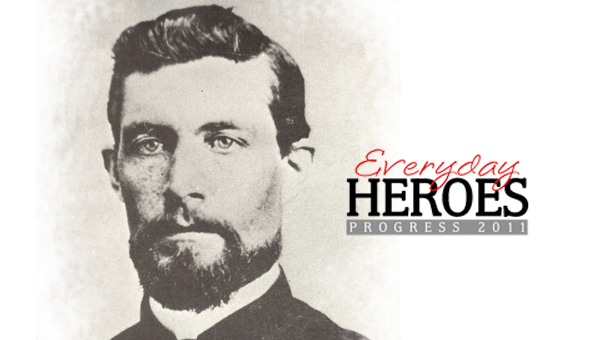
Timothy J. Sheehan (1835-1913) as profiled in the Albert Lea Tribune in 2011. Sheehan immigrated to the United States in 1850 at the age of 15, an orphaned survivor of the potato famine in Ireland. By 1857, he had settled in Albert Lea, Minnesota, where he was elected town clerk.

Sheehan enlisted in the 4th Minnesota Regiment of Volunteer Infantry in October, 1861. On February 15, 1862, he was commissioned 1st Lieutenant in the 5th Minnesota Infantry, company C, sent from Fort Ripley in June, 1862, to garrison the Sioux Agency town at Yellow Medicine during the expected annuity payment.

At the Upper Agency that summer, Sheehan butted heads with Galbraith over Sheehan’s councils, against Galbraith’s orders, with the young men of the Upper Soldiers’ Lodge. Tensions  culminated on August 4, 1862, when the warriors who had been cultivating Sheehan’s favor surprised his command and broke into the upper warehouse.

Galbraith alleged Sheehan was duped; Sheehan alleged Galbraith was drunk. Their opposing self-interests reengaged over the defense of Fort Ridgely two weeks later.

Galbraith literally moved on from Minnesota (in 1868) and his identity as Sioux Agent (he returned to law and retired a district court judge). However Sheehan’s military service, starring his defense of Fort Ridgely during the Dakota siege of 1862, became central to Sheehan’s identity, shaping the stories he told for the rest of his life.  

After Sheehan’s death, his neighbor and friend, historian Return Ira Holcomb, led a campaign to erect a monument to Sheehan on the State Capitol lawn to commemorate Sheehan’s heroism in 1862.

*****

Sheehan’s allegations

In an interview on January 6, 1906, Timothy J. Sheehan told William Watts Folwell that during the siege of Fort Ridgely in 1862, Sheehan, “Had to arrest Galbraith, who was drunk, disorderly and demoralizing to men, released him after battle.”[i]

Because Sheehan had known Galbraith personally and had made specific charges, Folwell entertained the possibility that the allegation could be true; the story might be verified by someone else who had been there.

Folwell’s interview notebooks show that after Sheehan reported this, Folwell asked old-timers about Galbraith without encountering anyone who had known him well. To the contrary, Folwell recorded positive recollections like David Stanchfield’s, “Galbraith was an honest man.”

In 1908, journalist and historian Return I. Holcombe cast the first stone Galbraith’s way in Minnesota in Three Centuries, alleging Galbraith was drunk during the warehouse break-in crisis at Yellow Medicine on August 4, 1862. Holcombe’s source for this story was Timothy J. Sheehan.[ii]

Holcombe had also tipped off Follwell to interview Sheehan in 1906.

Still, the 1908 allegation in Minnesota in Three Centuries was the only source in print. Yet, for a decade no one came forward to substantiate or to refute the Sheehan/Holcombe charge that Galbraith abused alcohol.

In the mean time, Galbraith died in February, 1909 of a heart infection (not cirrhosis of the liver) probably without knowing what Sheehan had said about him.

Fast forward to the fall of 1917. Folwell was drafting the second volume of A History of Minnesota and had concluded that Joseph R. Brown was the most able of the Sioux Agents. (For the record: Folwell’s papers show he took Samuel J. Brown’s word on it. A critical inquiry was in order.)

But Folwell had not made up his mind about how he would characterize Galbraith. On October 2, 1917, Folwell queried Samuel J. Brown, “Do you remember anything about Galbraith’s habits? Col. Sheehan told me that at Fort Ridgely he was drunk and disorderly and had to be put in arrest. I think I have seen a suggestion that he was intoxicated on the 4th of August 1862, when the flour was taken out of the warehouse.”

Samuel J. Brown replied, “I am well-acquainted with Major Galbraith. So far as I know and believe his personal habits were good — much better than some of those who would accuse him of drunkenness and cowardice. He was neither a drunk nor a coward; was a much abused man.”[iii]

If history was a matter of simple math, Brown’s statement might have zeroed out Sheehan’s allegation. But in 1918, when the Minnesota History Bulletin mis-attributed John Wakefield’s reputation to Galbraith (part 1 in this series), the error lent credibility to Sheehan’s story. Five years later, Buck’s annotation in Folwell’s History added a third source (see part 2).

Behind two of these sources stood the authority of the Superintendent of the Minnesota Historical Society. MHS’s unsupported assertions gave critical weight to the idea that Galbraith’s moral character contributed to the disastrous end of the Sioux Agency in Minnesota.

The cumulative effect

Take a look at just about anything written or produced about the Sioux Agency in Minnesota since 1968 –including ideas being publicly circulated today. 1968 was the year Roy Meyer’s seminal History of the Santee Sioux: United States Indian Policy on Trial first appeared. (See Meyer’s assessment of Galbraith in Chapter 6, p. 110 in the 1993 edition (text and note 1).

Meyer, in good faith, consulted MHS publications and unwittingly amplified the errors he found. To his credit, Meyer was a logical, analytic thinker and did a great job citing his sources. That’s one reason his book has endured –with MHS errors entombed in his conclusions like ancient bugs preserved in amber.

Galbraith’s reputation has plummeted so far that modern historians can assert, like David A. Nichols did in an August 14, 2012 interview on Minnesota Public Radio, that Galbraith told starving Dakota people they could eat grass in 1862.

Nichols is far from the first to mis-attribute trader Andrew Myrick’s insult (which I discuss here) to Agent Thomas J. Galbraith. It goes to show how muddied the historical record is with myth: 150 years later we can’t see any difference between an Ambassador with Federal trust obligations to a foreign Nation (an Indian Agent) and a disgruntled expat living on the embassy grounds in that country (an Indian trader).

Think of it this way: If as a private citizen, the next time I’m in Korea and visit the DMZ, I stand at the fence and shout, “Give up your nuclear weapons program or I will stop supporting North Korean orphans!” we’d judge it my right to express my opinion.

But if Hillary Clinton stood there and shouted the same thing, it would mean something entirely different. Wouldn’t it?

*****


[i] William W. Folwell interview with Timothy J. Sheehan  January 6, 1906. William W. Folwell Papers, MHS.

[ii] See Holcombe’s manuscript hagiography of Sheehan composed after Sheehan’s death in the Holcombe Papers, and Holcombe’s subsequent campaign to have a monument to Sheehan erected on the State Capitol mall, in both the Holcombe and Sheehan Papers, MHS.

[iii] William W. Folwell to Samuel J. Brown October 2, 1917. William W. Folwell Papers. MHS. Brown’s reply is written on the back of the letter.

[iv] Roy W. Meyer. History of the Santee Sioux: United States Indian Policy on Trial. (Lincoln: University of Nebraska Press) 1968. 1993 edition, p. 110.

Image credit: Albert Lea Tribune.com.

Posted in Minnesota Historical Society, Return Ira Holcombe, Thomas J. Galbraith, Timothy J. Sheehan, William Watts Folwell | Leave a comment